Department of Orthopedics, Taichung Veterans General Hospital, Taichung, Taiwan.
Department of Biomedical Engineering, Hung Kuang University, Taichung, Taiwan.
J Orthop Surg Res. 2023 Mar 2;18(1):158. doi: 10.1186/s13018-023-03652-5.
Regarding the increasing adoption of oblique lateral interbody fusion (OLIF) for treating degenerative lumbar disorders, we aimed to evaluate whether OLIF, one of the options for anterolateral approach lumbar interbody fusion, demonstrate clinical superiority over anterior lumbar interbody fusion (ALIF) or posterior approach, represented by transforaminal lumbar interbody fusion (TLIF).
Patients who received ALIF, OLIF, and TLIF for symptomatic degenerative lumbar disorders during the period 2017-2019 were identified. Radiographic, perioperative, and clinical outcomes were recorded and compared during 2-year follow-up.
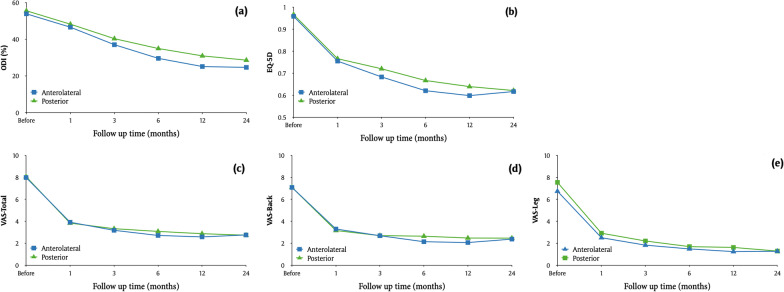
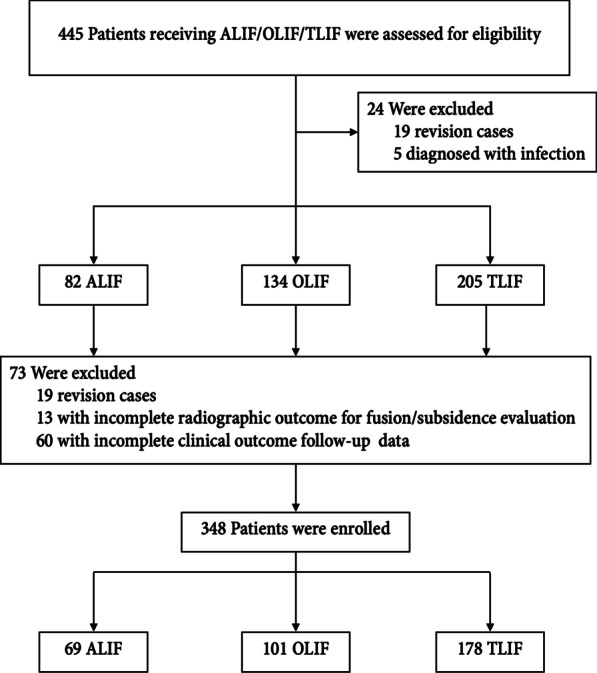
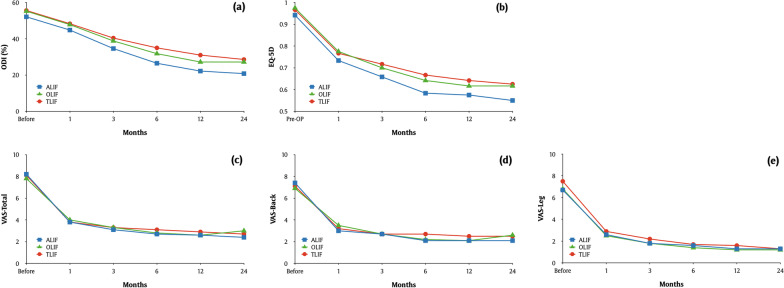
A total of 348 patients with 501 correction levels were enrolled in the study. Fundamental sagittal alignment profiles were substantially improved at 2-year follow-up, particularly in the anterolateral approach (A/OLIF) group. The Oswestry disability index (ODI) and EuroQol-5 dimension (EQ-5D) in the ALIF group were superior when compared to the OLIF and TLIF group 2-year following surgery. However, comparisons of VAS-Total, VAS-Back, and VAS-Leg revealed no statistically significance across all approaches. TLIF demonstrated highest subsidence rate of 16%, while OLIF had least blood loss and was suitable for high body mass index patients.
Regarding treatment for degenerative lumbar disorders, ALIF of anterolateral approach demonstrated superb alignment correction and clinical outcome. Comparing to TLIF, OLIF possessed advantage in reducing blood loss, restoring sagittal profiles and the accessibility at all lumbar level while simultaneously achieving comparable clinical improvement. Patient selection in accordance with baseline conditions, and surgeon preference both remain crucial issues circumventing surgical approach strategy.
随着斜外侧腰椎间融合术(OLIF)在治疗退行性腰椎疾病中的应用越来越多,我们旨在评估 OLIF(一种前外侧入路腰椎椎间融合术的选择)是否优于前路腰椎间融合术(ALIF)或经椎间孔腰椎间融合术(TLIF)等后外侧入路。
我们确定了 2017 年至 2019 年间接受 ALIF、OLIF 和 TLIF 治疗症状性退行性腰椎疾病的患者。记录了影像学、围手术期和临床结果,并在 2 年随访期间进行了比较。
共有 348 例患者(501 个矫正水平)入组本研究。在 2 年随访时,基本矢状面排列显著改善,特别是在前外侧入路(A/OLIF)组。与 OLIF 和 TLIF 组相比,ALIF 组在术后 2 年时的 Oswestry 残疾指数(ODI)和欧洲五维健康量表(EQ-5D)评分更高。然而,所有入路组之间的 VAS-Total、VAS-Back 和 VAS-Leg 比较均无统计学意义。TLIF 的沉降率最高,为 16%,而 OLIF 的出血量最少,适合高 BMI 患者。
对于退行性腰椎疾病的治疗,前外侧入路的 ALIF 具有出色的矫正效果和临床疗效。与 TLIF 相比,OLIF 具有减少出血量、恢复矢状面排列和在所有腰椎水平的可及性的优势,同时实现了相当的临床改善。根据基线情况选择患者和手术医生的偏好仍然是规避手术入路策略的关键问题。