Brugaletta Giorgio, Zampiga Marco, Laghi Luca, Indio Valentina, Oliveri Chiara, De Cesare Alessandra, Sirri Federico
Department of Agricultural and Food Sciences, Alma Mater Studiorum - University of Bologna, Ozzano Dell'Emilia, 40064, Bologna, Italy.
Department of Veterinary Medical Sciences, Alma Mater Studiorum - University of Bologna, Ozzano Dell'Emilia, 40064, Bologna, Italy.
J Anim Sci Biotechnol. 2023 Mar 3;14(1):33. doi: 10.1186/s40104-023-00839-y.
Arginine is an essential amino acid for chickens and feeding diets with arginine beyond the recommended levels has been shown to influence the growth performance of broiler chickens in a positive way. Nonetheless, further research is required to understand how arginine supplementation above the widely adopted dosages affects metabolism and intestinal health of broilers. Therefore, this study was designed to assess the effects of arginine supplementation (i.e., total arginine to total lysine ratio of 1.20 instead of 1.06-1.08 recommended by the breeding company) on growth performance of broiler chickens and to explore its impacts on the hepatic and blood metabolic profiles, as well as on the intestinal microbiota. For this purpose, 630 one-day-old male Ross 308 broiler chicks were assigned to 2 treatments (7 replicates each) fed a control diet or a crystalline L-arginine-supplemented diet for 49 d.
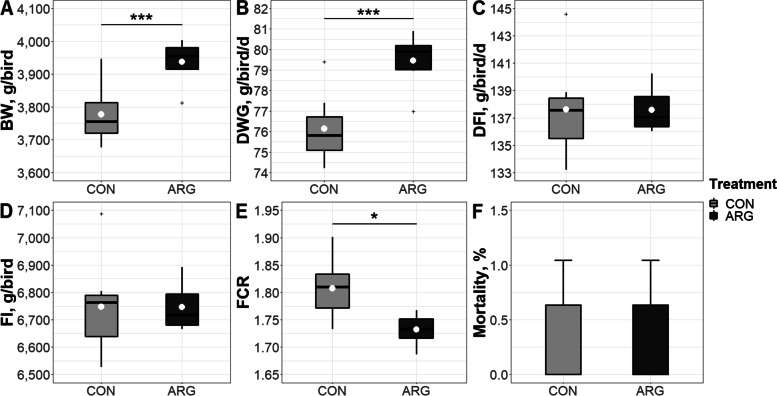
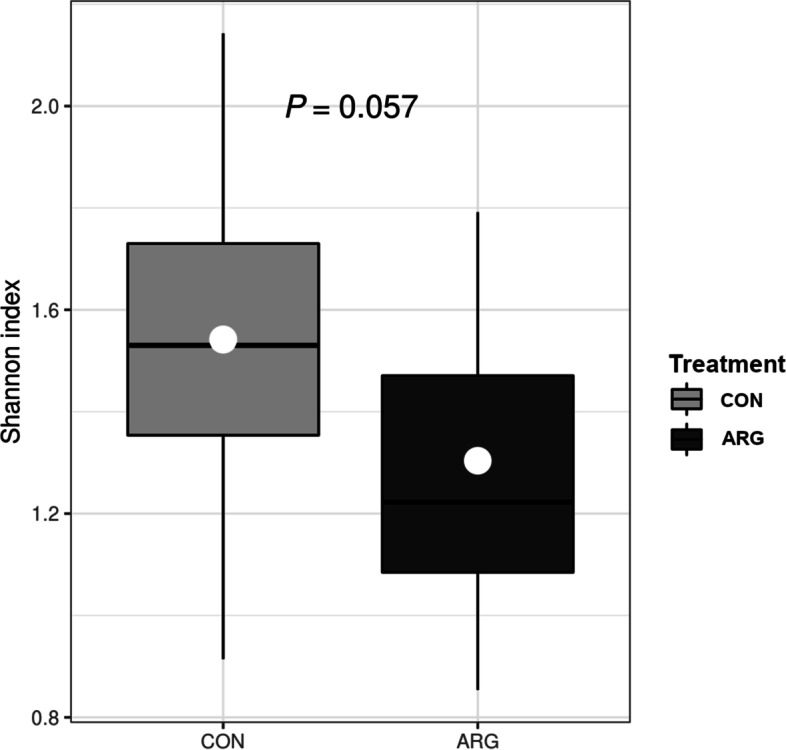
Compared to control birds, those supplemented with arginine performed significantly better exhibiting greater final body weight at D49 (3778 vs. 3937 g; P < 0.001), higher growth rate (76.15 vs. 79.46 g of body weight gained daily; P < 0.001), and lower cumulative feed conversion ratio (1.808 vs. 1.732; P < 0.05). Plasma concentrations of arginine, betaine, histidine, and creatine were greater in supplemented birds than in their control counterparts, as were those of creatine, leucine and other essential amino acids at the hepatic level. In contrast, leucine concentration was lower in the caecal content of supplemented birds. Reduced alpha diversity and relative abundance of Firmicutes and Proteobacteria (specifically Escherichia coli), as well as increased abundance of Bacteroidetes and Lactobacillus salivarius were found in the caecal content of supplemented birds.
The improvement in growth performance corroborates the advantages of supplementing arginine in broiler nutrition. It can be hypothesized that the performance enhancement found in this study is associated with the increased availability of arginine, betaine, histidine, and creatine in plasma and the liver, as well as to the ability of extra dietary arginine to potentially ameliorate intestinal conditions and microbiota of supplemented birds. However, the latter promising property, along with other research questions raised by this study, deserve further investigations.
精氨酸是鸡的必需氨基酸,研究表明,在日粮中添加超过推荐水平的精氨酸对肉鸡的生长性能有积极影响。然而,对于超过广泛采用剂量的精氨酸补充如何影响肉鸡的代谢和肠道健康,仍需要进一步研究。因此,本研究旨在评估精氨酸补充(即总精氨酸与总赖氨酸的比例为1.20,而非育种公司推荐的1.06 - 1.08)对肉鸡生长性能的影响,并探讨其对肝脏和血液代谢谱以及肠道微生物群的影响。为此,将630只1日龄雄性罗斯308肉鸡雏鸡分为2组处理(每组7个重复),分别饲喂对照日粮或添加结晶L - 精氨酸的日粮,为期49天。
与对照鸡相比,补充精氨酸的鸡表现明显更好,在第49天的终末体重更大(3778 vs. 3937 g;P < 0.001),生长速度更高(每日体重增加76.15 vs. 79.46 g;P < 0.001),累积饲料转化率更低(1.808 vs. 1.732;P < 0.05)。补充精氨酸的鸡血浆中精氨酸、甜菜碱、组氨酸和肌酸的浓度高于对照鸡,肝脏中肌酸、亮氨酸和其他必需氨基酸的浓度也是如此。相比之下,补充精氨酸的鸡盲肠内容物中亮氨酸浓度较低。在补充精氨酸的鸡的盲肠内容物中发现,α多样性降低,厚壁菌门和变形菌门(特别是大肠杆菌)的相对丰度降低,拟杆菌门和唾液乳杆菌的丰度增加。
生长性能的改善证实了在肉鸡营养中补充精氨酸的优势。可以推测,本研究中发现的性能提升与血浆和肝脏中精氨酸、甜菜碱、组氨酸和肌酸的可用性增加有关,以及额外的日粮精氨酸潜在改善补充精氨酸鸡的肠道状况和微生物群的能力有关。然而,后一个有前景的特性以及本研究提出的其他研究问题,值得进一步研究。