MRC Brain Network Dynamics Unit at the University of Oxford, Nuffield Department of Clinical Neurosciences, University of Oxford, Oxford OX1 3TH, UK.
Movement Disorders and Neurostimulation, Department of Neurology, Focus Program Translational Neuroscience (FTN), University Medical Center of the Johannes Gutenberg-University Mainz, 55131 Mainz, Germany.
Brain. 2023 Sep 1;146(9):3576-3586. doi: 10.1093/brain/awad069.
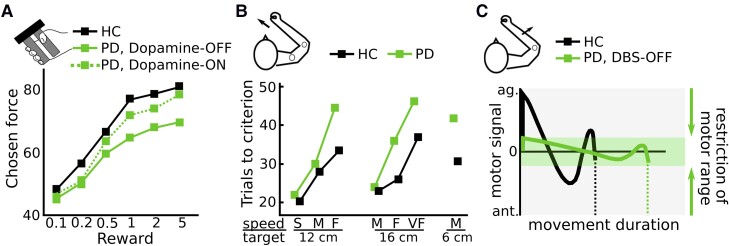
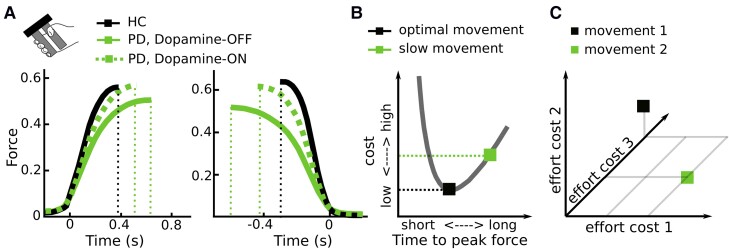
The debilitating symptoms of Parkinson's disease, including the hallmark slowness of movement, termed bradykinesia, were described more than 100 years ago. Despite significant advances in elucidating the genetic, molecular and neurobiological changes in Parkinson's disease, it remains conceptually unclear exactly why patients with Parkinson's disease move slowly. To address this, we summarize behavioural observations of movement slowness in Parkinson's disease and discuss these findings in a behavioural framework of optimal control. In this framework, agents optimize the time it takes to gather and harvest rewards by adapting their movement vigour according to the reward that is at stake and the effort that needs to be expended. Thus, slow movements can be favourable when the reward is deemed unappealing or the movement very costly. While reduced reward sensitivity, which makes patients less inclined to work for reward, has been reported in Parkinson's disease, this appears to be related mainly to motivational deficits (apathy) rather than bradykinesia. Increased effort sensitivity has been proposed to underlie movement slowness in Parkinson's disease. However, careful behavioural observations of bradykinesia are inconsistent with abnormal computations of effort costs due to accuracy constraints or movement energetic expenditure. These inconsistencies can be resolved when considering that a general disability to switch between stable and dynamic movement states can contribute to an abnormal composite effort cost related to movement in Parkinson's disease. This can account for paradoxical observations such as the abnormally slow relaxation of isometric contractions or difficulties in halting a movement in Parkinson's disease, both of which increase movement energy expenditure. A sound understanding of the abnormal behavioural computations mediating motor impairment in Parkinson's disease will be vital for linking them to their underlying neural dynamics in distributed brain networks and for grounding future experimental studies in well-defined behavioural frameworks.
帕金森病的致残症状,包括运动的标志性缓慢,即运动徐缓,在 100 多年前就已经被描述过。尽管在阐明帕金森病的遗传、分子和神经生物学变化方面取得了重大进展,但从概念上讲,为什么帕金森病患者的运动速度会变慢仍然不清楚。为了解决这个问题,我们总结了帕金森病患者运动缓慢的行为观察结果,并在最优控制的行为框架内讨论了这些发现。在这个框架中,代理人通过根据所涉及的奖励和需要付出的努力来调整运动活力,来优化收集和收获奖励所需的时间。因此,当奖励被认为没有吸引力或运动非常昂贵时,缓慢的运动可能是有利的。虽然帕金森病患者的报告显示,他们的奖励敏感性降低,使他们不太倾向于为奖励而工作,但这似乎主要与动机缺陷(冷漠)有关,而不是运动徐缓。有人提出,运动缓慢是由于帕金森病患者的努力敏感性增加所致。然而,对运动徐缓的仔细行为观察结果与由于准确性限制或运动能量消耗而导致的异常努力成本计算不一致。当考虑到一般的难以在稳定和动态运动状态之间切换的能力障碍可能导致与帕金森病运动相关的异常综合努力成本时,这些不一致可以得到解决。这可以解释一些矛盾的观察结果,例如在帕金森病中,等长收缩的异常缓慢放松或停止运动的困难,这两者都会增加运动能量消耗。对介导帕金森病运动障碍的异常行为计算的深入了解,对于将其与分布式大脑网络中的潜在神经动力学联系起来,以及为明确的行为框架中的未来实验研究提供基础,将是至关重要的。