Fischer Alex Emilio, Abrahams Musaed, Shankland Luke, Lalla-Edward Samanta Tresha, Edward Vinodh A, De Wit John
Aviro Health, Cape Town, South Africa.
Department of Interdisciplinary Social Science, Public Health, Utrecht University, Utrecht, Netherlands.
Front Reprod Health. 2023 Feb 14;5:1121478. doi: 10.3389/frph.2023.1121478. eCollection 2023.
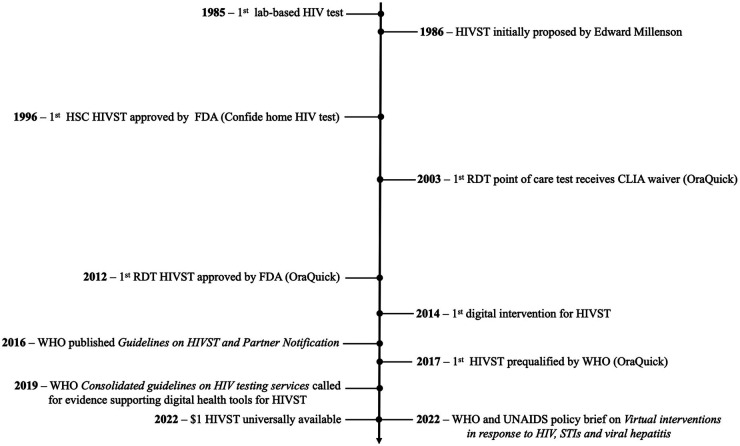
HIV self-testing (HIVST) complements traditional HIV testing programmes by removing barriers and increasing access to testing for key populations, and digital interventions have been developed for HIVST to improve the testing and linkage to care experience for users. The first HIVST kit was proposed in 1986, but it took 10 years for the home sample collection (HSC) HIVST to become available and another 16 years for rapid diagnostic test HIVST to be approved by the Federal Drug Administration. Since then, studies have shown high usability and performance of HIVST, which led the World Health Organization formally recommending HIVST in 2016, and currently almost 100 countries have incorporated HIVST into their national testing strategy. Despite the popularity, HIVST present challenges around pre-and post-test counselling, as well as the ability to report results and link users to care, and digital interventions for HIVST have been introduced to address these challenges. The first digital intervention for HIVST was introduced in 2014 and showed that digital interventions could be used to distribute HIVST kits, report results and link users to care. Since then, dozens of studies have been conducted, which have validated and expanded on these early findings, but many were pilot studies with small sample sizes and lacked the standardization of indicators required to aggregate data across platforms to prove impact at scale. For digital interventions for HIVST to be championed for scale-up, they must continue to show measurable impact at larger scales, while still maintaining and standardizing data security and integrity.
艾滋病毒自我检测(HIVST)通过消除障碍和增加关键人群的检测机会,对传统的艾滋病毒检测项目起到了补充作用,并且已经开发了数字干预措施用于HIVST,以改善用户的检测体验以及与护理的衔接。首个HIVST试剂盒于1986年被提出,但家庭样本采集(HSC)的HIVST经过10年才得以面世,快速诊断检测的HIVST又过了16年才获得美国食品药品监督管理局的批准。从那时起,研究表明HIVST具有很高的可用性和性能,这使得世界卫生组织在2016年正式推荐HIVST,目前几乎有100个国家已将HIVST纳入其国家检测战略。尽管很受欢迎,但HIVST在检测前和检测后的咨询以及报告结果并将用户与护理衔接方面存在挑战,因此引入了针对HIVST的数字干预措施来应对这些挑战。2014年引入了首个针对HIVST的数字干预措施,结果表明数字干预措施可用于分发HIVST试剂盒、报告结果并将用户与护理衔接起来。从那时起,已经开展了数十项研究,对这些早期发现进行了验证和扩展,但许多都是小样本量的试点研究,缺乏跨平台汇总数据以证明大规模影响所需的指标标准化。为了支持扩大针对HIVST的数字干预措施的规模,它们必须继续在更大规模上显示出可衡量的影响,同时仍要维护数据安全和完整性并使其标准化。