Division of Environmental Engineering, Faculty of Engineering, Hokkaido University, North 13 West 8, Kita-ku, Sapporo, Hokkaido 060-8628, Japan.
Center for Infectious Disease Education and Research, Osaka University, 2-8 Yamadaoka, Suita, Osaka 565-0871, Japan.
Environ Int. 2023 Mar;173:107743. doi: 10.1016/j.envint.2023.107743. Epub 2023 Jan 7.
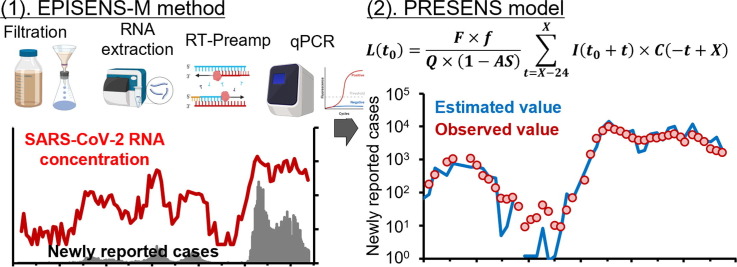
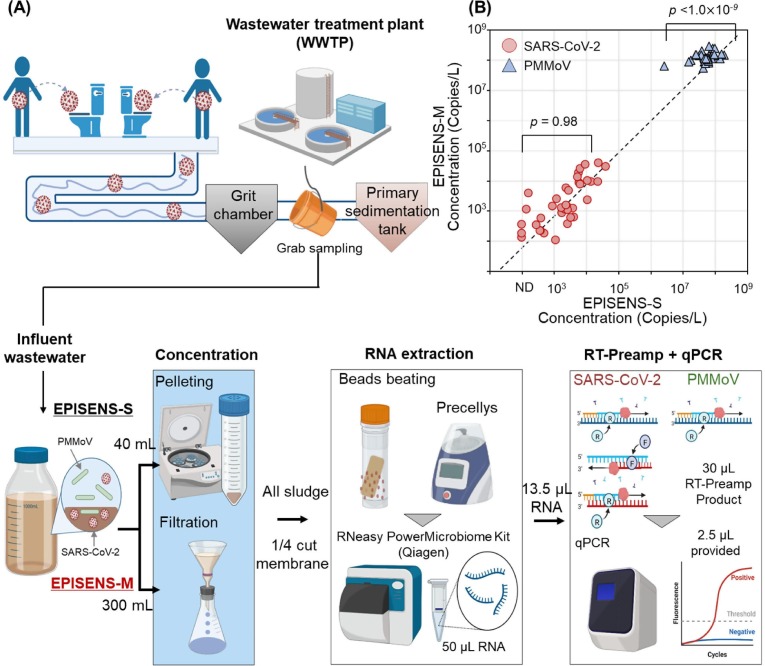
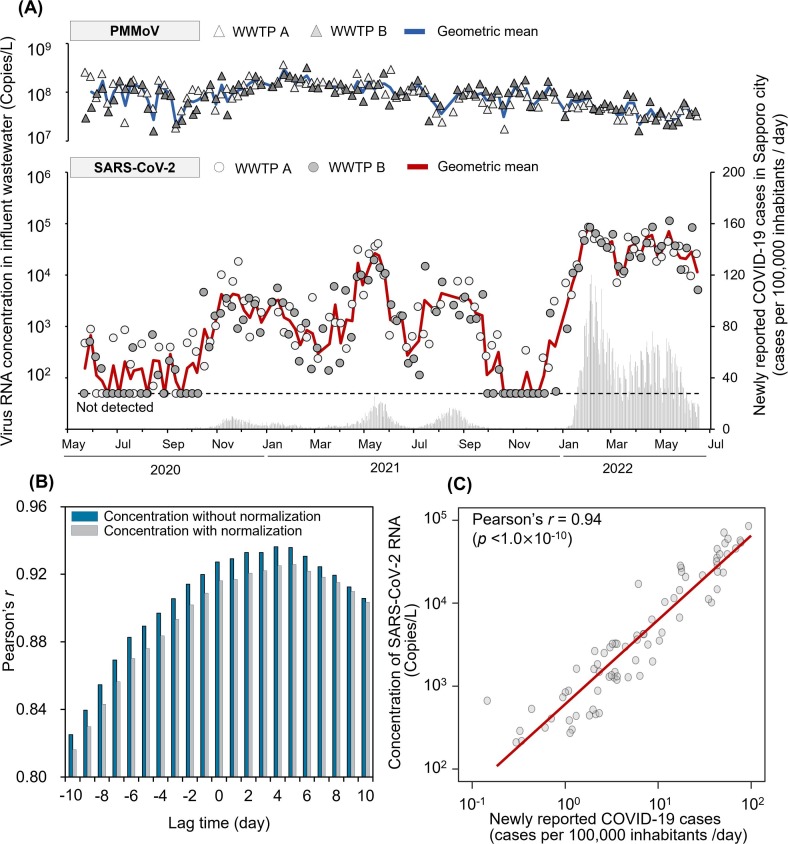
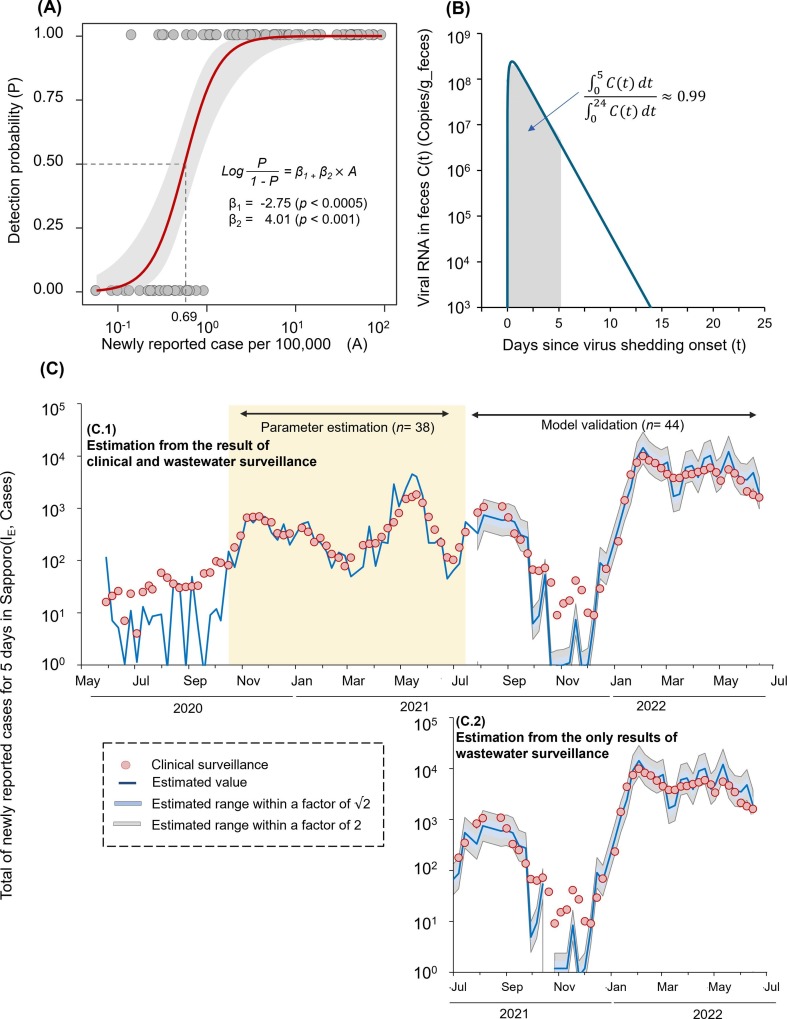
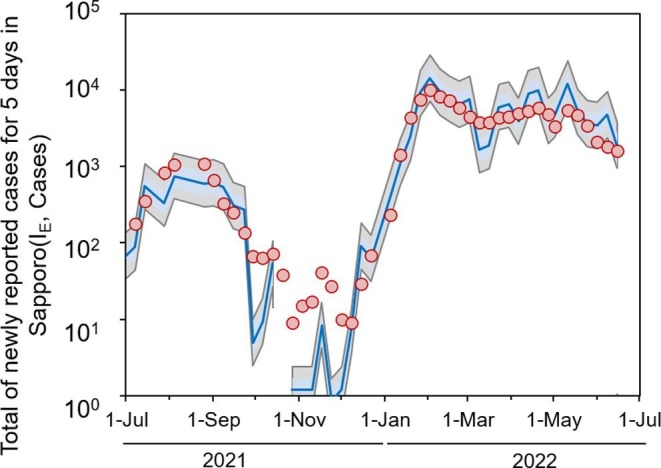
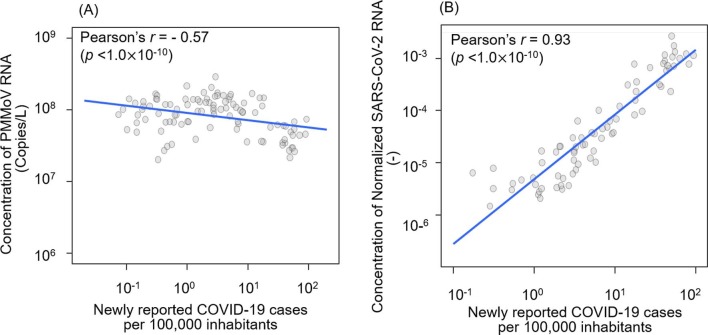
Wastewater-based epidemiology (WBE) has the potential to predict COVID-19 cases; however, reliable methods for tracking SARS-CoV-2 RNA concentrations (C) in wastewater are lacking. In the present study, we developed a highly sensitive method (EPISENS-M) employing adsorption-extraction, followed by one-step RT-Preamp and qPCR. The EPISENS-M allowed SARS-CoV-2 RNA detection from wastewater at 50 % detection rate when newly reported COVID-19 cases exceed 0.69/100,000 inhabitants in a sewer catchment. Using the EPISENS-M, a longitudinal WBE study was conducted between 28 May 2020 and 16 June 2022 in Sapporo City, Japan, revealing a strong correlation (Pearson's r = 0.94) between C and the newly COVID-19 cases reported by intensive clinical surveillance. Based on this dataset, a mathematical model was developed based on viral shedding dynamics to estimate the newly reported cases using C data and recent clinical data prior to sampling day. This developed model succeeded in predicting the cumulative number of newly reported cases after 5 days of sampling day within a factor of √2 and 2 with a precision of 36 % (16/44) and 64 % (28/44), respectively. By applying this model framework, another estimation mode was developed without the recent clinical data, which successfully predicted the number of COVID-19 cases for the succeeding 5 days within a factor of √2 and 2 with a precision of 39 % (17/44) and 66 % (29/44), respectively. These results demonstrated that the EPISENS-M method combined with the mathematical model can be a powerful tool for predicting COVID-19 cases, especially in the absence of intensive clinical surveillance.
基于污水的流行病学(WBE)有预测 COVID-19 病例的潜力;然而,缺乏可靠的方法来跟踪污水中 SARS-CoV-2 RNA 浓度(C)。在本研究中,我们开发了一种高灵敏度的方法(EPISENS-M),采用吸附-提取,然后进行一步 RT-Preamp 和 qPCR。当污水收集区域中报告的新 COVID-19 病例超过 0.69/100,000 居民时,EPISENS-M 可在 50%检测率下检测污水中的 SARS-CoV-2 RNA。使用 EPISENS-M,我们在 2020 年 5 月 28 日至 2022 年 6 月 16 日期间在日本札幌市进行了一项纵向 WBE 研究,发现 C 与密集临床监测报告的新 COVID-19 病例之间存在很强的相关性(Pearson's r = 0.94)。基于该数据集,我们基于病毒脱落动力学开发了一个数学模型,用于使用 C 数据和采样日前的最近临床数据来估计新报告的病例。该开发的模型成功地预测了采样日后 5 天内新报告的病例累积数,精度分别为 36%(16/44)和 64%(28/44)。通过应用该模型框架,开发了另一种不使用最近临床数据的估计模式,该模式成功地预测了随后 5 天内 COVID-19 病例的数量,精度分别为 39%(17/44)和 66%(29/44)。这些结果表明,EPISENS-M 方法结合数学模型可以成为预测 COVID-19 病例的有力工具,尤其是在没有密集临床监测的情况下。