Khunou Sisinyana H
Department of Health Studies, College of Human Sciences, University of South Africa, Pretoria, South Africa.
Health SA. 2023 Feb 15;28:1883. doi: 10.4102/hsag.v28i0.1883. eCollection 2023.
Adequate mentoring and support of community service nurses (CSNs) in transitioning from the learning environment to the public health setting is pivotal. Despite this notion, the mentoring of CSNs is inconsistently implemented. It was therefore imperative that the researchers developed the guidelines that can be used by managers to mentor the CSNs.
This article shares nine guidelines to ensure adequate mentoring of CSNs in public health settings.
The study was conducted in public health settings designated for placement of CSNs, in South Africa.
This study followed a convergent parallel mixed-methods design whereby qualitative data were obtained from purposefully selected CSNs and nurse managers. Quantitative data were obtained from 224 CSNs and 174 nurse managers, with the use of mentoring questionnaires. Semi-structured interviews were used on focus groups of nurse managers ( = 27) and CSNs ( = 28). Quantitative data were analysed with Statistical Package for Social Science software version 23, ATLAS.ti 7 software was used to analyse qualitative data.
The merged results evidenced that CSNs were not adequately mentored. The public health setting was not conducive to mentoring CSNs. Mentoring activities were not well structured. Monitoring and evaluation of mentoring of CSNs were not properly done. Evidence from merged results and literature were applied to develop mentoring guidelines for operationalising a mentoring programme for CSNs.
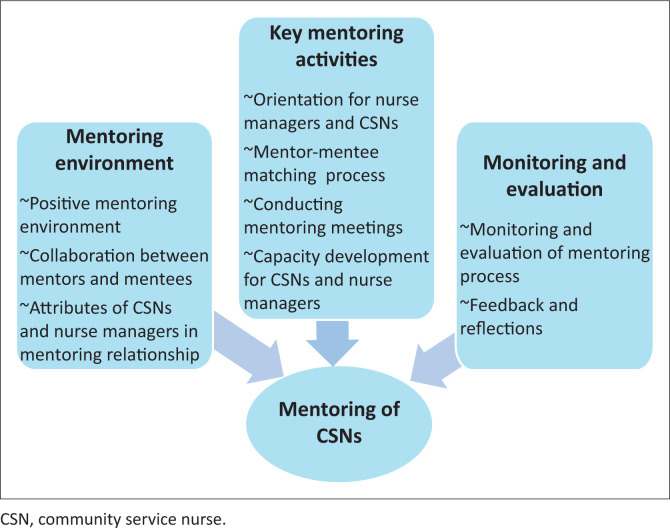
The guidelines were: (1) creation of a positive mentoring environment, (2) enhancement of collaboration between stakeholders, (3) attributes of CSNs and nurse managers in the mentoring relationship, (4) enhance orientation for nurse managers and CSNs, (5) facilitation of mentor-mentee matching process, (6) conducting mentoring meetings, (7) capacity development for CSNs and nurse managers, (8) monitoring and evaluation of mentoring process, and (9) reflections and feedback.
This was the first CSNs' guidelines to be developed in the public health setting. These guidelines could facilitate adequate mentoring of CSNs.
在社区服务护士(CSNs)从学习环境过渡到公共卫生环境的过程中,给予充分的指导和支持至关重要。尽管有这一理念,但对社区服务护士的指导实施情况并不一致。因此,研究人员制定可供管理人员用于指导社区服务护士的准则势在必行。
本文分享九条准则,以确保在公共卫生环境中对社区服务护士进行充分指导。
该研究在南非指定用于安置社区服务护士的公共卫生环境中进行。
本研究采用了收敛平行混合方法设计,通过有目的地选择社区服务护士和护士长获取定性数据。使用指导问卷从224名社区服务护士和174名护士长处获取定量数据。对护士长(n = 27)和社区服务护士(n = 28)的焦点小组进行了半结构化访谈。使用社会科学统计软件包第23版对定量数据进行分析,使用ATLAS.ti 7软件分析定性数据。
综合结果表明,社区服务护士未得到充分指导。公共卫生环境不利于指导社区服务护士。指导活动结构不完善。对社区服务护士指导的监测和评估工作做得不到位。综合结果和文献中的证据被用于制定指导准则,以实施针对社区服务护士的指导计划。
这些准则为:(1)营造积极的指导环境;(2)加强利益相关者之间的合作;(3)指导关系中社区服务护士和护士长的特质;(4)加强对护士长和社区服务护士的入职培训;(5)促进指导者与被指导者的匹配过程;(6)召开指导会议;(7)社区服务护士和护士长的能力发展;(8)指导过程的监测和评估;(9)反思与反馈。
这是在公共卫生环境中制定的首个社区服务护士指导准则。这些准则有助于对社区服务护士进行充分指导。