Anjum Gulnaz, Aziz Mudassar, Hamid Hadar Khasrow
Department of Psychology, University of Oslo, Oslo, Norway.
Department of Psychology, Kwantlen Polytechnic University, Surrey, BC, Canada.
Front Psychol. 2023 Feb 17;14:1129299. doi: 10.3389/fpsyg.2023.1129299. eCollection 2023.
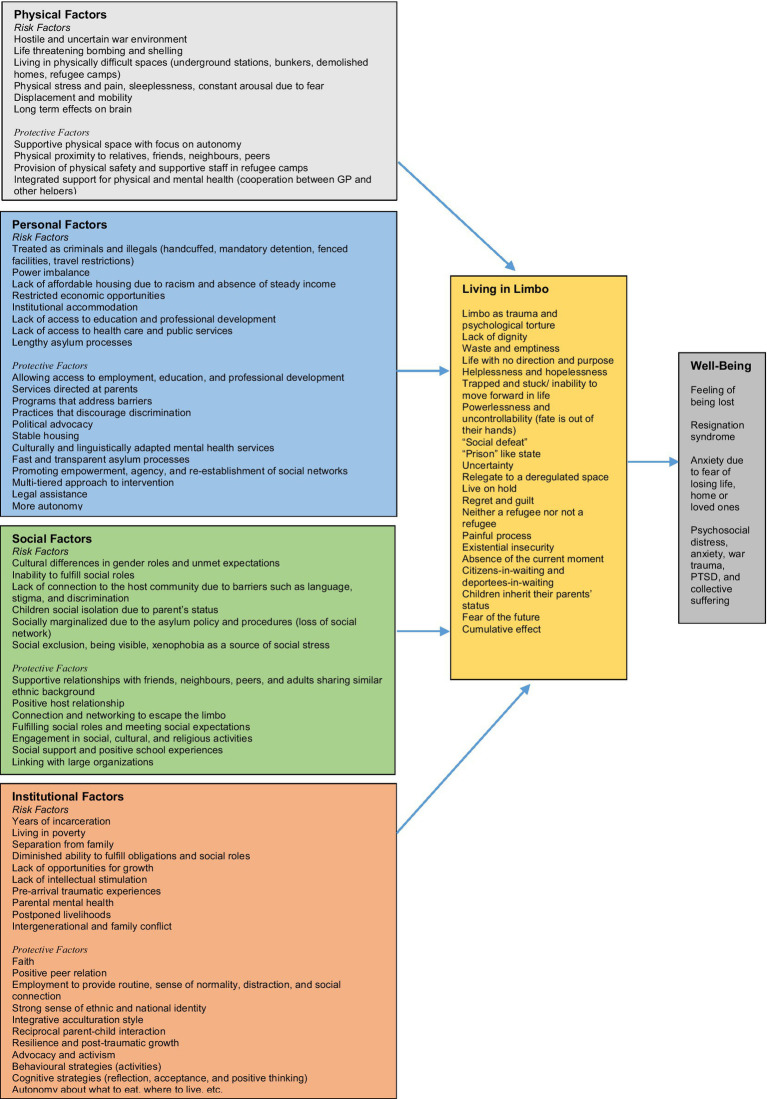
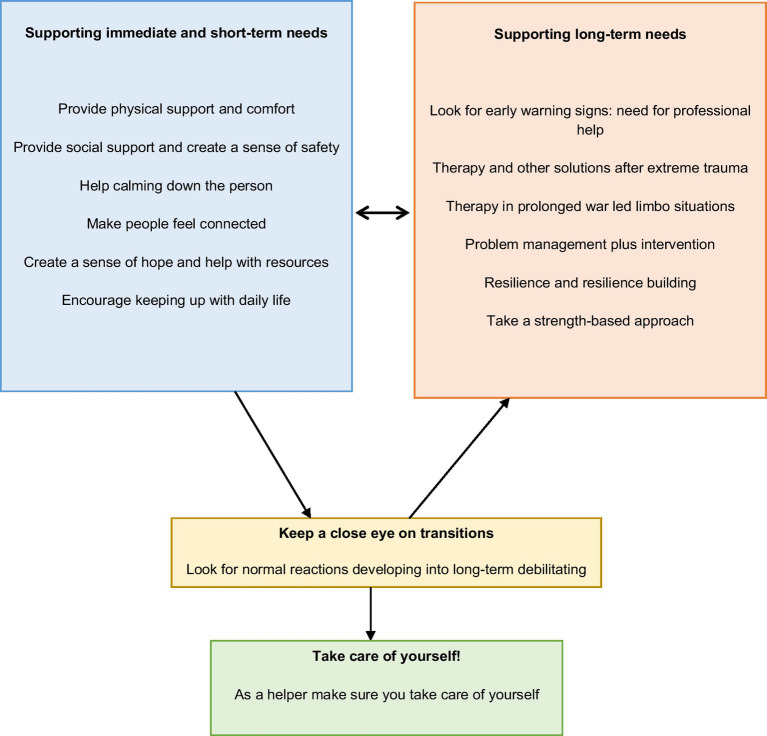
The terror spread by the war disrupts lives and severs families, leaving individuals and communities devastated. People are left to fend for themselves on multiple levels, especially psychologically. It is well documented that war adversely affects non-combatant civilians, both physically and psychologically. However, how the war puts civilians' lives in a limbo is an under-researched area. This paper focuses on three aspects: (1) how the mental health and well-being of Ukrainian civilians, asylum seekers, and refugees are affected by the war caused limbo; (2) what factors affect this process of being stuck in the limbo of war; and (3) how psychologists and helpers in the war-ridden and host countries can provide meaningful support. Based on the authors' own practical work with Ukrainian civilians, refugees, and professional helpers during the war, this paper provides an overview of multi-level factors that impact human psyches in a war, and possible ways to help those who are living in the war limbo. In this research and experiential learning-based review, we offer some helpful strategies, action plans, and resources for the helpers including psychologists, counselors, volunteers, and relief workers. We emphasize that the effects of war are neither linear nor equal for all civilians and refugees. Some will recover and return to a routine life while others will experience panic attacks, trauma, depression, and even PTSD, which can also surface much later and can prolong over the years. Hence, we provide experience-based ways of dealing with short-term and prolonged trauma of living with war and post-traumatic stress disorder (PTSD). Mental health professionals and other helpers in Ukraine and in host countries can use these helping strategies and resources to provide effective support for Ukrainians and for war refugees in general.
战争所带来的恐惧扰乱了生活,拆散了家庭,使个人和社区遭受重创。人们在多个层面上只能自力更生,尤其是在心理层面。有充分的文献记载表明,战争对非战斗平民的身体和心理都会产生不利影响。然而,战争如何使平民的生活陷入困境却是一个研究不足的领域。本文聚焦于三个方面:(1)乌克兰平民、寻求庇护者和难民的心理健康与幸福如何受到战争导致的生活困境的影响;(2)哪些因素影响了被困于战争困境的这一过程;(3)战乱国家和收容国的心理学家及援助人员如何提供有意义的支持。基于作者在战争期间与乌克兰平民、难民及专业援助人员的实际工作经验,本文概述了在战争中影响人类心理的多层次因素,以及帮助那些处于战争困境中的人们的可能方法。在这项基于研究和经验学习的综述中,我们为包括心理学家、咨询师、志愿者和救援人员在内的援助人员提供了一些有用的策略、行动计划和资源。我们强调,战争的影响对于所有平民和难民而言既不是线性的,也不是均等的。一些人会恢复并回归正常生活,而另一些人则会经历惊恐发作、创伤、抑郁,甚至创伤后应激障碍(PTSD),这些症状也可能在很久之后才出现,并且会持续数年。因此,我们提供了基于经验的方法来应对与战争共存的短期和长期创伤以及创伤后应激障碍(PTSD)。乌克兰和收容国的心理健康专业人员及其他援助人员可以利用这些帮助策略和资源,为乌克兰人和一般战争难民提供有效的支持。