Wan Minjie, Han Jiawen, Ding Lili, Hu Feng, Gao Pujun
Department of Hepatology, The First Hospital of Jilin University, Jilin University, Changchun, China.
Central Laboratory, The First Hospital of Jilin University, Jilin University, Changchun, China.
Front Med (Lausanne). 2021 Apr 1;8:604894. doi: 10.3389/fmed.2021.604894. eCollection 2021.
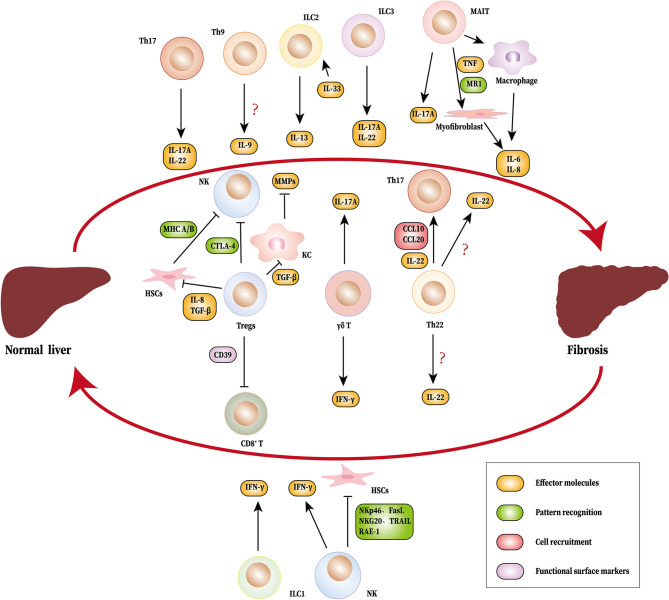
Liver fibrosis is a pathological process caused by persistent chronic injury of the liver. Kupffer cells, natural killer (NK) cells, NKT cells, and dendritic cells (DCs), which are in close contact with T and B cells, serve to bridge innate and adaptive immunity in the liver. Meanwhile, an imbalanced inflammatory response constitutes a challenge in liver disease. The dichotomous roles of novel immune cells, including T helper 17 (Th17), regulatory T cells (Tregs), mucosa-associated invariant T cells (MAIT), and innate lymphoid cells (ILCs) in liver fibrosis have gradually been revealed. These cells not only induce damage during liver fibrosis but also promote tissue repair. Hence, immune cells have unique, and often opposing, roles during the various stages of fibrosis. Due to this heterogeneity, the treatment, or reversal of fibrosis through the target of immune cells have attracted much attention. Moreover, activation of hepatic stellate cells (HSCs) constitutes the core of fibrosis. This activation is regulated by various immune mediators, including Th17, Th22, and Th9, MAIT, ILCs, and γδ T cells, as well as their related cytokines. Thus, liver fibrosis results from the complex interaction of these immune mediators, thereby complicating the ability to elucidate the mechanisms of action elicited by each cell type. Future developments in biotechnology will certainly aid in this feat to inform the design of novel therapeutic targets. Therefore, the aim of this review was to summarize the role of specific immune cells in liver fibrosis, as well as biomarkers and treatment methods related to these cells.
肝纤维化是由肝脏持续慢性损伤引起的病理过程。与T细胞和B细胞密切接触的库普弗细胞、自然杀伤(NK)细胞、NKT细胞和树突状细胞(DC)在肝脏中起着连接固有免疫和适应性免疫的作用。同时,炎症反应失衡是肝脏疾病面临的一个挑战。包括辅助性T细胞17(Th17)、调节性T细胞(Treg)、黏膜相关恒定T细胞(MAIT)和固有淋巴细胞(ILC)在内的新型免疫细胞在肝纤维化中的双重作用已逐渐被揭示。这些细胞不仅在肝纤维化过程中诱导损伤,还促进组织修复。因此,免疫细胞在纤维化的各个阶段具有独特且往往相反的作用。由于这种异质性,通过免疫细胞靶点治疗或逆转纤维化备受关注。此外,肝星状细胞(HSC)的激活是纤维化的核心。这种激活受多种免疫介质调节,包括Th17、Th22和Th9、MAIT、ILC和γδT细胞及其相关细胞因子。因此,肝纤维化是这些免疫介质复杂相互作用的结果,从而使阐明每种细胞类型引发的作用机制变得复杂。生物技术的未来发展肯定有助于实现这一目标,为新型治疗靶点的设计提供信息。因此,本综述的目的是总结特定免疫细胞在肝纤维化中的作用以及与这些细胞相关的生物标志物和治疗方法。