Ge Xiuhong, Wang Luoyu, Wang Mengze, Pan Lei, Ye Haiqi, Zhu Xiaofen, Fan Sandra, Feng Qi, Du Quan, Wenhua Yu, Ding Zhongxiang
Department of Radiology Hangzhou First People's Hospital, Zhejiang University School of Medicine, Hangzhou, Jiangsu, China.
Department of Radiology, Key Laboratory of Clinical Cancer Pharmacology and Toxicology Research of Zhejiang Province, The Affiliated Hangzhou First People's Hospital, Cancer Center, Zhejiang University School of Medicine, Hangzhou, China.
Front Neurosci. 2023 Feb 16;17:1109684. doi: 10.3389/fnins.2023.1109684. eCollection 2023.
The central nervous system may also be involved in the pathogenesis of classical trigeminal neuralgia (CTN). The present study aimed to explore the characteristics of static degree centrality (sDC) and dynamic degree centrality (dDC) at multiple time points after a single triggering pain in CTN patients.
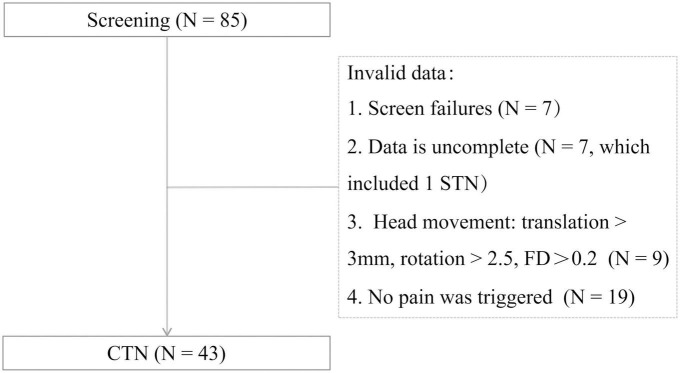
A total of 43 CTN patients underwent resting-state function magnetic resonance imaging (rs-fMRI) before triggering pain (baseline), within 5 s after triggering pain (triggering-5 s), and 30 min after triggering pain (triggering-30 min). Voxel-based degree centrality (DC) was used to assess the alteration of functional connection at different time points.
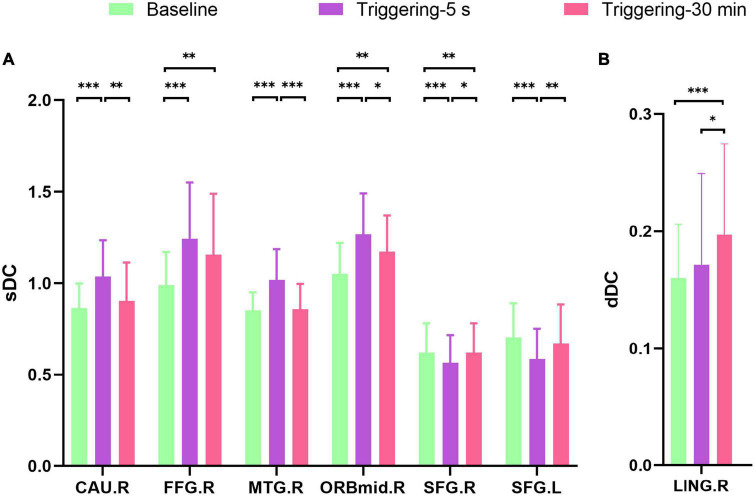
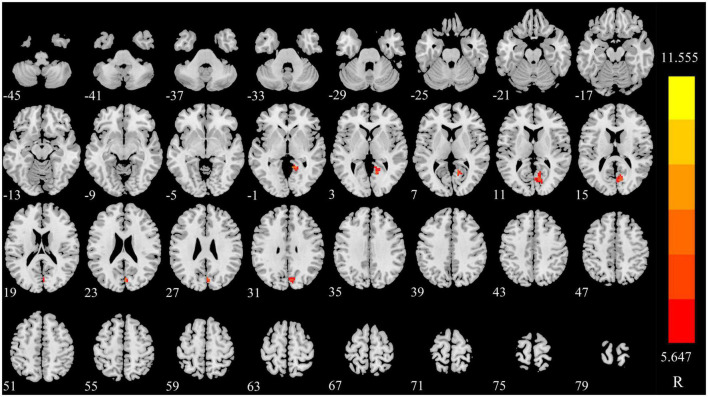
The sDC values of the right caudate nucleus, fusiform gyrus, middle temporal gyrus, middle frontal gyrus, and orbital part were decreased in triggering-5 s and increased in triggering-30 min. The sDC value of the bilateral superior frontal gyrus were increased in triggering-5 s and decreased in triggering-30 min. The dDC value of the right lingual gyrus was gradually increased in triggering-5 s and triggering-30 min.
Both the sDC and dDC values were changed after triggering pain, and the brain regions were different between the two parameters, which supplemented each other. The brain regions which the sDC and dDC values were changing reflect the global brain function of CTN patients, and provides a basis for further exploration of the central mechanism of CTN.
中枢神经系统也可能参与经典三叉神经痛(CTN)的发病机制。本研究旨在探讨CTN患者单次触发疼痛后多个时间点的静态度中心性(sDC)和动态度中心性(dDC)特征。
共43例CTN患者在触发疼痛前(基线)、触发疼痛后5秒内(触发-5秒)和触发疼痛后30分钟(触发-30分钟)接受静息态功能磁共振成像(rs-fMRI)。基于体素的度中心性(DC)用于评估不同时间点功能连接的改变。
右侧尾状核、梭状回、颞中回、额中回和眶部的sDC值在触发-5秒时降低,在触发-30分钟时升高。双侧额上回的sDC值在触发-5秒时升高,在触发-30分钟时降低。右侧舌回的dDC值在触发-5秒和触发-30分钟时逐渐升高。
触发疼痛后sDC和dDC值均发生变化,且两个参数的脑区不同,相互补充。sDC和dDC值发生变化的脑区反映了CTN患者的全脑功能,为进一步探索CTN的中枢机制提供了依据。