Dastgoshadeh Mahshid, Rabiei Zahra
Department of Engineering, Aliabad Katoul Branch, Islamic Azad University, Aliabad Katoul, Iran.
Front Hum Neurosci. 2023 Feb 1;16:1084061. doi: 10.3389/fnhum.2022.1084061. eCollection 2022.
Epilepsy is a disorder of the central nervous system that is often accompanied by recurrent seizures. World health organization (WHO) estimated that more than 50 million people worldwide suffer from epilepsy. Although electroencephalogram (EEG) signals contain vital physiological and pathological information of brain and they are a prominent medical tool for detecting epileptic seizures, visual interpretation of such tools is time-consuming. Since early diagnosis of epilepsy is essential to control seizures, we present a new method using data mining and machine learning techniques to diagnose epileptic seizures automatically.
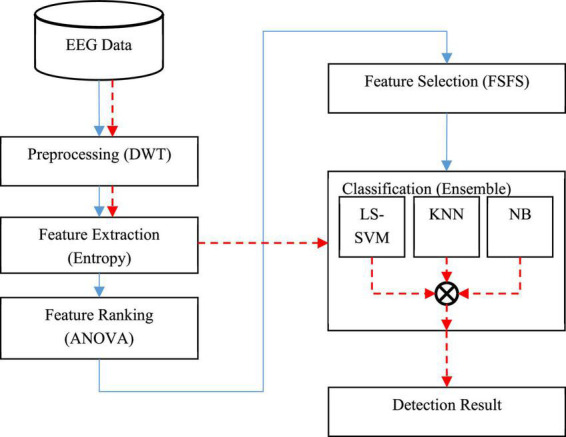
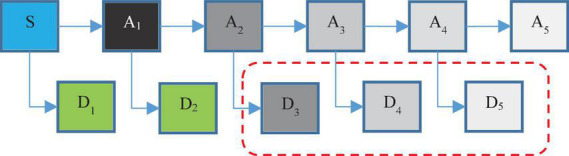
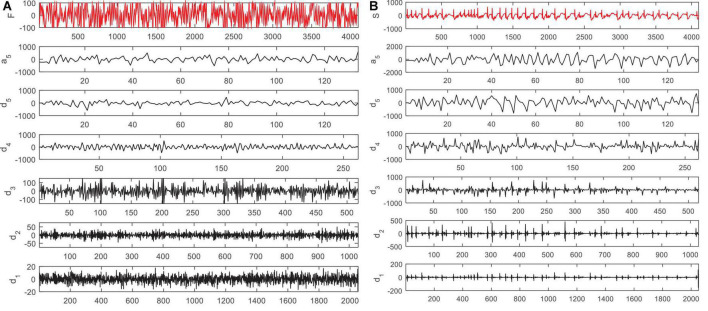
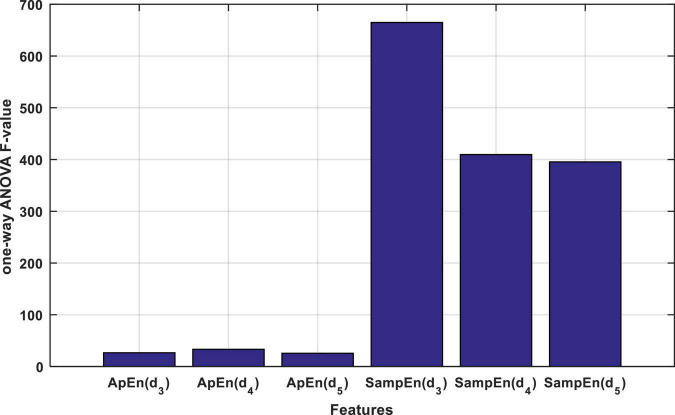
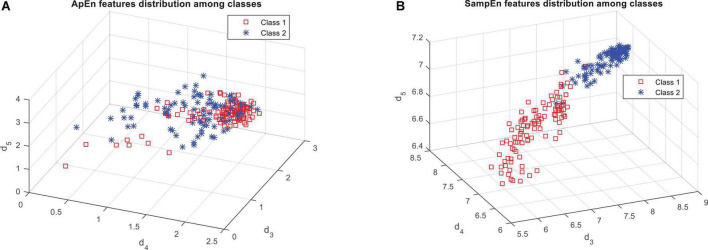
The proposed detection system consists of three main steps: In the first step, the input signals are pre-processed by discrete wavelet transform (DWT) and sub-bands containing useful information are extracted. In the second step, the features of each sub-band are extracted by approximate entropy (ApEn) and sample entropy (SampEn) and then these features are ranked by ANOVA test. Finally, feature selection is done by the FSFS technique. In the third step, three algorithms are used to classify seizures: Least squared support vector machine (LS-SVM), K nearest neighbors (KNN) and Naive Bayes model (NB).
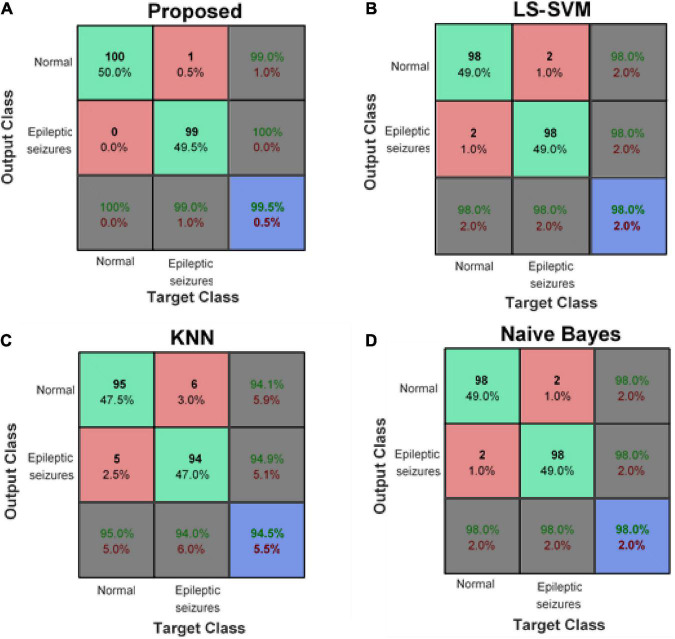
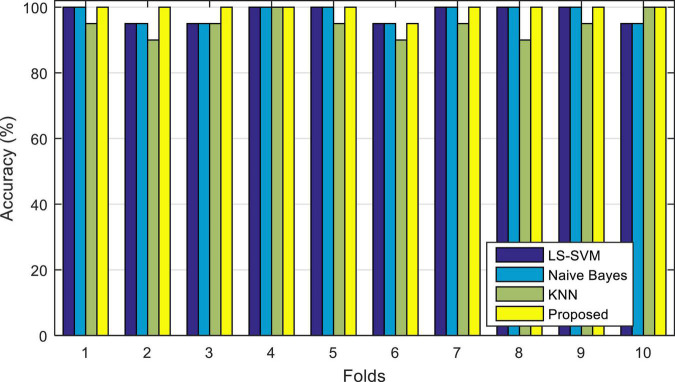
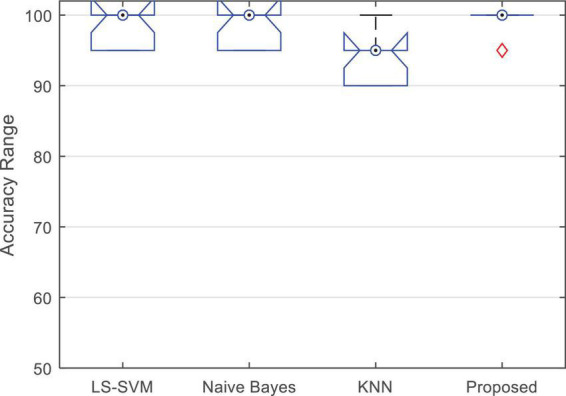
The average accuracy for both LS-SVM and NB was 98% and it was 94.5% for KNN, while the results show that the proposed method can detect epileptic seizures with an average accuracy of 99.5%, 99.01% of sensitivity and 100% of specificity which show an improvement over most similar methods and can be used as an effective tool in diagnosing this complication.
癫痫是一种中枢神经系统疾病,常伴有反复发作的癫痫发作。世界卫生组织(WHO)估计,全球有超过5000万人患有癫痫。尽管脑电图(EEG)信号包含大脑重要的生理和病理信息,并且是检测癫痫发作的重要医学工具,但对这些工具进行视觉解读很耗时。由于癫痫的早期诊断对于控制癫痫发作至关重要,我们提出了一种使用数据挖掘和机器学习技术自动诊断癫痫发作的新方法。
所提出的检测系统包括三个主要步骤:第一步,通过离散小波变换(DWT)对输入信号进行预处理,并提取包含有用信息的子带。第二步,通过近似熵(ApEn)和样本熵(SampEn)提取每个子带的特征,然后通过方差分析(ANOVA)测试对这些特征进行排序。最后,通过FSFS技术进行特征选择。第三步,使用三种算法对癫痫发作进行分类:最小二乘支持向量机(LS-SVM)、K最近邻(KNN)和朴素贝叶斯模型(NB)。
LS-SVM和NB的平均准确率均为98%,KNN为94.5%,而结果表明,所提出的方法能够以99.5%的平均准确率、99.01%的灵敏度和100%的特异性检测癫痫发作,这表明其优于大多数类似方法,可作为诊断这种并发症的有效工具。