Shnaider Polina V, Petrushanko Irina Yu, Aleshikova Olga I, Babaeva Nataliya A, Ashrafyan Lev A, Borovkova Ekaterina I, Dobrokhotova Julia E, Borovkov Ivan M, Shender Victoria O, Khomyakova Elena
Center for Precision Genome Editing and Genetic Technologies for Biomedicine, Federal Research and Clinical Center of Physical-Chemical Medicine of Federal Medical Biological Agency, Moscow, Russia.
Laboratory of Molecular Oncology, Federal Research and Clinical Center of Physical-Chemical Medicine of the Federal Medical and Biological Agency, Moscow, Russia.
Front Cell Dev Biol. 2023 Feb 16;11:1057484. doi: 10.3389/fcell.2023.1057484. eCollection 2023.
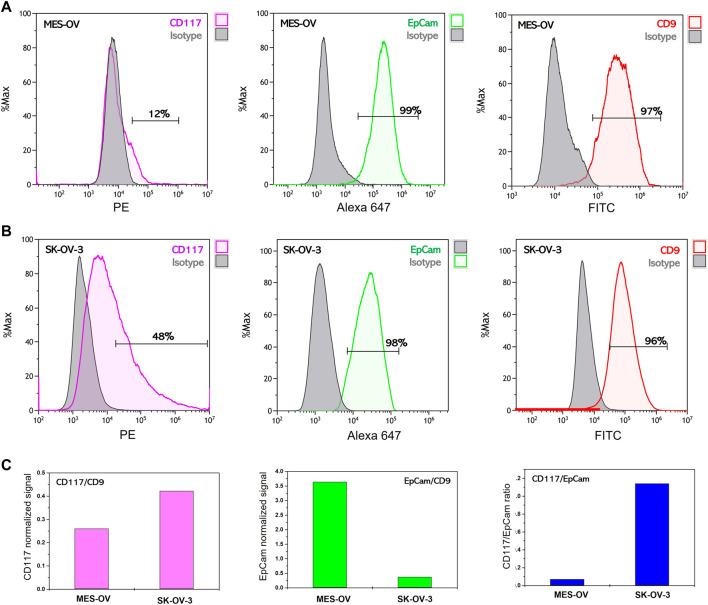
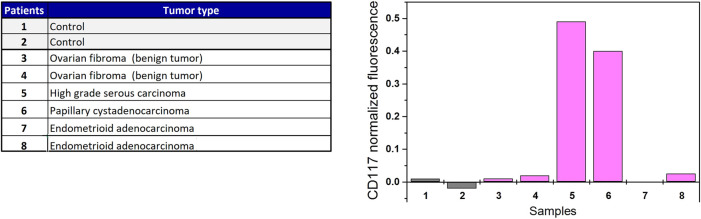
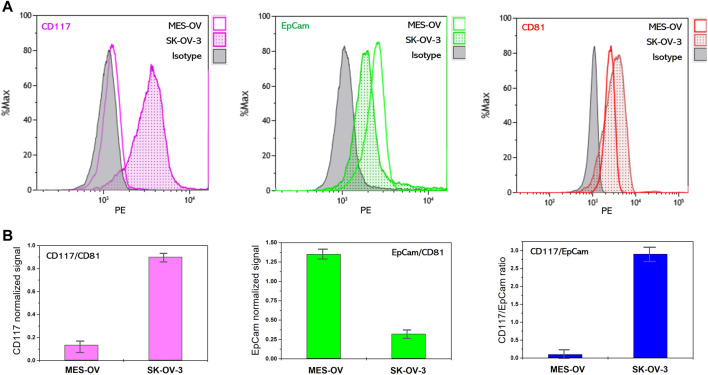
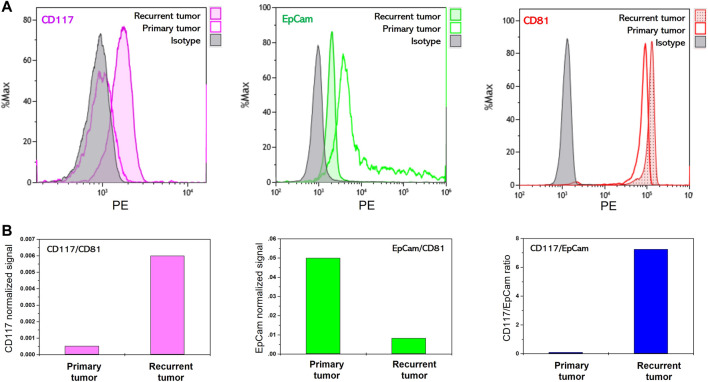
Ovarian cancer is known to be the most lethal malignancy among all gynecological cancers affecting a large number of women worldwide. The treatment of ovarian cancer is challenging due to the high recurrence rate of the disease and is further complicated by acquired chemoresistance. Most ovarian cancer deaths are the result of the metastatic spread of drug-resistant cells. The theory of cancer stem cells (CSC) suggests that both tumor initiation and progression are driven by a population of undifferentiated capable of self-renewal, tumor initiation and development of chemoresistance. The CD117 mast/stem cell growth factor receptor (KIT) is the most commonly used marker for ovarian CSCs. Here, we analyze the correlation between CD117 expression and histological tumor type in ovarian cancer cell lines (SK-OV-3 and MES-OV) and in small/medium extracellular vesicles (EVs) isolated from the urine of ovarian cancer patients. We have demonstrated that the abundance of CD117 on cells and EVs is correlated with tumor grade and therapy resistance status. Moreover, using small EVs isolated from ovarian cancer ascites, it was shown that recurrent disease is characterized by a much higher abundance of CD117 on EVs than primary tumor.
众所周知,卵巢癌是所有妇科癌症中最致命的恶性肿瘤,在全球影响着大量女性。由于该疾病的高复发率,卵巢癌的治疗具有挑战性,并且获得性化疗耐药性使其进一步复杂化。大多数卵巢癌死亡是耐药细胞转移扩散的结果。癌症干细胞(CSC)理论表明,肿瘤的起始和进展是由一群未分化的、能够自我更新、启动肿瘤并产生化疗耐药性的细胞驱动的。CD117肥大/干细胞生长因子受体(KIT)是卵巢癌干细胞最常用的标志物。在此,我们分析了卵巢癌细胞系(SK-OV-3和MES-OV)以及从卵巢癌患者尿液中分离出的小/中型细胞外囊泡(EVs)中CD117表达与肿瘤组织学类型之间的相关性。我们已经证明,细胞和细胞外囊泡上CD117的丰度与肿瘤分级和治疗耐药状态相关。此外,使用从卵巢癌腹水中分离出的小细胞外囊泡,结果显示复发性疾病的特征是细胞外囊泡上CD117的丰度比原发性肿瘤高得多。