Gómez-Quintero Laura María, Múnera-Marín Marlon Alexis, Urán-Serna María Alejandra, Serna-Galvis Efraím A, Galván-Diaz Ana Luz, Torres-Palma Ricardo A
Grupo de Microbiología Ambiental, Escuela de Microbiología, Universidad de Antioquia UdeA, Calle 70 No. 52-21, Medellín, Colombia.
Grupo de Investigación en Remediación Ambiental y Biocatálisis (GIRAB), Instituto de Química, Facultad de Ciencias Exactas y Naturales, Universidad de Antioquia UdeA, Calle 70 No. 52-21, Medellín, Colombia.
MethodsX. 2023 Feb 9;10:102068. doi: 10.1016/j.mex.2023.102068. eCollection 2023.
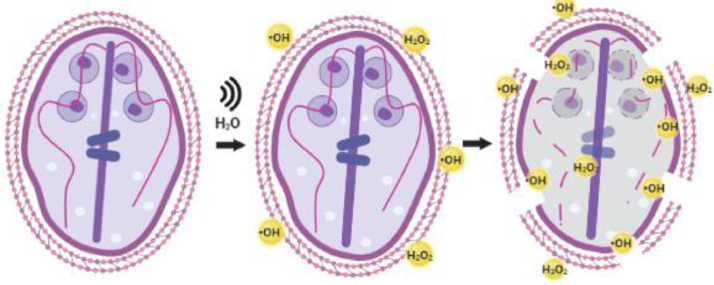
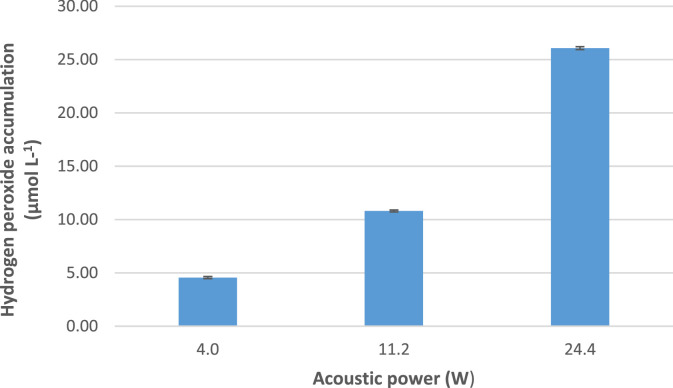
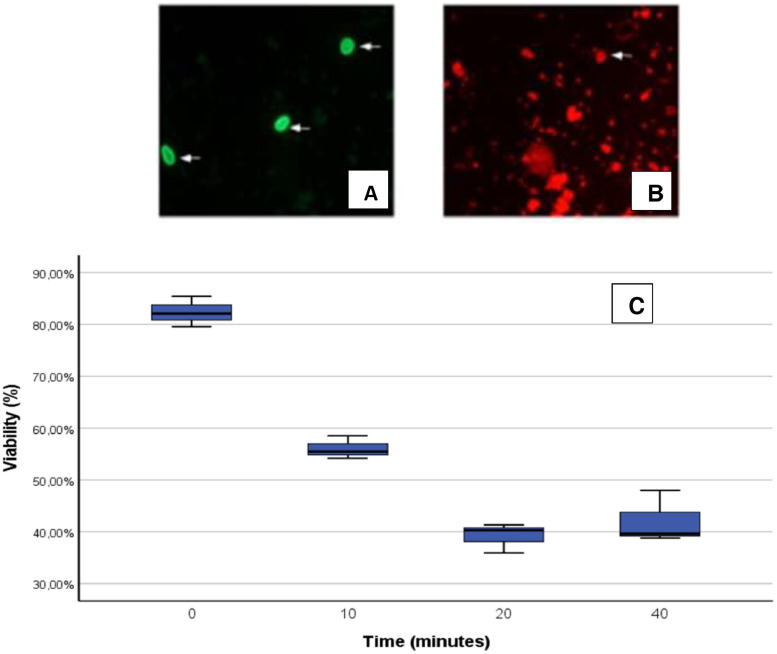
is a pollutant of food and water, resistant to conventional disinfection treatments and its elimination requires effective methods action. Herein, mid-high-frequency ultrasound (375 kHz), which produces HO• and HO, was used as an alternative method of treatment to inactivate cysts in water. The effect of ultrasound power (4.0, 11.2, 24.4 W) on the sonogeneration of radicals was tested, showing that 24.4 W was the condition most favorable to treat the parasite. The viability of the protozoan cysts was evaluated using the immunofluorescence technique and vital stains, showing this protocol was useful to quantify the parasite. The sonochemical method (at 375 kHz and 24.4 W) was applied at different treatment times (10, 20, and 40 min). A significant decrease in the protozoan concentration (reduction of 52.4% of viable cysts) was observed after 20 min of treatment. However, the extension of treatment time up to 40 min did not increase the inactivation. Disinfecting action was associated with attacks on the cyst by sonogenerated HO• and HO (which may induce structural damage, even the cell lysis). For future work is recommended to test combinations with UVC or Fenton process to enhance the inactivating action of this method.•Mid-high-frequency ultrasound produces HO• and HO profitable to inactivate .•Immunofluorescence technique and vital stains allowed us to quantify the parasite viability.• cysts concentration decreased by 52.4% after only 20 min of sonication.
是食物和水的污染物,对传统消毒处理具有抗性,其消除需要有效的方法。在此,产生羟基自由基(HO•)和过氧化氢(HO)的中高频超声(375kHz)被用作灭活水中包囊的替代处理方法。测试了超声功率(4.0、11.2、24.4W)对自由基声致产生的影响,结果表明24.4W是处理该寄生虫最有利的条件。使用免疫荧光技术和活体染色评估原生动物包囊的活力,结果表明该方案可用于量化寄生虫。在不同处理时间(10、20和40分钟)应用声化学方法(375kHz和24.4W)。处理20分钟后,观察到原生动物浓度显著降低(存活包囊减少52.4%)。然而,将处理时间延长至40分钟并未增加灭活效果。消毒作用与声致产生的HO•和HO对包囊的攻击有关(这可能导致结构损伤,甚至细胞裂解)。对于未来的工作,建议测试与紫外线C(UVC)或芬顿工艺的组合,以增强该方法的灭活作用。•中高频超声产生有利于灭活的HO•和HO。•免疫荧光技术和活体染色使我们能够量化寄生虫的活力。•仅超声处理20分钟后,包囊浓度降低了52.4%。