Centre for Medical Image Computing, Department of Medical Physics and Biomedical Engineering, University College London, London, UK.
Division of Psychology, Communication and Human Neuroscience, School of Health Sciences, Faculty of Biology, Medicine and Health, University of Manchester, Manchester, UK.
Magn Reson Med. 2023 Jul;90(1):34-50. doi: 10.1002/mrm.29616. Epub 2023 Mar 9.
To evaluate potential modeling paradigms and the impact of relaxation time effects on human blood-brain barrier (BBB) water exchange measurements using FEXI (BBB-FEXI), and to quantify the accuracy, precision, and repeatability of BBB-FEXI exchange rate estimates at 3 .
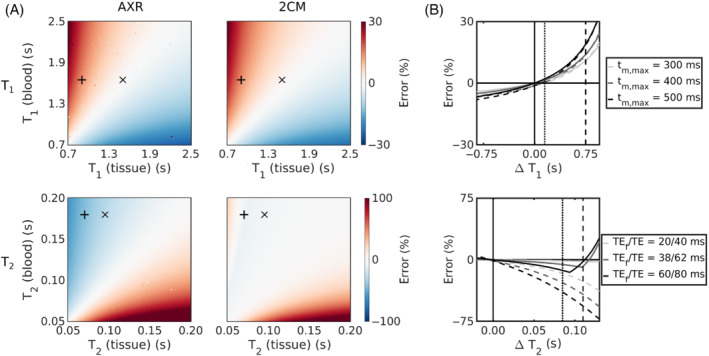
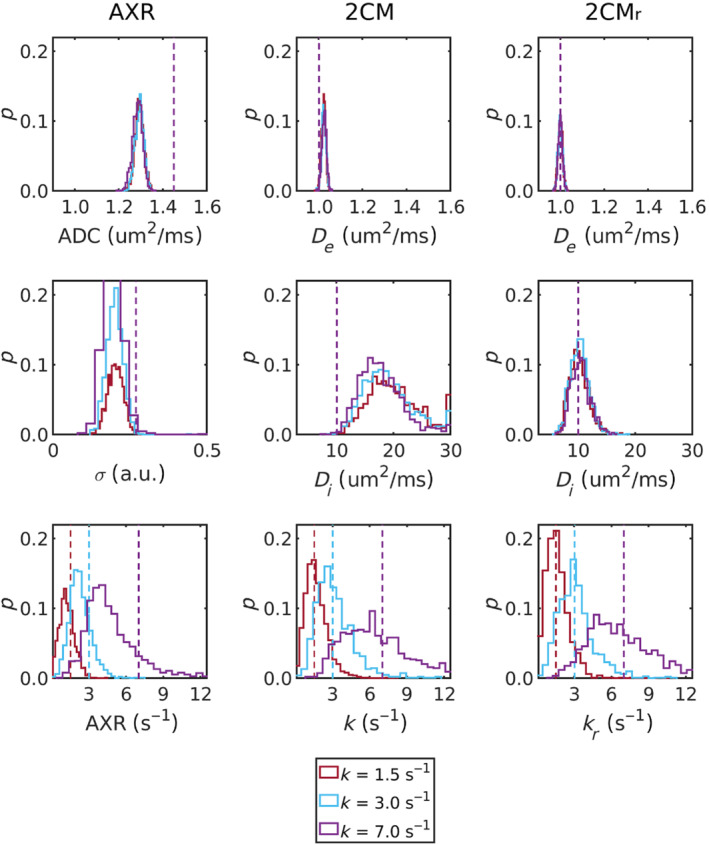
Three modeling paradigms were evaluated: (i) the apparent exchange rate (AXR) model; (ii) a two-compartment model ( ) explicitly representing intra- and extravascular signal components, and (iii) a two-compartment model additionally accounting for finite compartmental and relaxation times ( ). Each model had three free parameters. Simulations quantified biases introduced by the assumption of infinite relaxation times in the AXR and models, as well as the accuracy and precision of all three models. The scan-rescan repeatability of all paradigms was quantified for the first time in vivo in 10 healthy volunteers (age range 23-52 years; five female).
The assumption of infinite relaxation times yielded exchange rate errors in simulations up to 42%/14% in the AXR/ models, respectively. Accuracy was highest in the compartmental models; precision was best in the AXR model. Scan-rescan repeatability in vivo was good for all models, with negligible bias and repeatability coefficients in grey matter of , , and .
Compartmental modelling of BBB-FEXI signals can provide accurate and repeatable measurements of BBB water exchange; however, relaxation time and partial volume effects may cause model-dependent biases.
使用 FEXI(BBB-FEXI)评估人类血脑屏障(BBB)水交换测量的潜在建模范例和弛豫时间效应的影响,并定量评估 BBB-FEXI 交换率估计在 3T 下的准确性、精密度和可重复性。
评估了三种建模范例:(i)表观交换率(AXR)模型;(ii) 明确表示血管内和血管外信号分量的两室模型( ),以及(iii) 另外考虑有限隔室 和 弛豫时间( )的两室模型。每个模型有三个自由参数。模拟量化了在 AXR 和 模型中假设无限弛豫时间引入的偏差,以及所有三种模型的准确性和精密度。所有范例的扫描-重扫可重复性都是首次在 10 名健康志愿者(年龄范围 23-52 岁;5 名女性)体内进行量化的。
在模拟中,假设无限弛豫时间会导致 AXR/ 模型中的交换率误差分别高达 42%/14%。准确性在房室模型中最高;精密度在 AXR 模型中最好。所有模型在体内的扫描-重扫可重复性都很好,灰质中的偏差可忽略不计,重复性系数为 、 和 。
BBB-FEXI 信号的房室模型可以提供准确且可重复的 BBB 水交换测量;然而,弛豫时间和部分容积效应可能会导致模型依赖性偏差。