Institute of Biomedicine, School of Medicine, Faculty of Health Sciences, University of Eastern Finland, P.O. Box 1627, FI-70211, Kuopio, Finland.
Department of Environmental and Biological Sciences, Faculty of Science, Forestry and Technology, University of Eastern Finland, P.O. Box 111, FI-80101, Joensuu, Finland.
Arthritis Res Ther. 2023 Mar 9;25(1):39. doi: 10.1186/s13075-023-02998-9.
Individual fatty acids (FAs) and their derivatives (lipid mediators) with pro-inflammatory or dual anti-inflammatory and pro-resolving properties have potential to influence the health of joint tissues. Osteoarthritis (OA) is an age-associated chronic joint disease that can be featured with altered FA composition in the synovial fluid (SF) of human patients. The counts and cargo of extracellular vesicles (EVs), membrane-bound particles released by synovial joint cells and transporting bioactive lipids, can also be modified by OA. The detailed FA signatures of SF and its EVs have remained unexplored in the horse - a well-recognized veterinary model for OA research.
The aim of the present study was to compare the FA profiles in equine SF and its ultracentrifuged EV fraction between control, contralateral, and OA metacarpophalangeal joints (n = 8/group). The FA profiles of total lipids were determined by gas chromatography and the data compared with univariate and multivariate analyses.
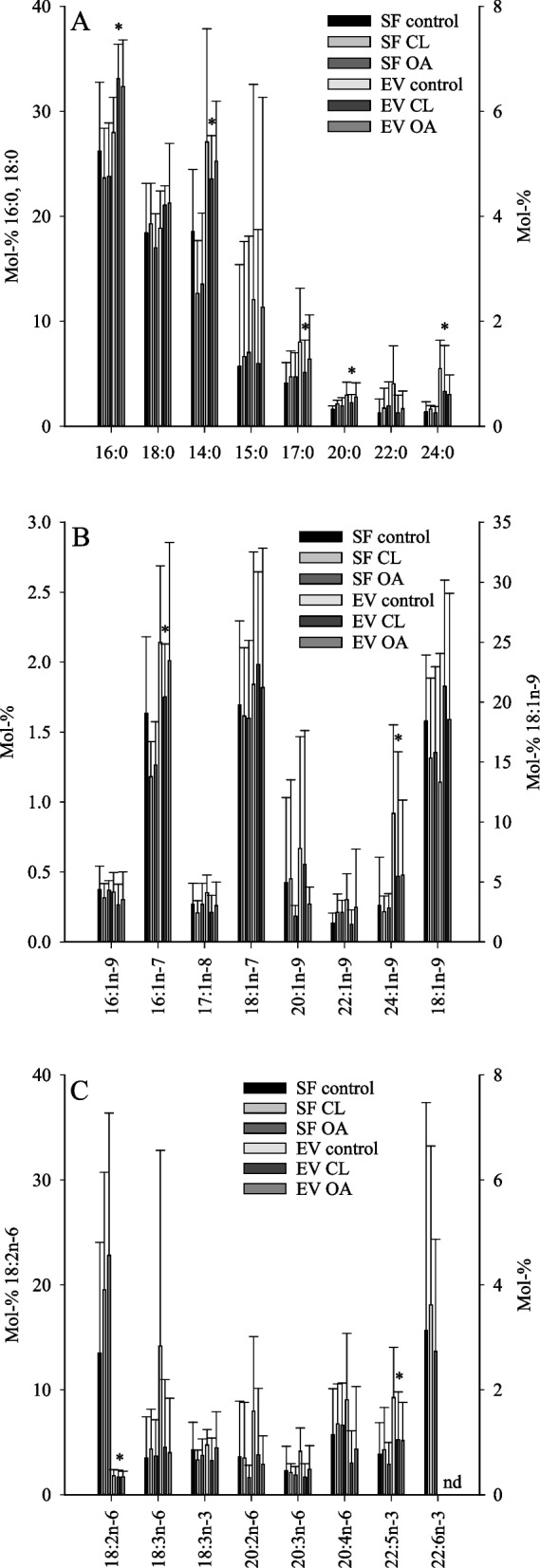
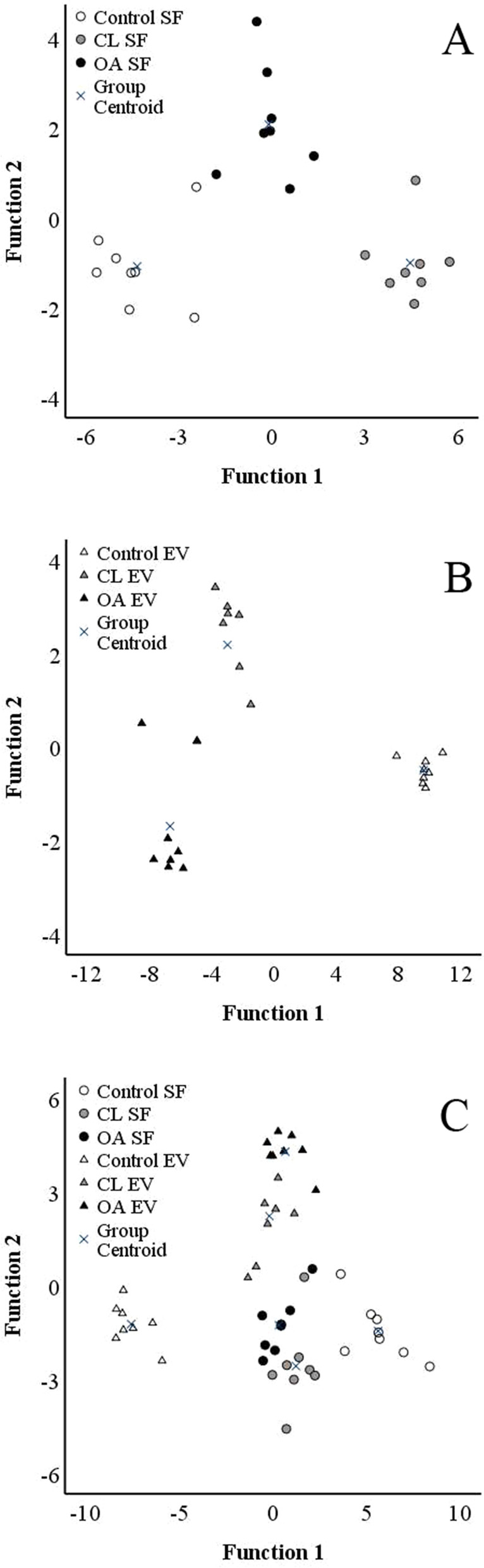
The data revealed distinct FA profiles in SF and its EV-enriched pellet that were modified by naturally occurring equine OA. Regarding SFs, linoleic acid (generalized linear model, p = 0.0006), myristic acid (p = 0.003), palmitoleic acid (p < 0.0005), and n-3/n-6 polyunsaturated FA ratio (p < 0.0005) were among the important variables that separated OA from control samples. In EV-enriched pellets, saturated FAs palmitic acid (p = 0.020), stearic acid (p = 0.002), and behenic acid (p = 0.003) indicated OA. The observed FA modifications are potentially detrimental and could contribute to inflammatory processes and cartilage degradation in OA.
Equine OA joints can be distinguished from normal joints based on their FA signatures in SF and its EV-enriched pellet. Clarifying the roles of SF and EV FA compositions in the pathogenesis of OA and their potential as joint disease biomarkers and therapeutic targets warrants future studies.
具有促炎或双重抗炎和促解决特性的个体脂肪酸(FA)及其衍生物(脂质介质)有可能影响关节组织的健康。骨关节炎(OA)是一种与年龄相关的慢性关节疾病,其特征是患者滑液(SF)中的 FA 组成发生改变。细胞外囊泡(EVs)的计数和货物,即滑膜关节细胞释放的膜结合颗粒,并运输生物活性脂质,也可以被 OA 改变。SF 及其 EV 的详细 FA 特征在马中仍未得到探索-这是 OA 研究的公认兽医模型。
本研究的目的是比较对照、对侧和 OA 掌指关节(n = 8/组)的马 SF 和超离心 EV 级分中的 FA 谱。通过气相色谱法测定总脂质的 FA 谱,并通过单变量和多变量分析进行比较。
数据显示,SF 和富含 EV 的沉淀中的 FA 谱明显不同,这是由自然发生的马 OA 引起的。关于 SF,亚油酸(广义线性模型,p = 0.0006)、肉豆蔻酸(p = 0.003)、棕榈油酸(p < 0.0005)和 n-3/n-6 多不饱和 FA 比(p < 0.0005)是区分 OA 与对照样本的重要变量。在富含 EV 的沉淀中,饱和 FA 棕榈酸(p = 0.020)、硬脂酸(p = 0.002)和山嵛酸(p = 0.003)表明 OA。观察到的 FA 修饰可能是有害的,并可能导致 OA 中的炎症过程和软骨降解。
可以根据 SF 和富含 EV 的沉淀中的 FA 特征区分马 OA 关节和正常关节。阐明 SF 和 EV FA 组成在 OA 发病机制中的作用及其作为关节疾病生物标志物和治疗靶点的潜力需要进一步研究。