Institute of Reproductive Health, Tongji Medical College, Huazhong University of Science and Technology, Wuhan, China.
Department of Urology, Union Hospital, Tongji Medical College, Huazhong University of Science and Technology, Wuhan, China.
Front Immunol. 2023 Feb 21;14:1139450. doi: 10.3389/fimmu.2023.1139450. eCollection 2023.
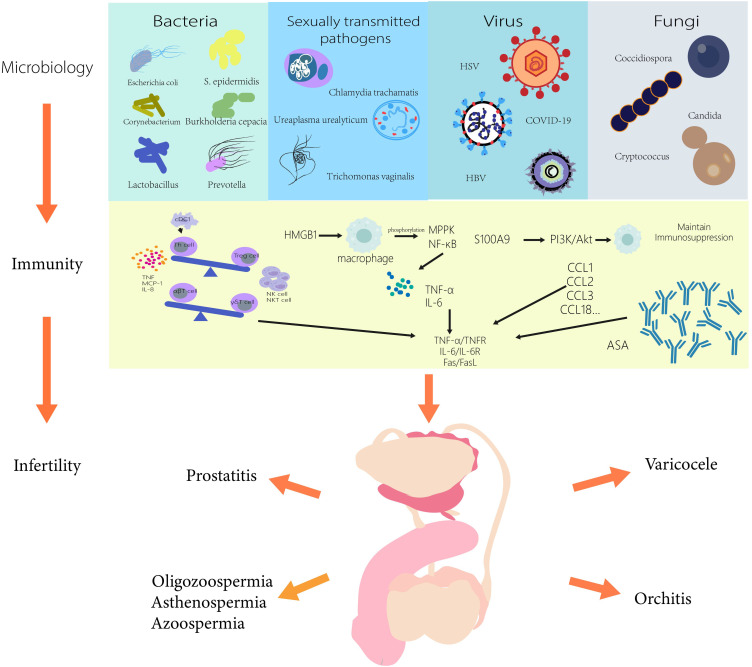
Up to 50% of infertility is caused by the male side. Varicocele, orchitis, prostatitis, oligospermia, asthenospermia, and azoospermia are common causes of impaired male reproductive function and male infertility. In recent years, more and more studies have shown that microorganisms play an increasingly important role in the occurrence of these diseases. This review will discuss the microbiological changes associated with male infertility from the perspective of etiology, and how microorganisms affect the normal function of the male reproductive system through immune mechanisms. Linking male infertility with microbiome and immunomics can help us recognize the immune response under different disease states, providing more targeted immune target therapy for these diseases, and even the possibility of combined immunotherapy and microbial therapy for male infertility.
高达 50%的不孕是由男性引起的。精索静脉曲张、睾丸炎、前列腺炎、少精症、弱精症和无精症是男性生殖功能障碍和男性不育的常见原因。近年来,越来越多的研究表明,微生物在这些疾病的发生中起着越来越重要的作用。本文将从病因学的角度讨论与男性不育相关的微生物变化,以及微生物如何通过免疫机制影响男性生殖系统的正常功能。将男性不育与微生物组学和免疫组学联系起来,可以帮助我们认识不同疾病状态下的免疫反应,为这些疾病提供更有针对性的免疫靶向治疗,甚至为男性不育提供联合免疫治疗和微生物治疗的可能性。