Laboratory of Clinical Microbiology, KU Leuven, Herestraat 49, 3000, Leuven, Belgium.
Department of General Internal Medicine, University Hospitals Leuven, Herestraat 49, 3000, Leuven, Belgium.
Nat Commun. 2023 Mar 11;14(1):1332. doi: 10.1038/s41467-023-36986-z.
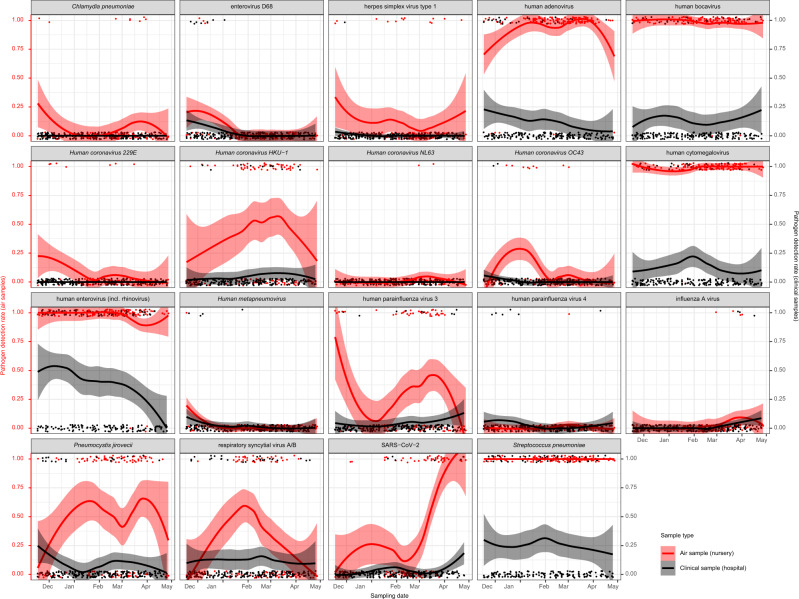
Currently, the real-life impact of indoor climate, human behaviour, ventilation and air filtration on respiratory pathogen detection and concentration are poorly understood. This hinders the interpretability of bioaerosol quantification in indoor air to surveil respiratory pathogens and transmission risk. We tested 341 indoor air samples from 21 community settings in Belgium for 29 respiratory pathogens using qPCR. On average, 3.9 pathogens were positive per sample and 85.3% of samples tested positive for at least one. Pathogen detection and concentration varied significantly by pathogen, month, and age group in generalised linear (mixed) models and generalised estimating equations. High CO and low natural ventilation were independent risk factors for detection. The odds ratio for detection was 1.09 (95% CI 1.03-1.15) per 100 parts per million (ppm) increase in CO, and 0.88 (95% CI 0.80-0.97) per stepwise increase in natural ventilation (on a Likert scale). CO concentration and portable air filtration were independently associated with pathogen concentration. Each 100ppm increase in CO was associated with a qPCR Ct value decrease of 0.08 (95% CI -0.12 to -0.04), and portable air filtration with a 0.58 (95% CI 0.25-0.91) increase. The effects of occupancy, sampling duration, mask wearing, vocalisation, temperature, humidity and mechanical ventilation were not significant. Our results support the importance of ventilation and air filtration to reduce transmission.
目前,室内气候、人类行为、通风和空气过滤对呼吸病原体检测和浓度的实际影响还了解甚少。这阻碍了室内空气中生物气溶胶定量检测以监测呼吸病原体和传播风险的可解释性。我们使用 qPCR 检测了比利时 21 个社区环境的 341 个室内空气样本中的 29 种呼吸道病原体。平均而言,每个样本中有 3.9 种病原体呈阳性,85.3%的样本至少有一种呈阳性。在广义线性(混合)模型和广义估计方程中,病原体检测和浓度因病原体、月份和年龄组而异。高 CO 和低自然通风是检测的独立危险因素。CO 每增加 100ppm,检测的比值比为 1.09(95%置信区间 1.03-1.15),自然通风每增加一步(Likert 量表),检测的比值比为 0.88(95%置信区间 0.80-0.97)。CO 浓度和便携式空气过滤与病原体浓度独立相关。CO 增加 100ppm 与 qPCR Ct 值降低 0.08(95%置信区间 -0.12 至 -0.04)相关,便携式空气过滤与 qPCR Ct 值降低 0.58(95%置信区间 0.25-0.91)相关。占用率、采样持续时间、戴口罩、发声、温度、湿度和机械通风的影响并不显著。我们的结果支持通风和空气过滤对于减少传播的重要性。