Data, Analytics, and Surveillance Group, UK Health Security Agency (Formerly part of the Joint Biosecurity Centre, Department of Health and Social Care), London, SW1P 3JR, UK.
Department of Physics and Astronomy, University College London, London, WC1E 6BT, UK.
Nat Commun. 2022 Jul 25;13(1):4313. doi: 10.1038/s41467-022-31753-y.
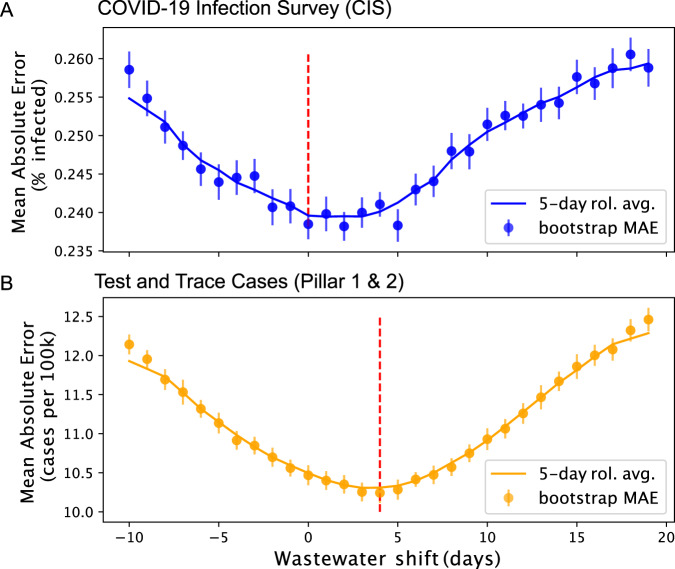
Accurate surveillance of the COVID-19 pandemic can be weakened by under-reporting of cases, particularly due to asymptomatic or pre-symptomatic infections, resulting in bias. Quantification of SARS-CoV-2 RNA in wastewater can be used to infer infection prevalence, but uncertainty in sensitivity and considerable variability has meant that accurate measurement remains elusive. Here, we use data from 45 sewage sites in England, covering 31% of the population, and estimate SARS-CoV-2 prevalence to within 1.1% of estimates from representative prevalence surveys (with 95% confidence). Using machine learning and phenomenological models, we show that differences between sampled sites, particularly the wastewater flow rate, influence prevalence estimation and require careful interpretation. We find that SARS-CoV-2 signals in wastewater appear 4-5 days earlier in comparison to clinical testing data but are coincident with prevalence surveys suggesting that wastewater surveillance can be a leading indicator for symptomatic viral infections. Surveillance for viruses in wastewater complements and strengthens clinical surveillance, with significant implications for public health.
对 COVID-19 大流行的准确监测可能因病例漏报而减弱,特别是由于无症状或症状前感染,导致出现偏差。污水中 SARS-CoV-2 RNA 的定量检测可用于推断感染流行率,但由于敏感性存在不确定性且变化较大,因此准确测量仍然难以实现。在这里,我们使用了来自英格兰 45 个污水监测点的数据,覆盖了 31%的人口,并将 SARS-CoV-2 的流行率估计值与代表性流行率调查的估计值相差在 1.1%以内(置信区间为 95%)。我们使用机器学习和现象学模型表明,采样点之间的差异,特别是污水流量,会影响流行率的估计值,需要谨慎解释。我们发现,与临床检测数据相比,污水中的 SARS-CoV-2 信号提前 4-5 天出现,但与流行率调查结果一致,表明污水监测可以作为有症状病毒感染的先行指标。污水中的病毒监测与临床监测相辅相成,对公共卫生具有重要意义。