Cao Linping, Wang Qing, Hong Jiawei, Han Yuzhe, Zhang Weichen, Zhong Xun, Che Yongqian, Ma Yaqi, Du Keyi, Wu Dongyan, Pang Tianxiao, Wu Jian, Liang Kewei
Division of Hepatobiliary and Pancreatic Surgery, Department of Surgery, First Affiliated Hospital, School of Medicine, Zhejiang University, Hangzhou 310003, China.
Key Laboratory of Combined Multi-Organ Transplantation, Ministry of Public Health, Hangzhou 310003, China.
Cancers (Basel). 2023 Feb 28;15(5):1538. doi: 10.3390/cancers15051538.
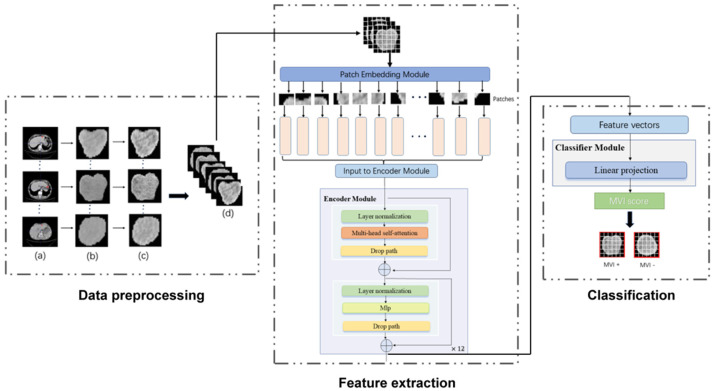
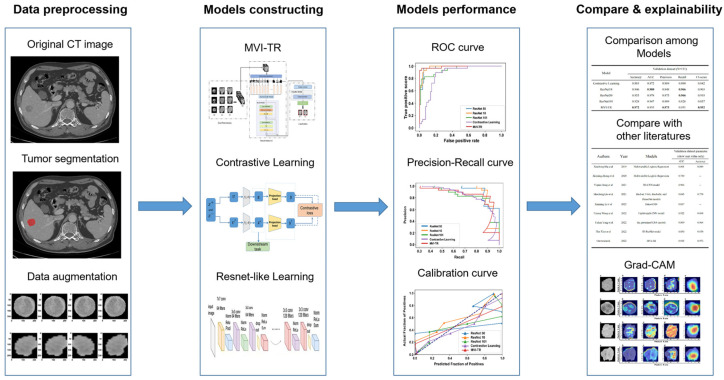
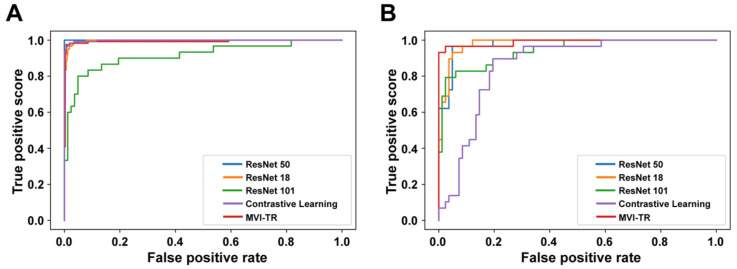
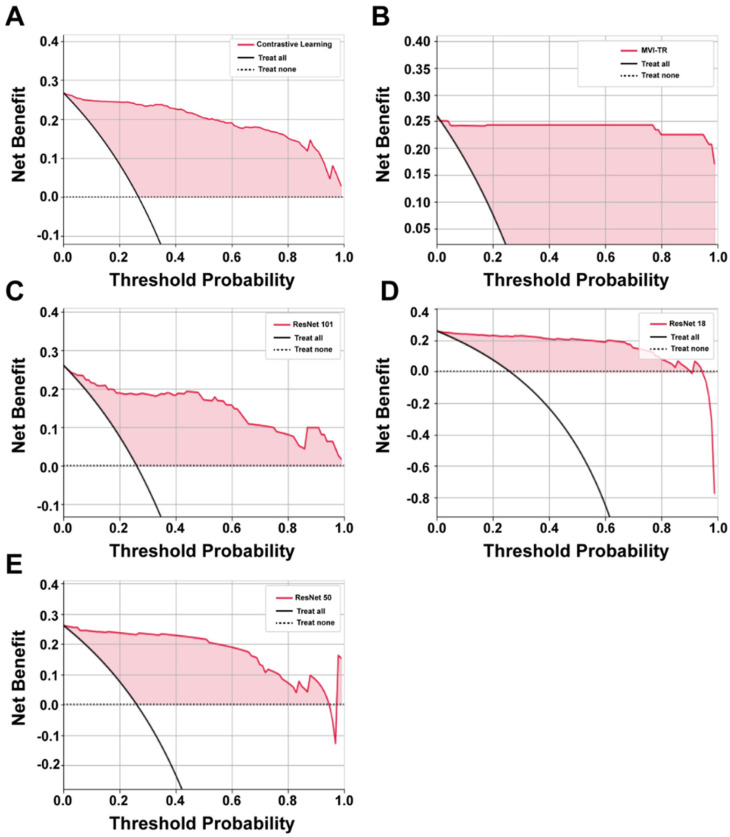
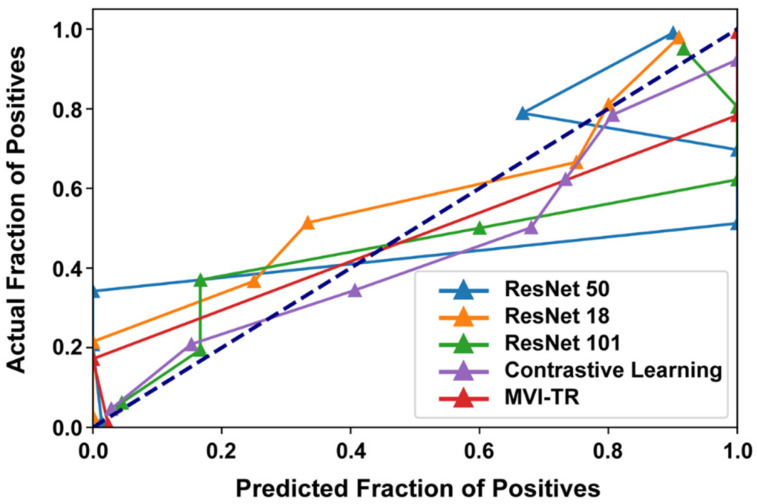
In this study, we considered preoperative prediction of microvascular invasion (MVI) status with deep learning (DL) models for patients with early-stage hepatocellular carcinoma (HCC) (tumor size ≤ 5 cm). Two types of DL models based only on venous phase (VP) of contrast-enhanced computed tomography (CECT) were constructed and validated. From our hospital (First Affiliated Hospital of Zhejiang University, Zhejiang, P.R. China), 559 patients, who had histopathological confirmed MVI status, participated in this study. All preoperative CECT were collected, and the patients were randomly divided into training and validation cohorts at a ratio of 4:1. We proposed a novel transformer-based end-to-end DL model, named MVI-TR, which is a supervised learning method. MVI-TR can capture features automatically from radiomics and perform MVI preoperative assessments. In addition, a popular self-supervised learning method, the contrastive learning model, and the widely used residual networks (ResNets family) were constructed for fair comparisons. With an accuracy of 99.1%, a precision of 99.3%, an area under the curve (AUC) of 0.98, a recalling rate of 98.8%, and an F1-score of 99.1% in the training cohort, MVI-TR achieved superior outcomes. Additionally, the validation cohort's MVI status prediction had the best accuracy (97.2%), precision (97.3%), AUC (0.935), recalling rate (93.1%), and F1-score (95.2%). MVI-TR outperformed other models for predicting MVI status, and showed great preoperative predictive value for early-stage HCC patients.
在本研究中,我们考虑使用深度学习(DL)模型对早期肝细胞癌(HCC)(肿瘤大小≤5 cm)患者的微血管侵犯(MVI)状态进行术前预测。构建并验证了仅基于对比增强计算机断层扫描(CECT)静脉期(VP)的两种DL模型。来自我院(浙江大学医学院附属第一医院,中国浙江)的559例经组织病理学确诊MVI状态的患者参与了本研究。收集了所有患者的术前CECT,并将患者以4:1的比例随机分为训练组和验证组。我们提出了一种基于新型变压器的端到端DL模型,名为MVI-TR,这是一种监督学习方法。MVI-TR可以从放射组学中自动提取特征,并进行MVI术前评估。此外,为了进行公平比较,构建了一种流行的自监督学习方法、对比学习模型以及广泛使用的残差网络(ResNets家族)。在训练组中,MVI-TR的准确率为99.1%,精确率为99.3%,曲线下面积(AUC)为0.98,召回率为98.8%,F1分数为99.1%,取得了优异的结果。此外,验证组的MVI状态预测具有最佳的准确率(97.2%)、精确率(97.3%)、AUC(0.935)、召回率(93.1%)和F1分数(95.2%)。MVI-TR在预测MVI状态方面优于其他模型,对早期HCC患者具有很大的术前预测价值。