Makarova Anastasiya O, Derkach Svetlana R, Khair Tahar, Kazantseva Mariia A, Zuev Yuriy F, Zueva Olga S
Kazan Institute of Biochemistry and Biophysics, FRC Kazan Scientific Center of RAS, Lobachevsky St., 2/31, 420111 Kazan, Russia.
Institute of Natural Science and Technology, Murmansk State Technical University, Sportivnaya Str. 13, 183010 Murmansk, Russia.
Polymers (Basel). 2023 Feb 28;15(5):1243. doi: 10.3390/polym15051243.
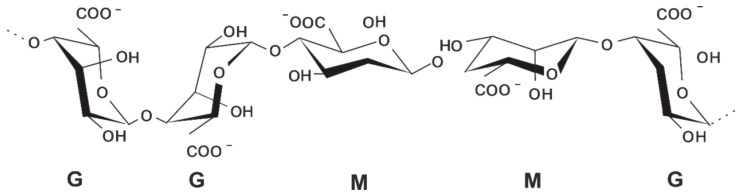
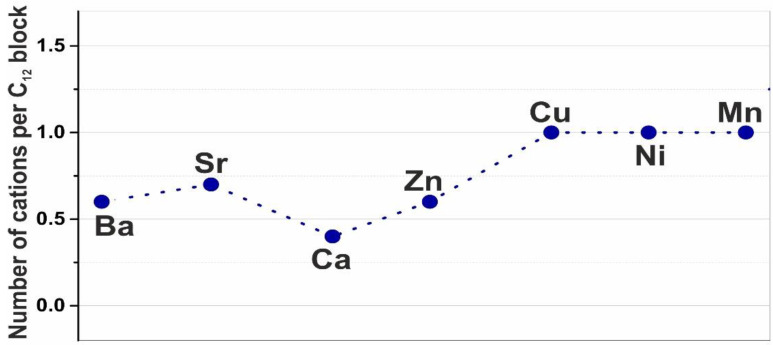
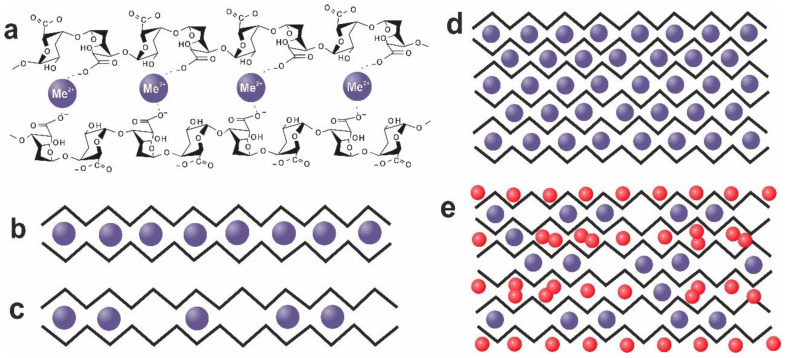
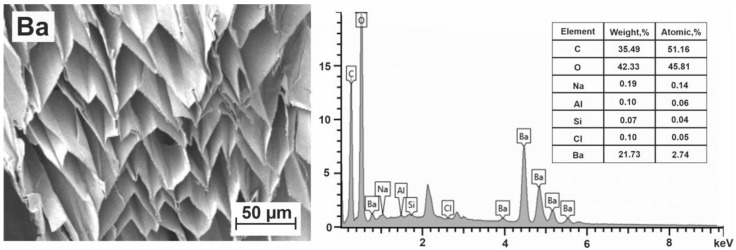
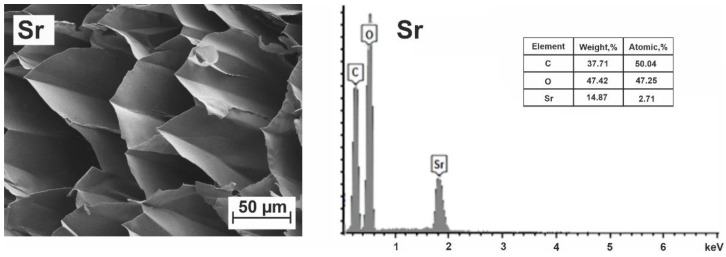
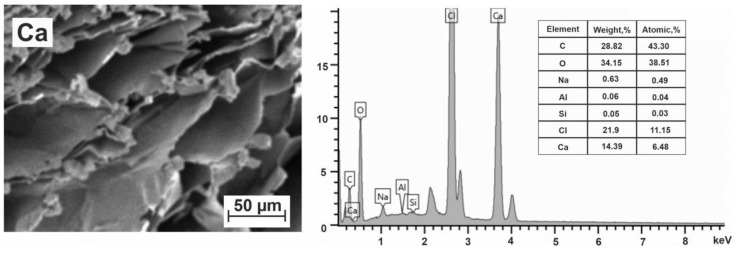
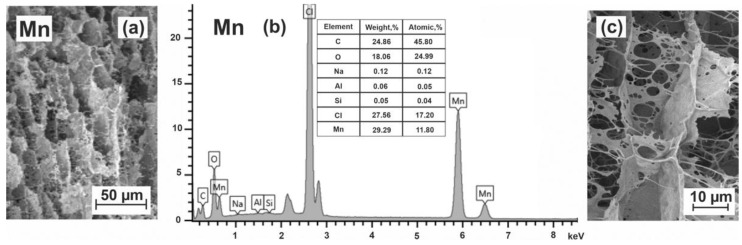
Structural aspects of polysaccharide hydrogels based on sodium alginate and divalent cations Ba, Ca, Sr, Cu, Zn, Ni and Mn was studied using data on hydrogel elemental composition and combinatorial analysis of the primary structure of alginate chains. It was shown that the elemental composition of hydrogels in the form of freezing dried microspheres gives information on the structure of junction zones in the polysaccharide hydrogel network, the degree of filling of egg-box cells by cations, the type and magnitude of the interaction of cations with alginate chains, the most preferred types of alginate egg-box cells for cation binding and the nature of alginate dimers binding in junction zones. It was ascertained that metal-alginate complexes have more complicated organization than was previously desired. It was revealed that in metal-alginate hydrogels, the number of cations of various metals per C12 block may be less than the limiting theoretical value equal to 1 for completely filled cells. In the case of alkaline earth metals and zinc, this number is equal to 0.3 for calcium, 0.6 for barium and zinc and 0.65-0.7 for strontium. We have determined that in the presence of transition metals copper, nickel and manganese, a structure similar to an egg-box is formed with completely filled cells. It was determined that in nickel-alginate and copper-alginate microspheres, the cross-linking of alginate chains and formation of ordered egg-box structures with completely filled cells are carried out by hydrated metal complexes with complicated composition. It was found that an additional characteristic of complex formation with manganese cations is the partial destruction of alginate chains. It has been established that the existence of unequal binding sites of metal ions with alginate chains can lead to the appearance of ordered secondary structures due to the physical sorption of metal ions and their compounds from the environment. It was shown that hydrogels based on calcium alginate are most promising for absorbent engineering in environmental and other modern technologies.
基于海藻酸钠和二价阳离子钡、钙、锶、铜、锌、镍和锰的多糖水凝胶的结构方面,利用水凝胶元素组成数据和海藻酸链一级结构的组合分析进行了研究。结果表明,冷冻干燥微球形式的水凝胶元素组成提供了有关多糖水凝胶网络中连接区结构、阳离子对蛋盒单元的填充程度、阳离子与海藻酸链相互作用的类型和大小、阳离子结合的最优选海藻酸蛋盒单元类型以及连接区中海藻酸二聚体结合性质的信息。已确定金属 - 海藻酸盐配合物具有比先前预期更复杂的组织。结果表明,在金属 - 海藻酸盐水凝胶中,每个C12块中各种金属阳离子的数量可能小于完全填充单元的极限理论值1。对于碱土金属和锌,钙的这个数字等于0.3,钡和锌为0.6,锶为0.65 - 0.7。我们已经确定,在过渡金属铜、镍和锰存在的情况下,会形成类似于蛋盒的结构,且单元完全填充。已确定在镍 - 海藻酸盐和铜 - 海藻酸盐微球中,海藻酸链的交联以及具有完全填充单元的有序蛋盒结构的形成是由组成复杂的水合金属配合物进行的。发现与锰阳离子形成配合物的另一个特征是海藻酸链的部分破坏。已经确定,由于金属离子及其化合物从环境中的物理吸附,金属离子与海藻酸链存在不等的结合位点会导致有序二级结构的出现。结果表明,基于海藻酸钙的水凝胶在环境和其他现代技术中的吸收剂工程方面最有前景。