Da Fonseca Leonardo G, Uratani Lucas Fernando, Soares Gabriella Fernandes, Do Amaral Paulo Siqueira, De Souza Melo Alencar Regiane Saraiva, Chagas Aline Lopes, Alves Venancio Avancini Ferreira, Carrilho Flair Jose
Department of Oncology, ICESP - Institute of Cancer of Sao Paulo, University of Sao Paulo School of Medicine, 01246-000 Sao Paulo-SP, Brazil.
Sao Paulo Clínicas Liver Cancer Group, University of São Paulo School of Medicine, 01246-000 Sao Paulo-SP, Brazil.
Mol Clin Oncol. 2023 Feb 21;18(4):29. doi: 10.3892/mco.2023.2625. eCollection 2023 Apr.
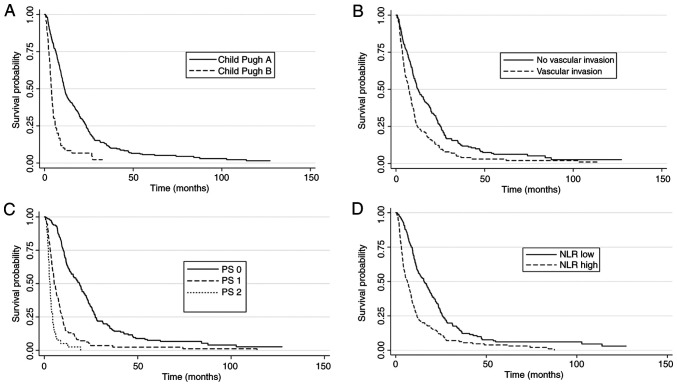
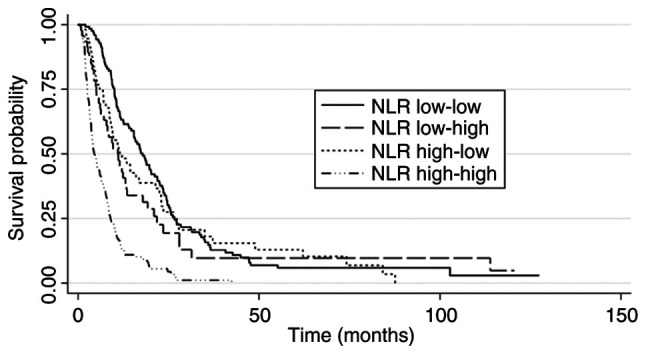
Prognostic markers in advanced hepatocellular carcinoma (HCC) are relevant for clinical decisions. Variations in inflammatory indexes, such as neutrophil-to-lymphocyte ratio (NLR) or platelet-to-lymphocyte ratio (PLR), may correlate with outcomes. In the present study, it was aimed to assess the prognostic role of inflammation indexes in patients with HCC and the evolutionary behavior of these variables within the first month of treatment in a cohort of patients treated with sorafenib from 2009-2021. Subgroups were divided based on the median of each variable ('low' or 'high)'. Survival was estimated using the Kaplan-Meier method. Hazard Ratio (HR) with 95% confidence interval (CI) were estimated using Cox regression models. A total of 373 patients were included, most Child-Pugh-A (83.1%) and BCLC-C (74%). Child-Pugh-A (P=0.011), performance status 0 (P<0.001), no ascites (P<0.001) and NLR<2.6 (P<0.001) were independently associated with improved survival. Baseline PLR was not correlated with survival (P=0.137). Patients who maintained low NLR at baseline and at 1 month (reference subgroup) had improved survival (18.6 months, 95% CI:15.4-22.0) compared with the subgroup that maintained high NLR at baseline and at 1 month (4.2 months, 95% CI:3.6-5.9), with HR: 3.80 (95% CI: 2.89-4.96). The subgroup with low NLR at baseline and high NLR at 1 month had a worse prognosis compared with the reference group (HR:1.4, 95% CI: 1.1-2.0), whereas the subgroup with high NLR at baseline and low at 1 month had similar outcome (HR:1.2, 95% CI: 0.8-1.6). It was concluded that evolutionary variation of NLR has a prognostic role in HCC patients under systemic therapy. This finding suggested that systemic inflammation and early modulation of the immune environment during treatment may correlate with outcomes.
晚期肝细胞癌(HCC)的预后标志物与临床决策相关。炎症指标的变化,如中性粒细胞与淋巴细胞比值(NLR)或血小板与淋巴细胞比值(PLR),可能与预后相关。在本研究中,旨在评估炎症指标在HCC患者中的预后作用,以及在2009年至2021年接受索拉非尼治疗的一组患者中,这些变量在治疗后第一个月内的演变行为。根据每个变量的中位数(“低”或“高”)进行亚组划分。使用Kaplan-Meier方法估计生存率。使用Cox回归模型估计95%置信区间(CI)的风险比(HR)。共纳入373例患者,大多数为Child-Pugh-A级(83.1%)和BCLC-C期(74%)。Child-Pugh-A级(P=0.011)、体能状态0(P<0.001)、无腹水(P<0.001)和NLR<2.6(P<0.001)与生存率提高独立相关。基线PLR与生存率无关(P=0.137)。与在基线和1个月时维持高NLR的亚组(4.2个月,95%CI:3.6-5.9)相比,在基线和1个月时维持低NLR的患者(参考亚组)生存率更高(18.6个月,95%CI:15.4-22.0),HR为3.80(95%CI:2.89-4.96)。与参考组相比,基线时NLR低而1个月时NLR高的亚组预后较差(HR:1.4,95%CI:1.1-2.0),而基线时NLR高而1个月时NLR低的亚组预后相似(HR:1.2,95%CI:0.8-1.6)。得出结论,NLR的演变变化在接受全身治疗的HCC患者中具有预后作用。这一发现表明,全身炎症和治疗期间免疫环境的早期调节可能与预后相关。