Institute of Biomedical Engineering, University of Toronto, Toronto, ON, Canada.
KITE, Toronto Rehabilitation Institute, University Health Network, Toronto, ON, Canada.
Neurorehabil Neural Repair. 2023 Feb-Mar;37(2-3):142-150. doi: 10.1177/15459683231159663. Epub 2023 Mar 13.
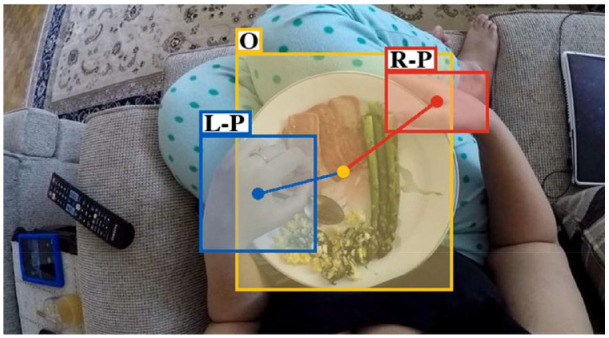
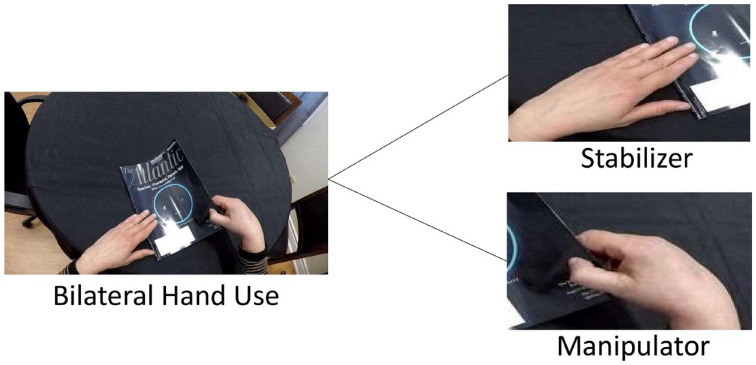
Evaluating upper limb (UL) interventions after stroke calls for outcome measures that describe impact on daily life in the community. UL use ratio has been used to quantify the performance domain of UL function, but generally focuses on arm use only. A hand use ratio could provide additional information about UL function after stroke. Additionally, a ratio based on the role of the more-affected hand in bilateral activities (stabilizer or manipulator) may also reflect hand function recovery. Egocentric video is a novel modality that can record both dynamic and static hand use and hand roles at home after stroke.
To validate hand use and hand role ratios from egocentric video against standardized clinical UL assessments.
Twenty-four stroke survivors recorded daily tasks in a home simulation laboratory and their daily routines at home using egocentric cameras. Spearman's correlation was used to compare the ratios with the Fugl-Meyer Assessment-Upper Extremity (FMA-UE), Action Research Arm Test (ARAT), and Motor Activity Log-30 (MAL, Amount of Use (AoU), and Quality of Movement (QoM)).
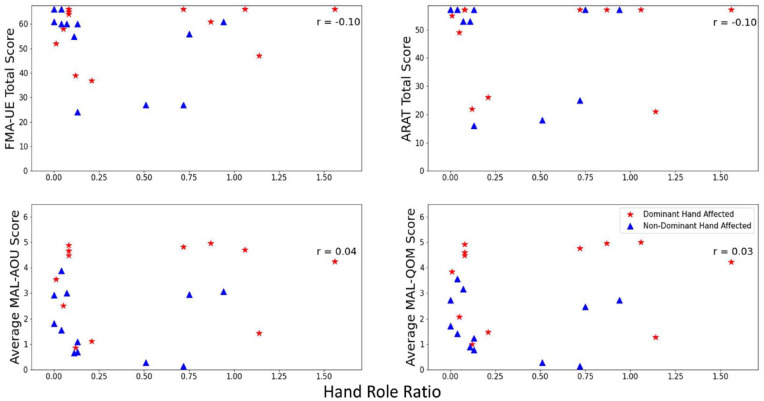
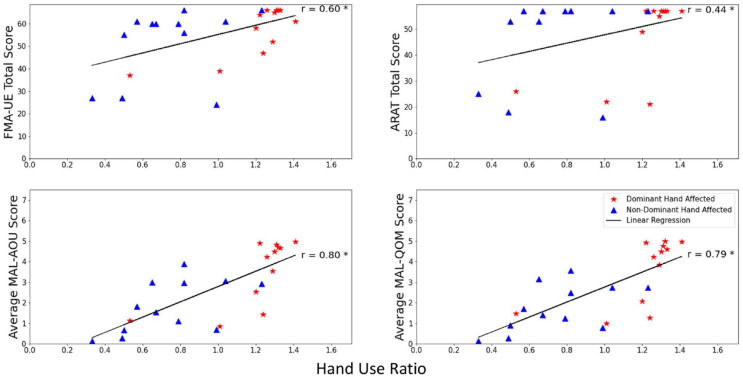
Hand use ratio significantly correlated with the FMA-UE (0.60, 95% CI: 0.26, 0.81), ARAT (0.44, CI: 0.04, 0.72), MAL-AoU (0.80, CI: 0.59, 0.91), and MAL-QoM (0.79, CI: 0.57, 0.91). Hand role ratio had no significant correlations with the assessments.
Hand use ratio automatically extracted from egocentric video, but not hand role ratio, was found to be a valid measure of hand function performance in our sample. Further investigation is necessary to interpret hand role information.
评估脑卒中后的上肢(UL)干预措施需要使用能够描述社区日常生活影响的结果测量指标。UL 使用比例已用于量化 UL 功能的表现领域,但通常仅关注手臂使用。手使用比例可以提供脑卒中后 UL 功能的额外信息。此外,基于更受影响的手在双侧活动中的角色(稳定器或操纵器)的比例也可能反映手功能的恢复情况。自拍照是一种新颖的模式,可以在家中记录脑卒中后上肢的动态和静态使用以及手的角色。
验证自拍照中手使用和手角色比例与标准化的临床 UL 评估之间的关系。
24 名脑卒中幸存者在家模拟实验室中记录日常任务,并在家中使用自拍照记录日常活动。使用 Spearman 相关系数比较比例与 Fugl-Meyer 上肢评估(FMA-UE)、动作研究上肢测试(ARAT)和运动活动日志-30(MAL,使用量(AoU)和运动质量(QoM))的相关性。
手使用比例与 FMA-UE(0.60,95%CI:0.26,0.81)、ARAT(0.44,CI:0.04,0.72)、MAL-AoU(0.80,CI:0.59,0.91)和 MAL-QoM(0.79,CI:0.57,0.91)显著相关。手角色比例与评估无显著相关性。
从自拍照中自动提取的手使用比例,但不是手角色比例,被发现是我们样本中手功能表现的有效测量指标。需要进一步研究以解释手角色信息。