Department of Computer and Information Sciences, Graduate School of Engineering, Tokyo University of Agriculture and Technology, 2-24-16, Naka-cho, Koganei, Tokyo, Japan.
Department of Rehabilitation, Shonan Keiiku Hospital, 4360, Endo, Fujisawa, Kanagawa, Japan.
J Neuroeng Rehabil. 2023 Jun 6;20(1):73. doi: 10.1186/s12984-023-01199-4.
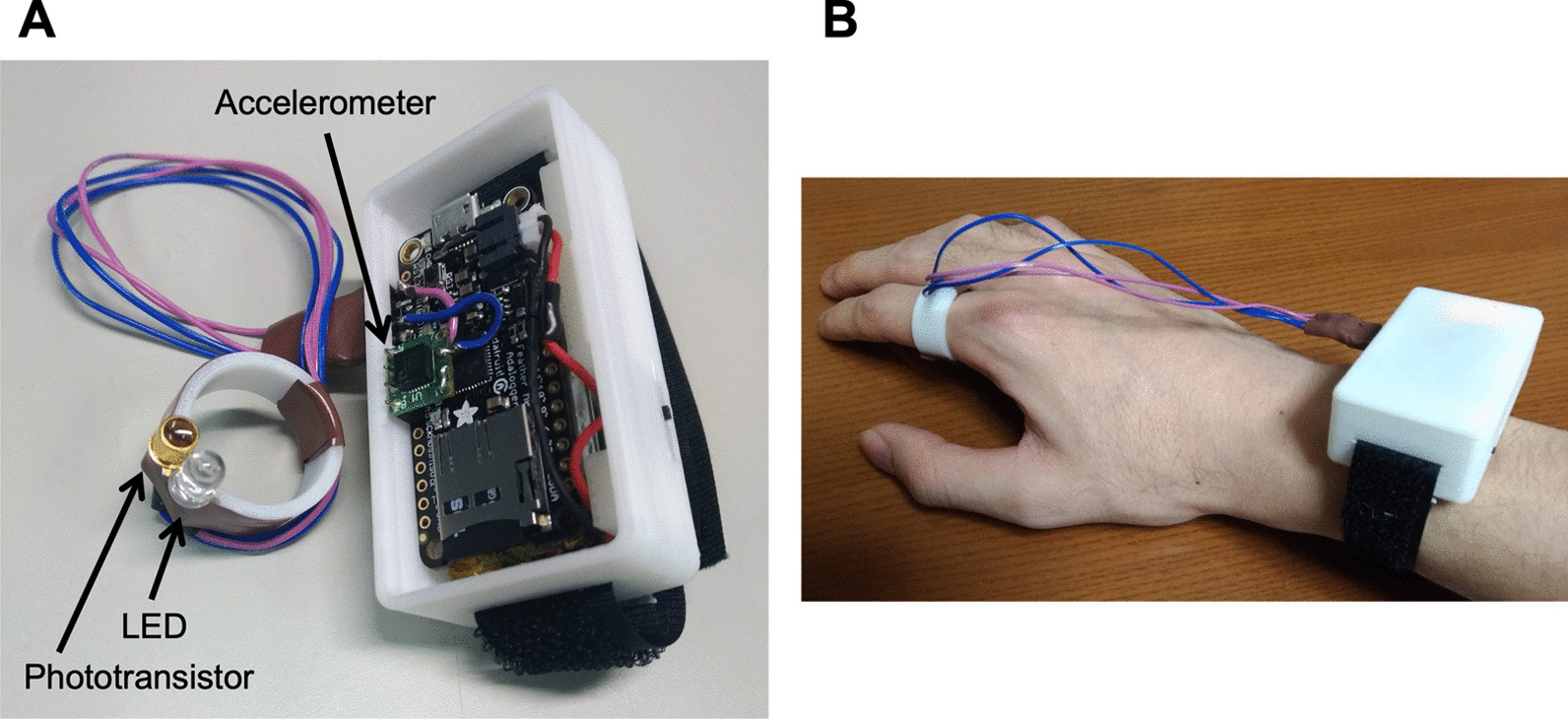
In post-stroke rehabilitation, positive use of affected limbs in daily life is important to improve affected upper-limb function. Several studies have quantitatively evaluated the amount of upper-limb activity, but few have measured finger usage. In this study, we used a ring-shaped wearable device to measure upper-limb and finger usage simultaneously in hospitalized patients with hemiplegic stroke and investigated the association between finger usage and general clinical evaluation.
Twenty patients with hemiplegic stroke in an inpatient hospital participated in this study. All patients wore a ring-shaped wearable device on both hands for 9 h on the day of the intervention, and their finger and upper-limb usage were recorded. For the rehabilitation outcome assessments, the Fugl-Meyer Assessment of the Upper Extremity (FMA-UE), Simple Test for Evaluating Hand Function (STEF), Action Research Arm Test (ARAT), Motor Activity Log-14 (MAL), and Functional Independence Measure Motor (FIM-m) were performed and evaluated on the same day as the intervention.
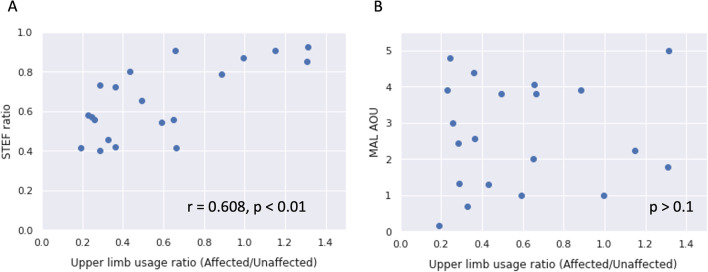
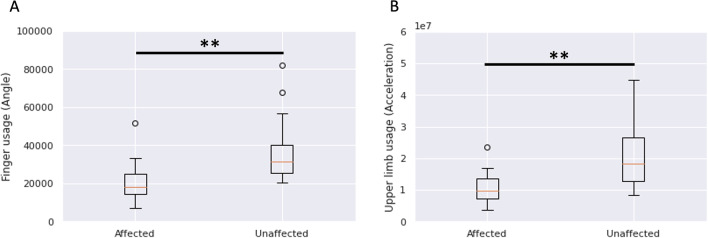
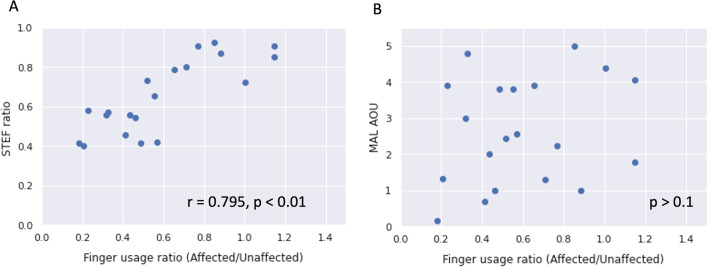
Finger usage of the affected hand was moderately correlated with STEF ([Formula: see text], [Formula: see text]) and STEF ratio ([Formula: see text], [Formula: see text]). The finger-usage ratio was moderately correlated with FMA-UE ([Formula: see text], [Formula: see text]) and ARAT ([Formula: see text], [Formula: see text]), and strongly correlated with STEF ([Formula: see text], [Formula: see text]) and STEF ratio ([Formula: see text], [Formula: see text]). The upper-limb usage of the affected side was moderately correlated with FMA-UE ([Formula: see text], [Formula: see text]), STEF ([Formula: see text], [Formula: see text]) and STEF ratio ([Formula: see text], [Formula: see text]), and strongly correlated with ARAT ([Formula: see text], [Formula: see text]). The upper-limb usage ratio was moderately correlated with ARAT ([Formula: see text], [Formula: see text]) and STEF ([Formula: see text], [Formula: see text]), and strongly correlated with the STEF ratio ([Formula: see text], [Formula: see text]). By contrast, there was no correlation between MAL and any of the measurements.
This measurement technique provided useful information that was not biased by the subjectivity of the patients and therapists.
在脑卒中后的康复中,积极使用患侧肢体进行日常生活活动对于改善患侧上肢功能非常重要。有几项研究已经对上肢活动量进行了定量评估,但很少有研究测量手指的使用情况。本研究使用一种环状可穿戴设备同时测量住院脑卒中偏瘫患者的上肢和手指使用情况,并探讨了手指使用与一般临床评估之间的关系。
20 名住院脑卒中偏瘫患者参与了本研究。所有患者在干预当天双手佩戴环状可穿戴设备 9 小时,记录手指和上肢的使用情况。在康复效果评估中,在干预当天同时进行 Fugl-Meyer 上肢评估(FMA-UE)、简易上肢功能测试(STEF)、动作研究臂测试(ARAT)、运动日志 14 项(MAL)和功能性独立性测量运动(FIM-m)。
患手的手指使用与 STEF([公式:见文本],[公式:见文本])和 STEF 比值([公式:见文本],[公式:见文本])中度相关。手指使用比率与 FMA-UE([公式:见文本],[公式:见文本])和 ARAT([公式:见文本],[公式:见文本])中度相关,与 STEF([公式:见文本],[公式:见文本])和 STEF 比值([公式:见文本],[公式:见文本])高度相关。患侧上肢使用与 FMA-UE([公式:见文本],[公式:见文本])、STEf([公式:见文本],[公式:见文本])和 STEF 比值([公式:见文本],[公式:见文本])中度相关,与 ARAT([公式:见文本],[公式:见文本])高度相关。上肢使用比率与 ARAT([公式:见文本],[公式:见文本])和 STEF([公式:见文本],[公式:见文本])中度相关,与 STEF 比值([公式:见文本],[公式:见文本])高度相关。相比之下,MAL 与任何测量值均无相关性。
这种测量技术提供了有用的信息,不受患者和治疗师主观性的影响。