
磁共振超短回波时间成像评估膝关节非钙化软骨及其损伤的价值。
The value of magnetic resonance ultrashort echo time imaging to evaluate non-calcified cartilage of the knee joint and its damage.
作者信息
Hu Yawen, Xu Jun, Zhou Ruizhi, Xu Qi, Sun Shiqing, Wang Wenzhe, Chen Haisong
机构信息
Department of Radiology, The Affliated Hospital of Qingdao University Qingdao, 266003, China.
Department of Joint Surgery, The Affliated Hospital of Qingdao University Qingdao, 266003, China.
出版信息
Heliyon. 2023 Mar 1;9(3):e14120. doi: 10.1016/j.heliyon.2023.e14120. eCollection 2023 Mar.
OBJECTIVES
To image knee osteochondral specimens using magnetic resonance (MR) ultrashort echo time imaging with pointwise encoding time reduction with radial acquisition combined fat suppression (PETRA-FS) sequence to determine whether it can reveal non-calcified cartilage, including the deep radial layer, and to assess its effectiveness in cartilage damage diagnosis.
MATERIALS AND METHODS
PETRA-FS imaging was performed on 58 osteochondral specimens of the lower femur and upper tibia to observe depth of cartilage damage, combined with histological results to observe signal intensity composition. Sensitivity, specificity, and reliability of PETRA-FS sequence for diagnosing cartilage damage were evaluated using histological results as the gold standard. Diagnostic efficacy was assessed using receiver operating characteristic (ROC) curve.
RESULTS
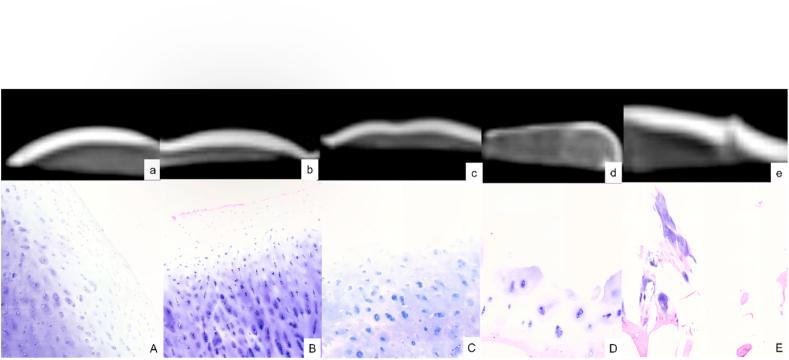
MR ultrashort echo time imaging PETRA-FS sequence showed non-calcified cartilage, including tangential, transitional, and radial layers, which showed a high signal. PETRA-FS sequence showed 37 cases of cartilage damage and 21 cases of no damage among 58 specimens, kappa value of 0.75. Histological analysis of the 58 osteochondral specimens revealed 38 cases of cartilage injury and 20 cases of undamaged cartilage. Using histological results as the gold standard, PETRA-FS sequence had a sensitivity of 87.00%, specificity of 80.00%, kappa value of 0.81, and an area under the ROC curve (AUC) of 0.83 for cartilage injury diagnosis.
CONCLUSION
MR ultrashort echo time imaging PETRA-FS sequence can show non-calcified cartilage, including the deep radial layer (which cannot be shown by conventional MR), by exhibiting a high signal in knee osteo-chondral specimens. Thus, PETRA-FS sequences may have important diagnostic value for cartilage injury diagnosis.
目的
使用磁共振(MR)超短回波时间成像结合径向采集的逐点编码时间缩短和脂肪抑制(PETRA-FS)序列对膝关节骨软骨标本进行成像,以确定其是否能显示包括深层放射状层在内的非钙化软骨,并评估其在软骨损伤诊断中的有效性。
材料与方法
对58个股骨远端和胫骨近端的骨软骨标本进行PETRA-FS成像,观察软骨损伤深度,并结合组织学结果观察信号强度组成。以组织学结果为金标准,评估PETRA-FS序列诊断软骨损伤的敏感性、特异性和可靠性。使用受试者操作特征(ROC)曲线评估诊断效能。
结果
MR超短回波时间成像PETRA-FS序列显示了包括切线层、过渡层和放射状层在内的非钙化软骨,呈高信号。在58个标本中,PETRA-FS序列显示37例软骨损伤和21例无损伤,kappa值为0.75。对58个骨软骨标本的组织学分析显示38例软骨损伤和20例未损伤的软骨。以组织学结果为金标准,PETRA-FS序列对软骨损伤诊断的敏感性为87.00%,特异性为80.00%,kappa值为0.81,ROC曲线下面积(AUC)为0.83。
结论
MR超短回波时间成像PETRA-FS序列通过在膝关节骨软骨标本中呈现高信号,可显示包括深层放射状层(传统MR无法显示)在内的非钙化软骨。因此,PETRA-FS序列在软骨损伤诊断中可能具有重要的诊断价值。


 Zotero 插件