Department of Orthopedic Surgery, Nagoya University Graduate School of Medicine, Nagoya, Japan.
Department of Orthopedic Surgery, National Center for Geriatrics and Gerontology, Obu, Japan.
Nagoya J Med Sci. 2023 Feb;85(1):103-112. doi: 10.18999/nagjms.85.1.103.
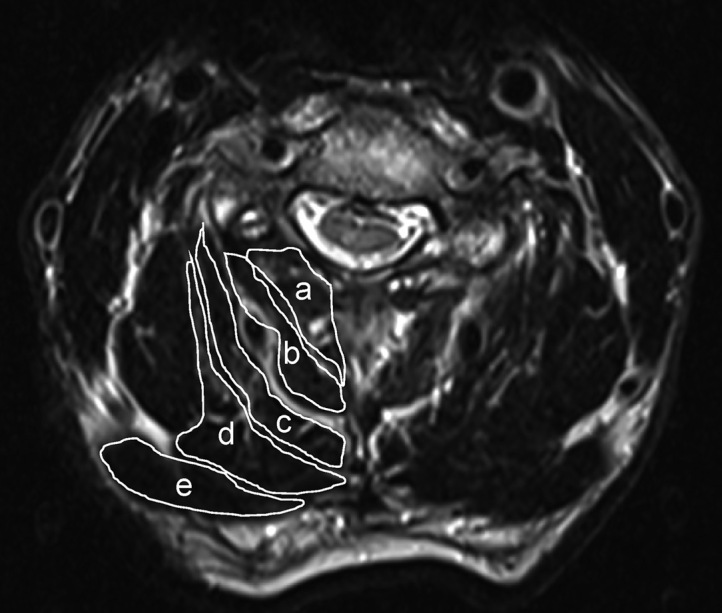
Cervical laminoplasty is a safe and effective treatment for cervical myelopathy. However, it has a higher frequency of postoperative axial pain than other methods. A variety of causes of postoperative axial pain have been reported, but these have not been fully elucidated. This study aimed to investigate the association between postoperative axial pain and changes in the posterior neck muscles before and after surgery. The study included 93 patients with cervical myelopathy who underwent surgery at our institute between June 2010 and March 2013. The patients with greater preoperative and 1-year postoperative neck pain visual analog scale scores comprised the neck pain group. The cross-sectional area of the cervical posterior extensor muscles and the trapezius muscle were measured by magnetic resonance imaging before and 1 year after surgery at the C3/4, C4/5, and C5/6 levels to compare with neck pain. The total cross-sectional area atrophy rate (C3/C4, C4/C5, and C5/C6) of the trapezius muscle was significantly larger in patients with neck pain (12.8 ± 13.2) than in those without (6.2 ± 14.4; p<0.05). The cross-sectional area atrophy rate of the trapezius muscle at only the C5/6 level was significantly higher in patients with neck pain (16.7 ± 11.7) compared to those without (3.3 ± 14.4; p<0.001). No significant differences were found in the cross-sectional areas of the cervical posterior extensor muscles. Trapezius atrophy, especially at the lower cervical vertebrae, was associated with neck pain after cervical laminoplasty.
颈椎板成形术是治疗颈椎病的一种安全有效的方法。然而,它的术后轴性疼痛发生率高于其他方法。术后轴性疼痛的多种原因已被报道,但尚未完全阐明。本研究旨在探讨手术前后颈后肌群变化与术后轴性疼痛的关系。研究纳入了 2010 年 6 月至 2013 年 3 月在我院接受手术治疗的 93 例颈椎病患者。术前和术后 1 年颈部疼痛视觉模拟评分较高的患者为颈部疼痛组。通过 MRI 测量术前和术后 1 年 C3/4、C4/5 和 C5/6 水平颈椎后伸肌和斜方肌的横截面积,与颈部疼痛进行比较。颈部疼痛组的斜方肌总横截面积萎缩率(C3/C4、C4/C5 和 C5/C6)显著大于无颈部疼痛组(12.8 ± 13.2)(p<0.05)。仅 C5/6 水平的斜方肌横截面积萎缩率在有颈部疼痛的患者中显著高于无颈部疼痛的患者(16.7 ± 11.7)(p<0.001)。颈椎后伸肌的横截面积无显著差异。斜方肌萎缩,尤其是在下颈椎,与颈椎板成形术后的颈部疼痛有关。