Lu Yi, Su Hao, Wang Yutao, Li Hongjun
Department of Urology, Peking Union Medical College, Peking Union Medical College Hospital, Chinese Academy of Medical Sciences, Beijing, China.
Front Nutr. 2023 Feb 27;10:1016243. doi: 10.3389/fnut.2023.1016243. eCollection 2023.
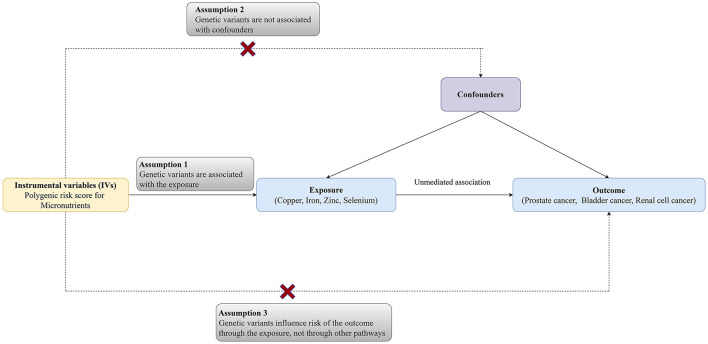
The effect of micronutrients on urologic cancers has been explored in observational studies. We conducted the two-sample mendelian randomization (TSMR) study to investigate whether micronutrients could causally influence the risk of urologic cancers.
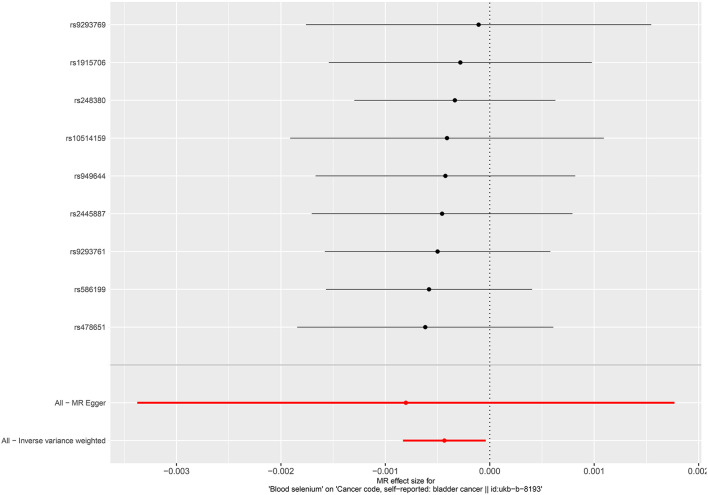
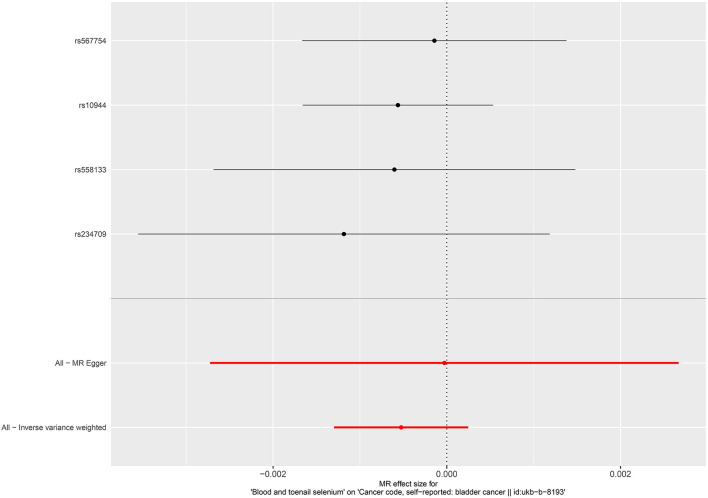
Summary statistics for four micronutrients and three main urologic cancers outcomes were obtained from genome-wide association studies (GWAS). MR analyses were applied to explore the potential causal association between them. Sensitivity analyses using multiple methods were also conducted.
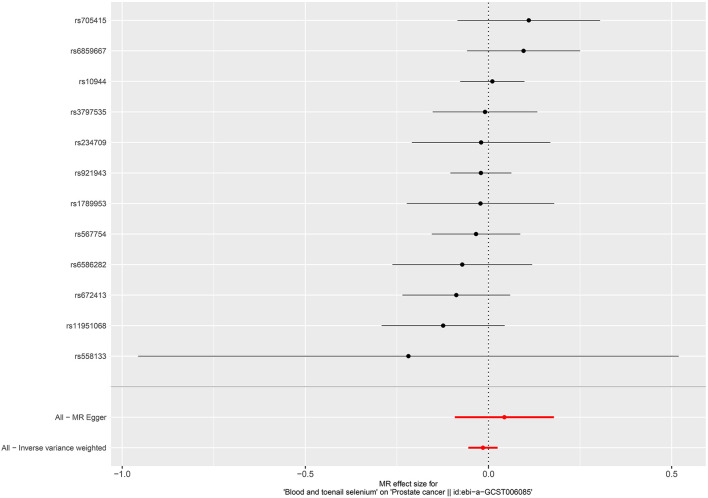
Genetically predicted one SD increase in serum copper and iron concentrations was causally associated with increased risks of renal cell carcinoma (RCC) (OR = 3.021, 95%CI = 2.204-4.687, < 0.001, male; OR = 2.231, 95%CI = 1.524-3.953, < 0.001, female; OR = 1.595, 95%CI = 1.310-1.758, = 0.0238, male; OR = 1.484, 95%CI = 1.197-2.337, = 0.0210, female, respectively) and per SD increase in serum zinc levels was related to decreased risks of RCC (OR = 0.131, 95%CI = 0.0159-0.208, < 0.001, male; OR = 0.124, 95%CI = 0.0434-0.356, < 0.001, female). No significant results were observed between micronutrients and the risk of bladder cancer after Bonferroni correction. Additionally, per SD increase in serum zinc level was associated with a 5.8% higher risk of prostate cancer (PCa) [OR = 1.058, 95%CI = 1.002-1.116, = 0.0403, inverse-variance weight (IVW)].
Micronutrients play a vital role in the development of urological tumors. Future studies are required to replicate the findings, explore the underlying mechanisms, and examine the preventive or therapeutic role of micronutrients in clinical settings.
在观察性研究中已探讨了微量营养素对泌尿系统癌症的影响。我们进行了两项样本孟德尔随机化(TSMR)研究,以调查微量营养素是否会因果性地影响泌尿系统癌症的风险。
从全基因组关联研究(GWAS)中获取了四种微量营养素和三种主要泌尿系统癌症结局的汇总统计数据。应用孟德尔随机化分析来探索它们之间的潜在因果关联。还使用多种方法进行了敏感性分析。
遗传预测血清铜和铁浓度每增加一个标准差与肾细胞癌(RCC)风险增加存在因果关联(男性:OR = 3.021,95%CI = 2.204 - 4.687,P < 0.001;女性:OR = 2.231,95%CI = 1.524 - 3.9,53,P < 0.001;男性:OR = 1.595,95%CI = 1.310 - 1.758,P = 0.0238;女性:OR = 1.484,95%CI = 1.197 - 2.337,P = 0.0210),血清锌水平每增加一个标准差与RCC风险降低相关(男性:OR = 0.131,95%CI = 0.0159 - 0.208,P < 0.001;女性:OR = 0.124,95%CI = 0.0434 - 0.356,P < 0.001)。经Bonferroni校正后,未观察到微量营养素与膀胱癌风险之间的显著结果。此外,血清锌水平每增加一个标准差与前列腺癌(PCa)风险高5.8%相关[OR = 1.058,95%CI = 1.002 - 1.116,P = 0.0403,逆方差加权(IVW)]。
微量营养素在泌尿系统肿瘤的发生发展中起着至关重要的作用。未来需要进行研究以重复这些发现,探索潜在机制,并在临床环境中检验微量营养素的预防或治疗作用。