Cullen Nicholas C, Janelidze Shorena, Stomrud Erik, Bateman Randall J, Palmqvist Sebastian, Hansson Oskar, Mattsson-Carlgren Niklas
Clinical Memory Research Unit, Department of Clinical Sciences Malmö, Faculty of Medicine, Lund University, 202 13 Lund, Sweden.
Memory Clinic, Skåne University Hospital, 205 02 Malmö, Sweden.
Brain Commun. 2023 Jan 24;5(2):fcad015. doi: 10.1093/braincomms/fcad015. eCollection 2023.
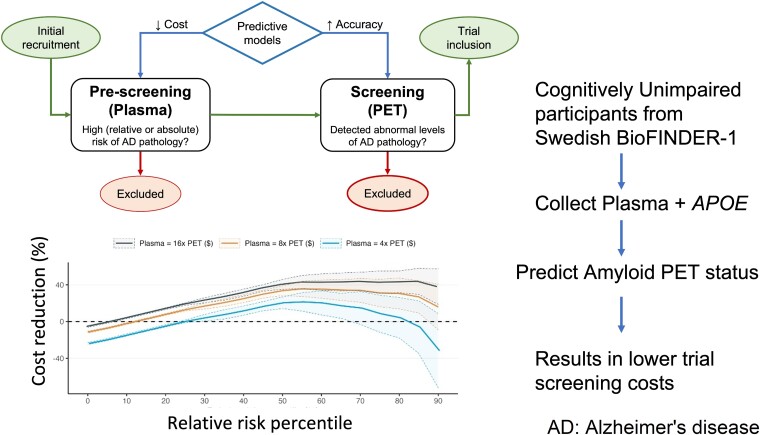
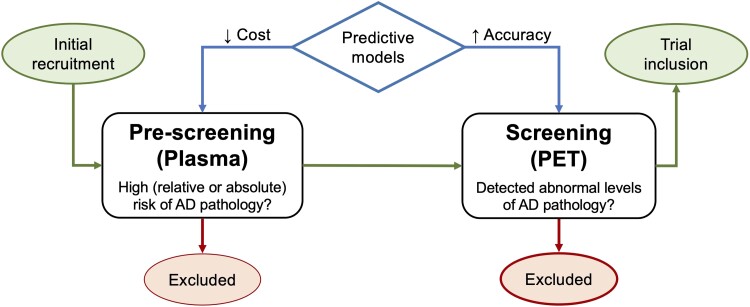
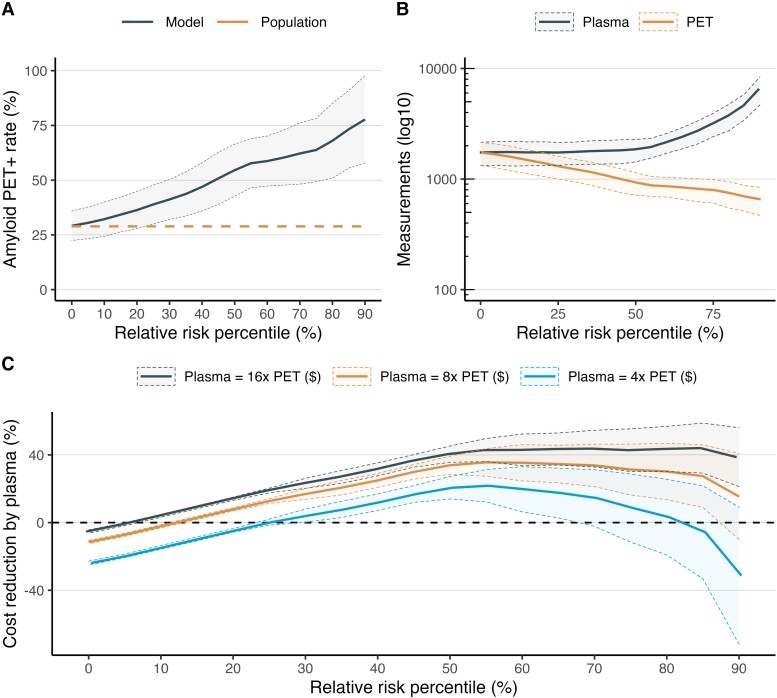
The extent to which newly developed blood-based biomarkers could reduce screening costs in secondary prevention trials of Alzheimer's disease is mostly unexplored. We collected plasma amyloid-β42/40, apolipoprotein E ε4 status and amyloid PET at baseline in 181 cognitively unimpaired participants [the age of 72.9 (5.3) years; 61.9% female; education of 11.9 (3.4) years] from the Swedish BioFINDER-1 study. We tested whether a model predicting amyloid PET status from plasma amyloid-β42/40, apolipoprotein E status and age (combined) reduced cost of recruiting amyloid PET + cognitively unimpaired participants into a theoretical trial. We found that the percentage of cognitively unimpaired participants with an amyloid PET + scan rose from 29% in an unscreened population to 64% [(49, 79); < 0.0001] when using the biomarker model to screen for high risk for amyloid PET + status. In simulations, plasma screening also resulted in a 54% reduction of the total number of amyloid PET scans required and reduced total recruitment costs by 43% [(31, 56), < 0.001] compared to no pre-screening when assuming a 16× PET-to-plasma cost ratio. Total savings remained significant when the PET-to-plasma cost ratio was assumed to be 8× or 4×. This suggests that a simple plasma biomarker model could lower recruitment costs in Alzheimer's trials requiring amyloid PET positivity for inclusion.
新开发的血液生物标志物在阿尔茨海默病二级预防试验中能在多大程度上降低筛查成本,这一点大多尚未得到探索。我们从瑞典BioFINDER - 1研究中收集了181名认知未受损参与者(年龄为72.9[5.3]岁;61.9%为女性;受教育年限为11.9[3.4]年)基线时的血浆淀粉样蛋白β42/40、载脂蛋白E ε4状态和淀粉样蛋白PET数据。我们测试了一个从血浆淀粉样蛋白β 42/40、载脂蛋白E状态和年龄(综合)预测淀粉样蛋白PET状态的模型,是否能降低将淀粉样蛋白PET阳性且认知未受损的参与者招募到一项理论试验中的成本。我们发现,当使用生物标志物模型筛查淀粉样蛋白PET阳性的高风险人群时,认知未受损且淀粉样蛋白PET扫描阳性的参与者比例从未筛查人群中的29%升至64%[(49,79);<0.0001]。在模拟中,与不进行预筛查相比,假设PET与血浆成本比为16倍时,血浆筛查还使所需淀粉样蛋白PET扫描总数减少了54%,总招募成本降低了43%[(31,56),<0.001]。当假设PET与血浆成本比为8倍或4倍时,总节省仍然显著。这表明,一个简单的血浆生物标志物模型可以降低阿尔茨海默病试验中要求淀粉样蛋白PET呈阳性才能纳入的招募成本。