Lorman Vitaly, Rao Suchitra, Jhaveri Ravi, Case Abigail, Mejias Asuncion, Pajor Nathan M, Patel Payal, Thacker Deepika, Bose-Brill Seuli, Block Jason, Hanley Patrick C, Prahalad Priya, Chen Yong, Forrest Christopher B, Bailey L Charles, Lee Grace M, Razzaghi Hanieh
Applied Clinical Research Center, Children's Hospital of Philadelphia, Philadelphia, Pennsylvania, USA.
Department of Pediatrics, University of Colorado School of Medicine and Children's Hospital of Colorado, Aurora, Colorado, USA.
JAMIA Open. 2023 Mar 14;6(1):ooad016. doi: 10.1093/jamiaopen/ooad016. eCollection 2023 Apr.
Post-acute sequalae of SARS-CoV-2 infection (PASC) is not well defined in pediatrics given its heterogeneity of presentation and severity in this population. The aim of this study is to use novel methods that rely on data mining approaches rather than clinical experience to detect conditions and symptoms associated with pediatric PASC.
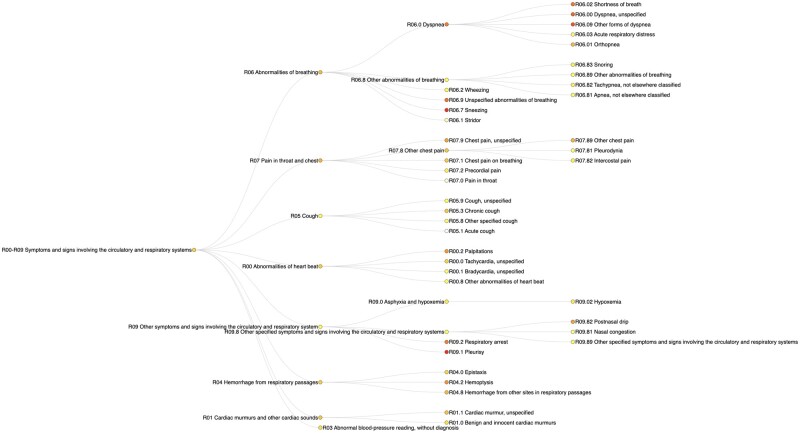
We used a propensity-matched cohort design comparing children identified using the new PASC ICD10CM diagnosis code (U09.9) ( = 1309) to children with ( = 6545) and without ( = 6545) SARS-CoV-2 infection. We used a tree-based scan statistic to identify potential condition clusters co-occurring more frequently in cases than controls.
We found significant enrichment among children with PASC in cardiac, respiratory, neurologic, psychological, endocrine, gastrointestinal, and musculoskeletal systems, the most significant related to circulatory and respiratory such as dyspnea, difficulty breathing, and fatigue and malaise.
Our study addresses methodological limitations of prior studies that rely on prespecified clusters of potential PASC-associated diagnoses driven by clinician experience. Future studies are needed to identify patterns of diagnoses and their associations to derive clinical phenotypes.
We identified multiple conditions and body systems associated with pediatric PASC. Because we rely on a data-driven approach, several new or under-reported conditions and symptoms were detected that warrant further investigation.
鉴于儿童群体中SARS-CoV-2感染的急性后遗症(PASC)表现和严重程度存在异质性,其在儿科领域尚未得到明确界定。本研究的目的是使用依赖数据挖掘方法而非临床经验的新方法,来检测与儿童PASC相关的病症和症状。
我们采用倾向匹配队列设计,将使用新的PASC ICD10CM诊断代码(U09.9)确定的儿童(n = 1309)与感染SARS-CoV-2的儿童(n = 6545)和未感染SARS-CoV-2的儿童(n = 6545)进行比较。我们使用基于树的扫描统计量来识别病例中比对照更频繁共现的潜在病症集群。
我们发现PASC患儿在心脏、呼吸、神经、心理、内分泌、胃肠和肌肉骨骼系统中存在显著富集,其中与循环和呼吸系统最相关的是呼吸困难、呼吸急促以及疲劳和不适。
我们的研究解决了先前研究的方法学局限性,这些研究依赖于由临床医生经验驱动的潜在PASC相关诊断的预先指定集群。未来需要开展研究以确定诊断模式及其关联,从而得出临床表型。
我们确定了与儿童PASC相关的多种病症和身体系统。由于我们采用数据驱动方法,检测到了一些新的或报告不足的病症和症状,值得进一步研究。