C.J. Gorter MRI Centre, Department of Radiology, Leiden University Medical Center, Leiden, The Netherlands.
Percuros B.V., Leiden, The Netherlands.
MAGMA. 2023 Jul;36(3):429-438. doi: 10.1007/s10334-023-01073-3. Epub 2023 Mar 18.
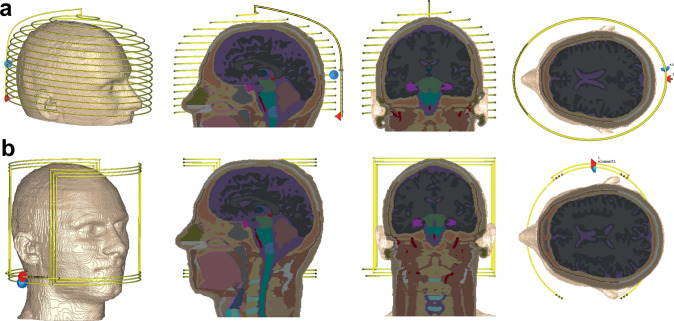
To simulate the magnetic and electric fields produced by RF coil geometries commonly used at low field. Based on these simulations, the specific absorption rate (SAR) efficiency can be derived to ensure safe operation even when using short RF pulses and high duty cycles.
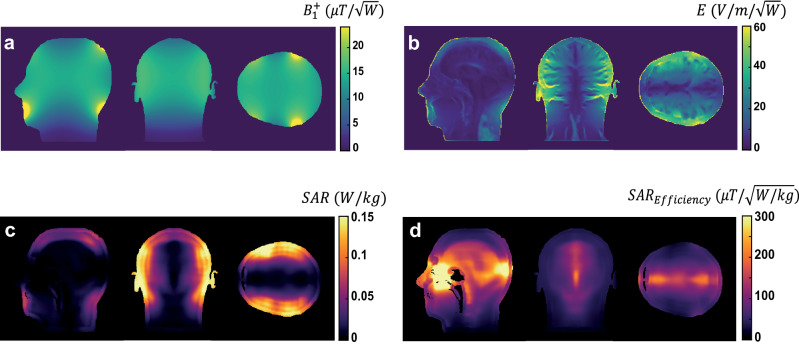
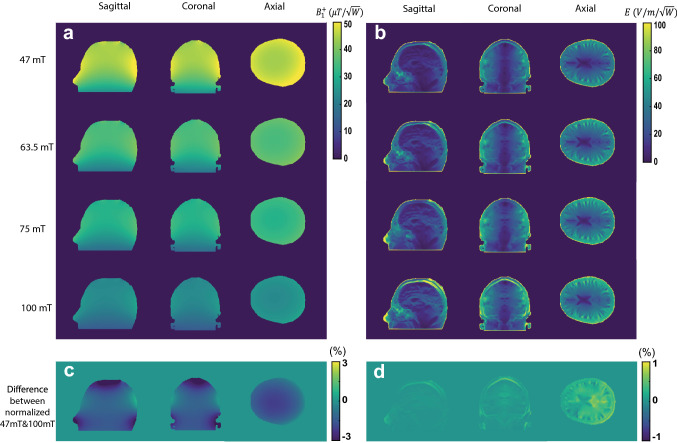
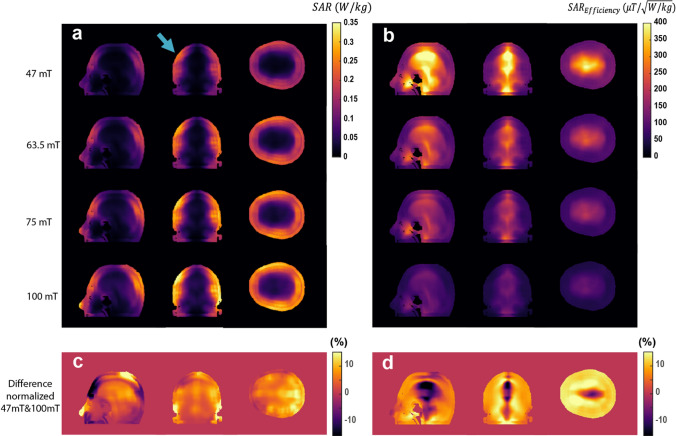
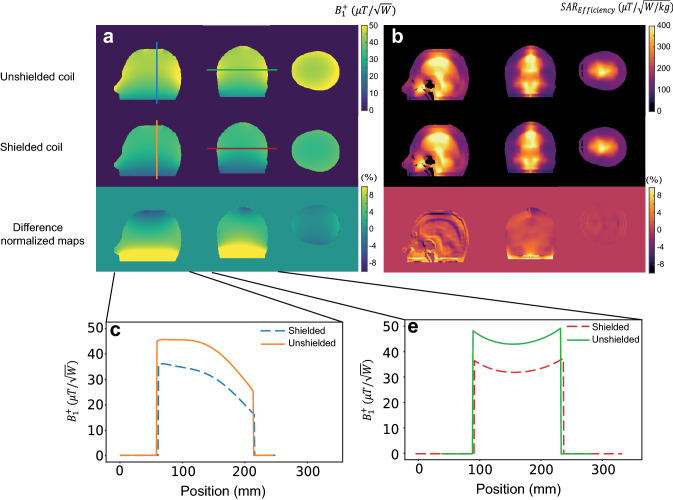
Electromagnetic simulations were performed at four different field strengths between 0.05 and 0.1 T, corresponding to the lower and upper limits of current point-of-care (POC) neuroimaging systems. Transmit magnetic and electric fields, as well as transmit efficiency and SAR efficiency were simulated. The effects of a close-fitting shield on the EM fields were also assessed. SAR calculations were performed as a function of RF pulse length in turbo-spin echo (TSE) sequences.
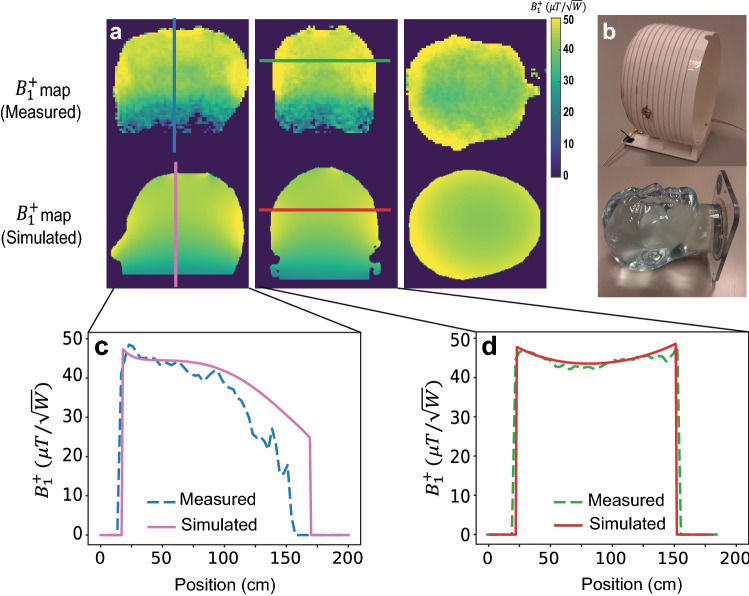
Simulations of RF coil characteristics and B transmit efficiencies agreed well with corresponding experimentally determined parameters. Overall, the SAR efficiency was, as expected, higher at the lower frequencies studied, and many orders of magnitude greater than at conventional clinical field strengths. The tight-fitting transmit coil results in the highest SAR in the nose and skull, which are not thermally sensitive tissues. The calculated SAR efficiencies showed that only when 180° refocusing pulses of duration ~ 10 ms are used for TSE sequences does SAR need to be carefully considered.
This work presents a comprehensive overview of the transmit and SAR efficiencies for RF coils used for POC MRI neuroimaging. While SAR is not a problem for conventional sequences, the values derived here should be useful for RF intensive sequences such as T, and also demonstrate that if very short RF pulses are required then SAR calculations should be performed.
模拟在低场中常用的射频线圈几何形状产生的磁场和电场。基于这些模拟,可以得出特定吸收率(SAR)效率,以确保即使使用短射频脉冲和高占空比也能安全运行。
在 0.05 到 0.1T 之间的四个不同场强下进行了电磁模拟,分别对应于当前即时护理(POC)神经成像系统的下限和上限。模拟了发射磁场和电场以及发射效率和 SAR 效率。还评估了紧贴屏蔽对 EM 场的影响。SAR 计算作为涡轮自旋回波(TSE)序列中射频脉冲长度的函数进行。
RF 线圈特性和 B 发射效率的模拟与相应的实验确定参数吻合良好。总体而言,SAR 效率在所研究的较低频率下较高,并且比传统临床场强高几个数量级。紧密贴合的发射线圈导致鼻子和颅骨中的 SAR 最高,而这些组织对热不敏感。计算出的 SAR 效率表明,只有当 TSE 序列使用持续时间约 10ms 的 180°重聚焦脉冲时,才需要仔细考虑 SAR。
本工作全面介绍了用于 POC MRI 神经成像的射频线圈的发射和 SAR 效率。虽然 SAR 对于常规序列不是问题,但这里得出的值对于 T 等射频密集序列应该是有用的,并且还表明,如果需要非常短的射频脉冲,则应进行 SAR 计算。