Department of Hematology, Radboudumc Medical Center, Geert Grooteplein Noord 21, 6525EZ, Nijmegen, The Netherlands.
Department of Primary and Community Care, Radboudumc Medical Center, Nijmegen, The Netherlands.
BMC Med Educ. 2023 Mar 18;23(1):169. doi: 10.1186/s12909-023-04103-9.
In order to best prepare medical students for their increasingly complex future career, interdisciplinary higher education is swiftly gaining popularity. However, the implementation of interdisciplinary learning in medical education is challenging. The present study deepens the understanding of the challenges and opportunities inherent to the implementation of an interdisciplinary course. We elucidated the attitudes and beliefs of students participating in a newly developed interdisciplinary minor, in which students of medicine (MS) and communication and information sciences (CISS) were involved.
We conducted four semi-structured focus group interviews, of which two were held before, and two were held after the course. Seven MS and six CISS participated voluntarily. A pre-arranged interview guide was used. The interviews were recorded and afterwards systematically analyzed with the 'constant comparative analysis' technique.
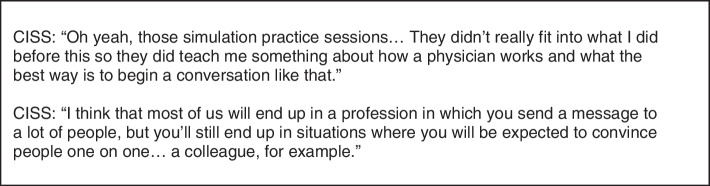
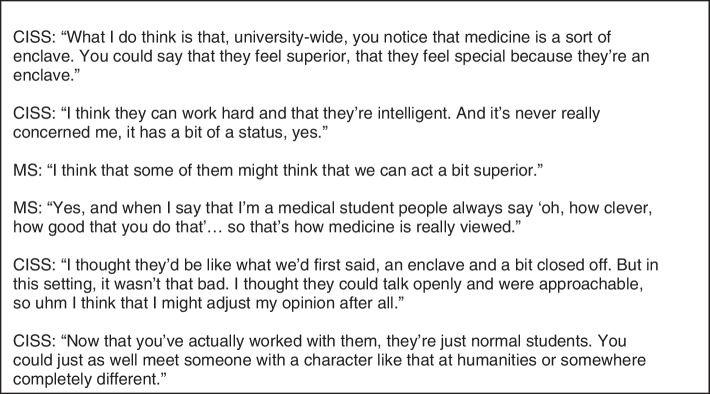
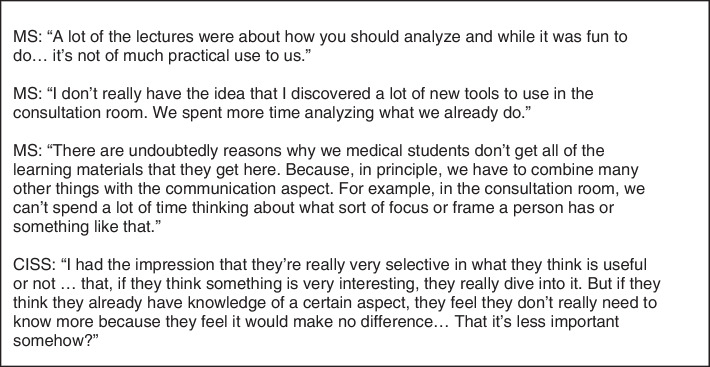
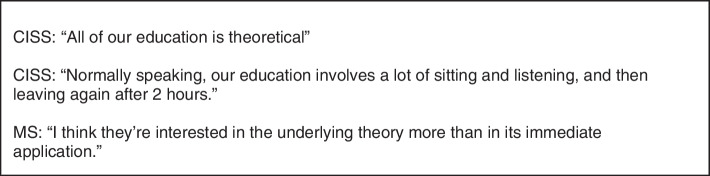
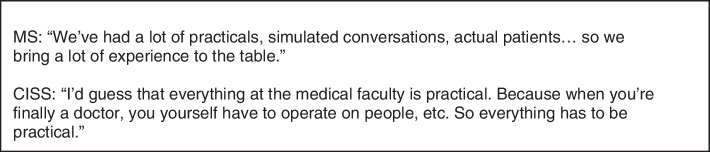
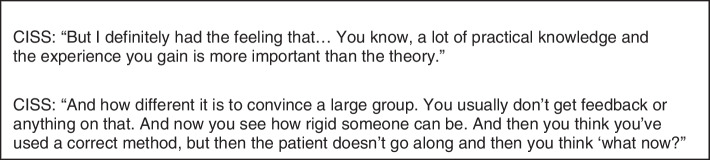
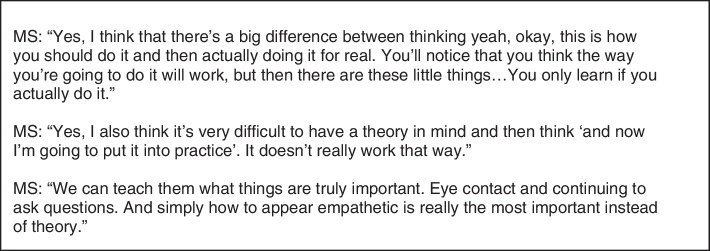
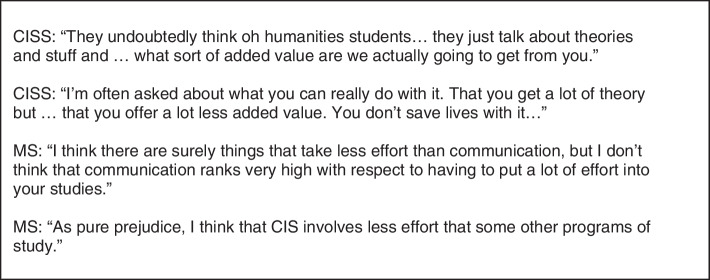
The focus group interviews revealed three differences in epistemics between students in terms of 1) curriculum content, 2) educational formats and 3) student's competence perceptions. These factors influenced the way students evaluated themselves, each other and the interdisciplinary course.
We conclude that factors that influence interdisciplinary learning are personal epistemics, individual learning preferences, and the synergy that is achieved throughout interdisciplinary learning. Organizing the dialogue among students of different disciplines could make students aware of inequalities, implicated biases and assigned status of different student groups. These empirical results are crucial to tailor interdisciplinary education to each specific discipline and to take interdisciplinary learning to a higher level of maturity.
为了让医学生为未来日益复杂的职业生涯做好最佳准备,跨学科高等教育正在迅速普及。然而,在医学教育中实施跨学科学习具有挑战性。本研究深入了解了在实施一门跨学科课程时所固有的挑战和机遇。我们阐明了参与新开发的跨学科辅修课程的学生的态度和信念,其中包括医学(MS)和传播与信息科学(CISS)的学生。
我们进行了四次半结构化焦点小组访谈,其中两次在课程之前进行,两次在课程之后进行。七名 MS 和六名 CISS 自愿参加。使用预先安排的访谈指南。对访谈进行了记录,并随后使用“不断比较分析”技术系统地进行了分析。
焦点小组访谈揭示了学生在三个方面的认识论差异,即 1)课程内容,2)教育形式和 3)学生的能力感知。这些因素影响了学生评估自己、彼此和跨学科课程的方式。
我们得出的结论是,影响跨学科学习的因素是个人认识论、个人学习偏好以及跨学科学习中实现的协同作用。组织不同学科的学生之间的对话可以使学生意识到不平等、隐含的偏见和不同学生群体的分配地位。这些实证结果对于根据特定学科调整跨学科教育以及将跨学科学习提升到更高水平的成熟度至关重要。