Office of Oncologic Diseases, Center for Drug Evaluation and Research (CDER), U.S. Food and Drug Administration (U.S. FDA), Silver Spring, MD, USA.
Department of Pharmaceutical Care and Health Systems, University of Minnesota - College of Pharmacy, Minneapolis, MN, USA.
Qual Life Res. 2023 Aug;32(8):2281-2292. doi: 10.1007/s11136-023-03390-5. Epub 2023 Mar 20.
The objective of this retrospective study was to determine the feasibility of measuring frailty using patient responses to relevant EORTC QLQ-C30 items as proxy criteria for the Fried Frailty Phenotype, in a cohort of patients with Relapsed/Refractory Multiple Myeloma (RRMM).
Data were pooled from nine Phase III randomized clinical trials submitted to the FDA for regulatory review between 2010 and 2021, for the treatment of RRMM. Baseline EORTC QLQ-C30 responses were used to derive a patient-reported frailty phenotype (PRFP), based on the Fried definition of frailty. PRFP was assessed for internal consistency reliability, structural validity, and known groups validity.
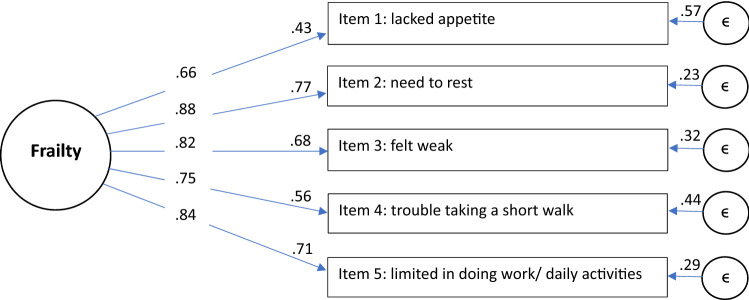
This study demonstrated the feasibility of adapting patient responses to relevant EORTC QLQ-C30 items to serve as proxy Fried frailty criteria. Selected items were well correlated with one another and PRFP as a whole demonstrated adequate internal consistency reliability and structural validity. Known groups analysis demonstrated that PRFP could be used to detect distinct comorbidity levels and distinguish between different functional profiles, with frail patients reporting more difficulty in walking about, washing/dressing, and doing usual activities, as compared to their pre-frail and fit counterparts. Among the 4928 patients included in this study, PRFP classified 2729 (55.4%) patients as fit, 1209 (24.5%) as pre-frail, and 990 (20.1%) as frail.
Constructing a frailty scale from existing PRO items commonly collected in cancer trials may be a patient-centric and practical approach to measuring frailty. Additional psychometric evaluation and research is warranted to further explore the utility of such an approach.
本回顾性研究的目的是确定使用患者对 EORTC QLQ-C30 相关项目的反应来衡量虚弱程度的可行性,这些反应作为 Fried 虚弱表型的替代标准,用于复发/难治性多发性骨髓瘤 (RRMM) 患者队列。
数据来自 2010 年至 2021 年期间提交给 FDA 进行监管审查的九项 III 期随机临床试验,用于 RRMM 的治疗。使用 EORTC QLQ-C30 的基线反应来根据 Fried 虚弱定义得出患者报告的虚弱表型 (PRFP)。评估 PRFP 的内部一致性可靠性、结构有效性和已知组有效性。
本研究证明了适应患者对 EORTC QLQ-C30 相关项目的反应以作为替代 Fried 虚弱标准的可行性。选定的项目彼此之间相关性良好,PRFP 整体表现出足够的内部一致性可靠性和结构有效性。已知组分析表明,PRFP 可用于检测不同的合并症水平,并区分不同的功能谱,虚弱患者比其前虚弱和健康患者报告在走动、洗漱和进行日常活动方面更困难。在这项研究中纳入的 4928 名患者中,PRFP 将 2729 名(55.4%)患者归类为健康、1209 名(24.5%)为前虚弱和 990 名(20.1%)为虚弱。
从癌症试验中通常收集的现有 PRO 项目构建虚弱量表可能是一种以患者为中心和实用的衡量虚弱程度的方法。需要进一步的心理测量评估和研究来进一步探索这种方法的实用性。