Kathi Shivani, Laza Haydee, Singh Sukhbir, Thompson Leslie, Li Wei, Simpson Catherine
Department of Plant and Soil Science, Texas Tech University, Lubbock, TX, United States.
Department of Animal and Food Sciences, Texas Tech University, Lubbock, TX, United States.
Front Plant Sci. 2023 Mar 3;14:1145992. doi: 10.3389/fpls.2023.1145992. eCollection 2023.
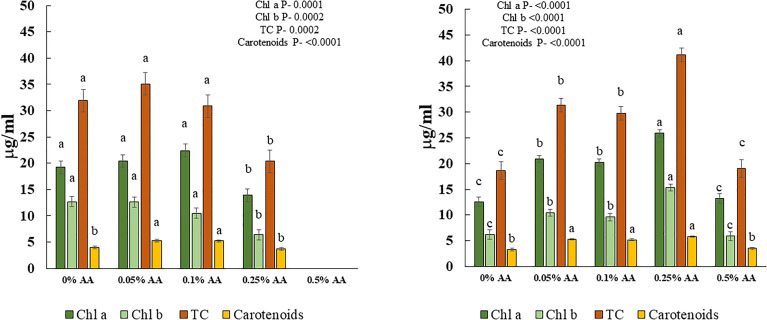
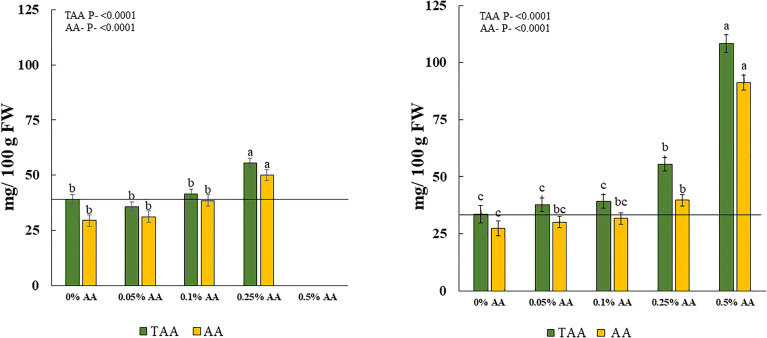
The consumption of plants plays an important role in human health. In addition to providing macro and micronutrients, plants are the sole sources of several phytonutrients that play a major role in disease prevention. However, in modern diets, increased consumption of cheaper, processed foods with poor nutritional value over fruits and vegetables leads to insufficient consumption of essential nutrients such as vitamin C. Taking supplements can address some of the insufficient nutrients in a diet. However, supplements are not as diverse or bioavailable as the nutrients in plants. Improving the abundance of nutrients in plants will reduce the amounts that need to be consumed, thereby reducing the price barrier and use of supplements. In this study, broccoli ( var. ) microgreens grown in a controlled environment were biofortified for increased vitamin C content. The microgreens grown on growing pads were treated with supplemental nutrient solutions. Treatments were applied four to five days after germination and included four different concentrations of ascorbic acid specifically, 0% (control), 0.05%, 0.1%, 0.25% and 0.5%, added to the nutrient solution. Microgreens with turgid cotyledons and appearance of tip of first true leaves were harvested about 14 days after germination and were analyzed for biomass, chlorophylls, carotenoids, vitamin C and other minerals content. The ascorbic acid improved the microgreens' fresh biomass, percent dry matter, chlorophylls, carotenoids, vitamin C, and potassium content. Moreover, this study also mapped out the correlation between ascorbic acid, phytochemicals, and broccoli microgreens' mineral composition. The total vitamin C was positively correlated to K and negatively correlated to chlorophylls, N, P, Mg, Ca, S, and B (p < 0.01). These relationships can be applied in future vitamin C biofortification research across different microgreens. In conclusion, vitamin C was increased up to 222% by supplemental ascorbic acid without being detrimental to plant health and mineral composition.
食用植物对人类健康起着重要作用。除了提供大量和微量营养素外,植物还是几种植物营养素的唯一来源,这些植物营养素在疾病预防中发挥着重要作用。然而,在现代饮食中,与水果和蔬菜相比,营养价值低的廉价加工食品的消费增加,导致维生素C等必需营养素的摄入量不足。服用补充剂可以解决饮食中一些营养素不足的问题。然而,补充剂不如植物中的营养素多样或具有生物可利用性。提高植物中的营养素含量将减少所需的摄入量,从而降低价格障碍并减少补充剂的使用。在本研究中,在可控环境中种植的西兰花(品种)嫩苗进行了生物强化,以提高维生素C含量。在生长垫上生长的嫩苗用补充营养液处理。在发芽后四到五天进行处理,具体包括在营养液中添加四种不同浓度的抗坏血酸,即0%(对照)、0.05%、0.1%、0.25%和0.5%。发芽后约14天收获子叶饱满且第一片真叶尖端出现的嫩苗,并分析其生物量、叶绿素、类胡萝卜素、维生素C和其他矿物质含量。抗坏血酸提高了嫩苗的鲜生物量、干物质百分比、叶绿素、类胡萝卜素、维生素C和钾含量。此外,本研究还绘制了抗坏血酸、植物化学物质与西兰花嫩苗矿物质组成之间的相关性。总维生素C与钾呈正相关,与叶绿素、氮、磷、镁、钙、硫和硼呈负相关(p < 0.01)。这些关系可应用于未来不同嫩苗的维生素C生物强化研究。总之,通过补充抗坏血酸,维生素C含量提高了222%,且对植物健康和矿物质组成没有不利影响。