Adar Sevda, Konya Petek Şarlak, Akçin Ali İzzet, Dündar Ümit, Demirtürk Neşe
Department of Physical Medicine and Rehabilitation, Afyonkarahisar Health Sciences University, Afyonkarahisar, Turkey.
Department of Infectious Diseases and Clinical Microbiology, Afyonkarahisar Health Sciences University, Afyonkarahisar, Turkey.
Osong Public Health Res Perspect. 2023 Feb;14(1):40-50. doi: 10.24171/j.phrp.2022.0275. Epub 2023 Feb 1.
We evaluated pain, fatigue, anxiety, depression, and quality of life in patients hospitalized for coronavirus disease 2019 (COVID-19) and observed them over a period of 3 months. We also investigated the relationship of these symptoms to age, sex, disease severity, and levels of anxiety and depression.
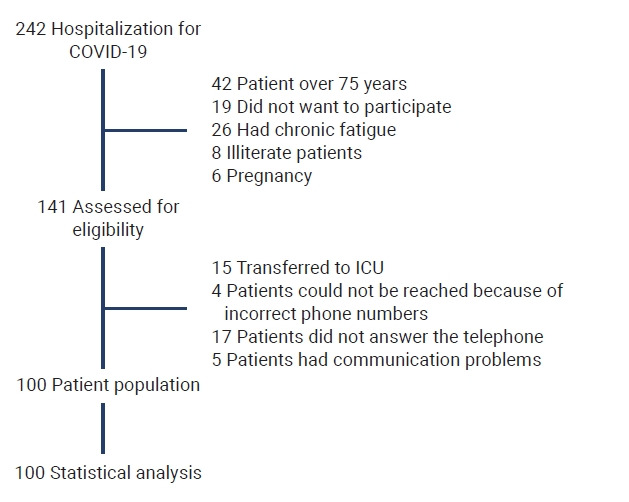
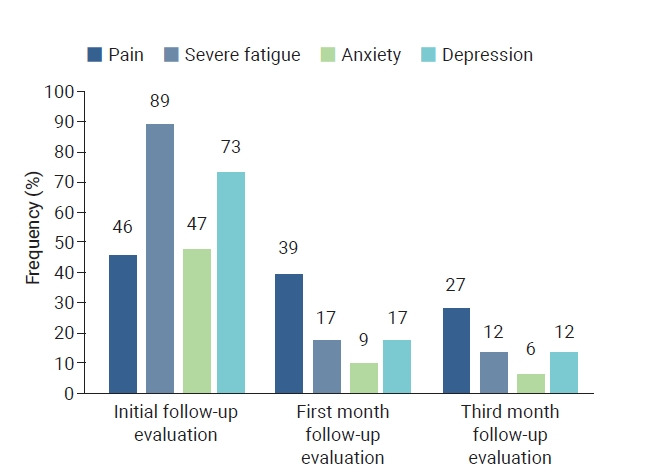
The study included 100 confirmed COVID-19 patients (i.e., positive on a polymerase chain reaction test) between the ages of 18 and 75 years. Pain (visual analog scale [VAS]), fatigue (fatigue severity scale), anxiety, and depression (hospital anxiety and depression scales) were evaluated on the first day of hospitalization and at 1-month and 3-month follow-ups. The short form-12 questionnaire was used to measure quality of life at the 1-month and 3-month followups.
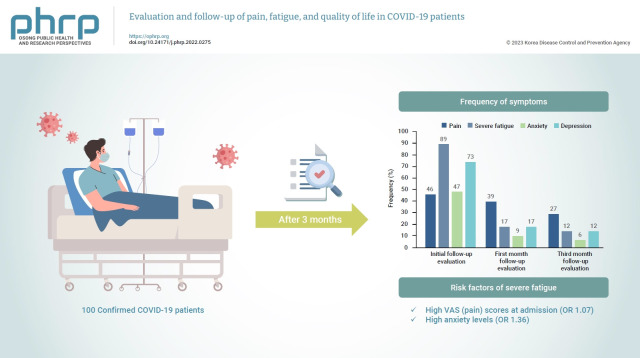
No differences were found in pain, fatigue, anxiety levels, depression levels, and quality of life according to disease severity. High VAS scores at hospital admission were related to continued pain at the 3-month follow-up (odds ratio [OR], 1.067; p<0.001). High VAS (OR, 1.072; p=0.003) and anxiety levels (OR, 1.360; p=0.007) were related to severe fatigue at the 3-month evaluation.
Pain, fatigue, anxiety, and depression appear to be long-term sequelae of COVID-19 and can affect quality of life. High VAS and anxiety levels were found to be associated with long-term fatigue.
我们评估了因2019冠状病毒病(COVID-19)住院患者的疼痛、疲劳、焦虑、抑郁及生活质量,并对他们进行了为期3个月的观察。我们还研究了这些症状与年龄、性别、疾病严重程度以及焦虑和抑郁水平之间的关系。
该研究纳入了100名年龄在18至75岁之间的确诊COVID-19患者(即聚合酶链反应检测呈阳性)。在住院第一天以及1个月和3个月随访时评估疼痛(视觉模拟量表[VAS])、疲劳(疲劳严重程度量表)、焦虑和抑郁(医院焦虑抑郁量表)。在1个月和3个月随访时使用简短健康调查问卷-12来测量生活质量。
根据疾病严重程度,在疼痛、疲劳、焦虑水平、抑郁水平和生活质量方面未发现差异。入院时VAS评分高与3个月随访时持续疼痛相关(比值比[OR],1.067;p<0.001)。高VAS(OR,(1.072);p = 0.003)和焦虑水平(OR,1.360;p = 0.007)与3个月评估时的严重疲劳相关。
疼痛、疲劳、焦虑和抑郁似乎是COVID-19的长期后遗症,并且会影响生活质量。发现高VAS和焦虑水平与长期疲劳有关。