National Health and Medical Research Council Transdisciplinary Centre of Research Excellence in Frailty Research to Achieve Healthy Ageing, Adelaide, SA, Australia.
Caring Futures Institute, College of Nursing and Health Sciences, Flinders University, Bedford Park, SA, 5042, Australia.
Health Res Policy Syst. 2023 Mar 21;21(1):20. doi: 10.1186/s12961-023-00967-x.
Transdisciplinary research and knowledge translation are increasingly regarded as key concepts underpinning applied research across the health and social sciences, due to their presumed potential in addressing complex, "wicked" problems and improving the use of research in practice and policy, respectively. Despite sharing an impact mandate, the relationship between transdisciplinary research collaboration and knowledge translation remains unclear. In response, we examined the relationship between transdisciplinary collaboration and knowledge translation to generate these understandings with a view towards maximizing the impact of collaborative efforts.
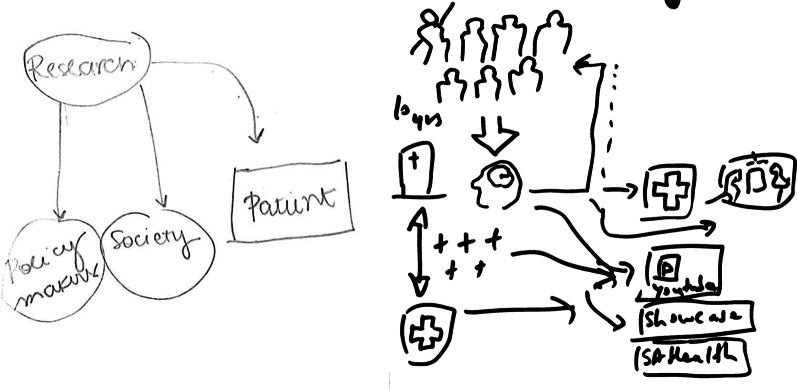
We undertook a realist evaluation and longitudinal case study of a 5-year National Health and Medical Research Council-funded Centre of Research Excellence in Transdisciplinary Frailty Research. Data were collected between February 2017 and March 2020 over three rounds of theory development, refinement and testing using interviews, observation, document review and visual elicitation as data sources. The Human Research Ethics Committee of the University of Adelaide approved this study.
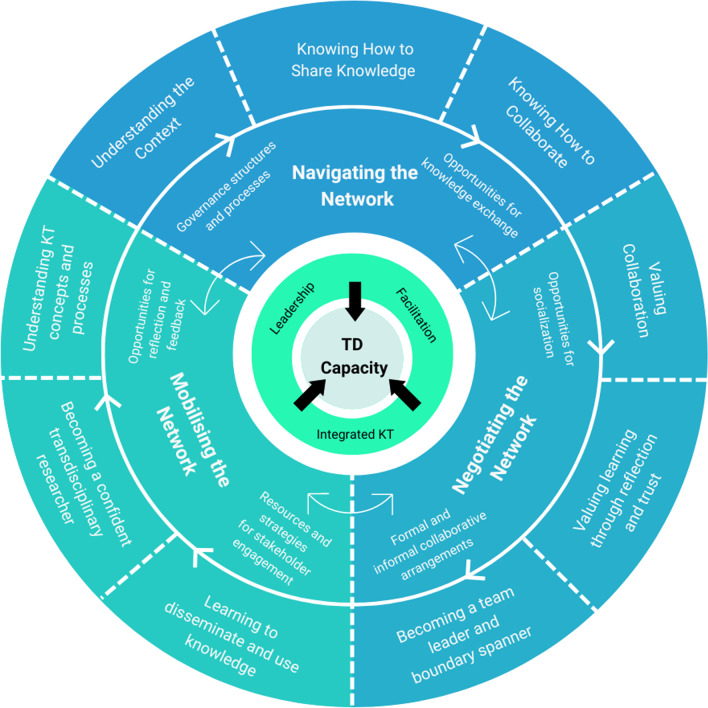
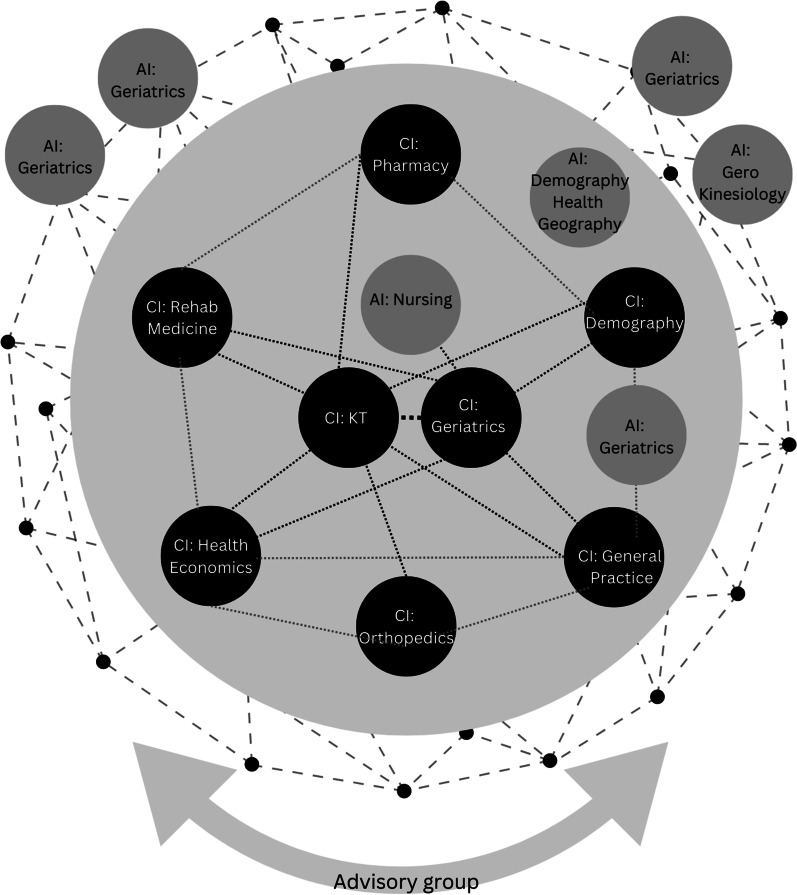
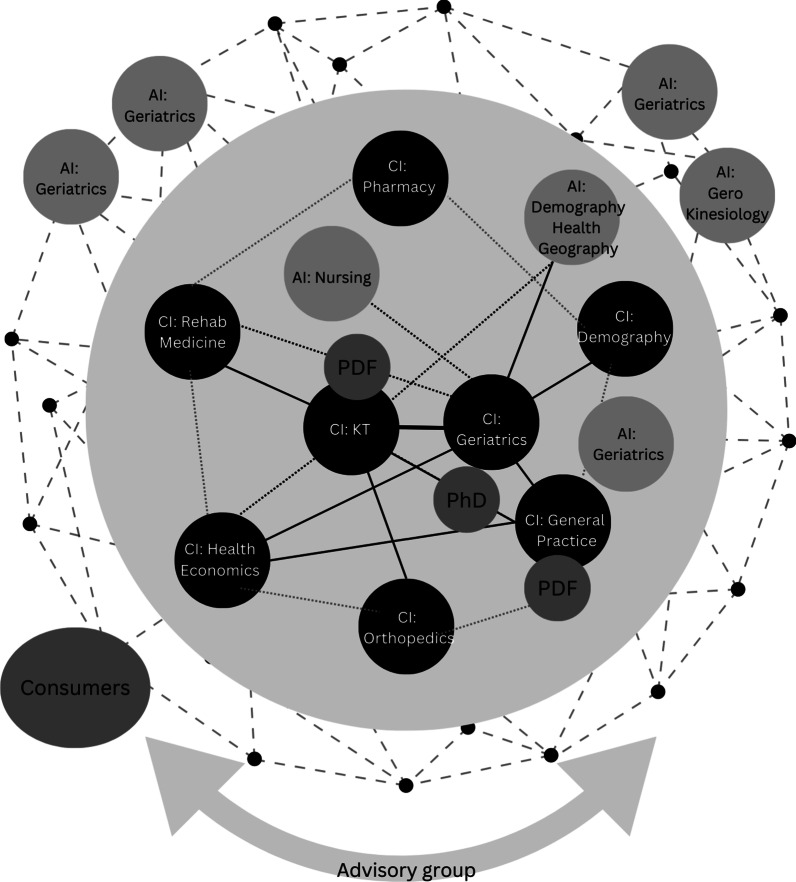
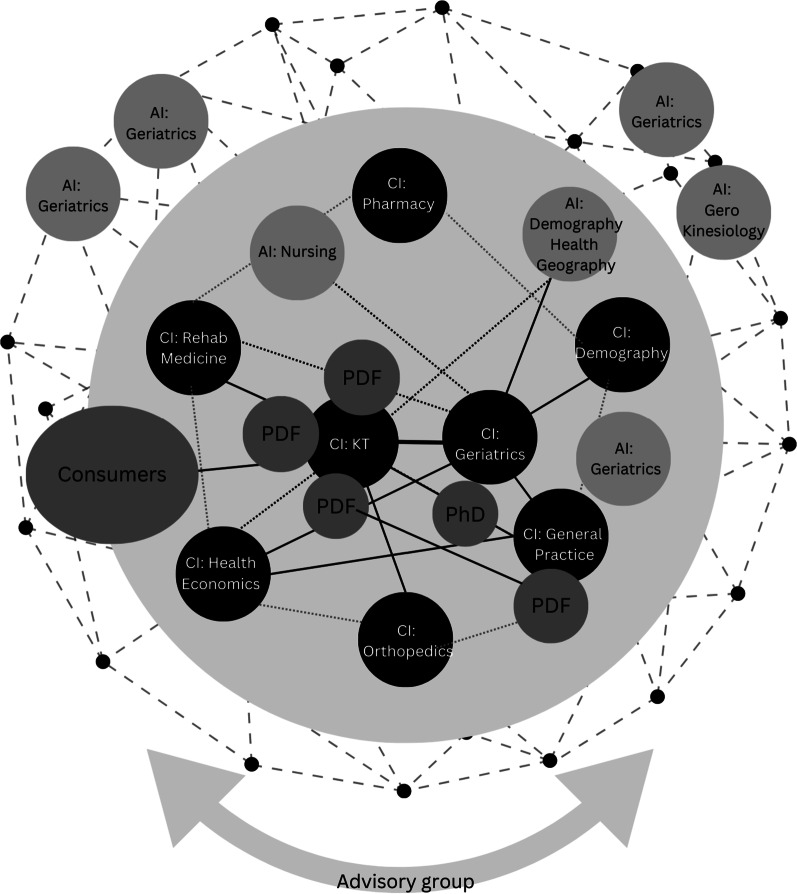
Iterative analysis of narrative interviews and visual data led to the development of three overarching programme theories explicating the reciprocal relationship between KT understandings and transdisciplinary team process. These programme theories revolve around the concept of a network, which we define in alignment with extant theoretical literature on network mechanisms and complex networks as graphically representable networks of agents/people (nodes) joined by social relationships (links). Our findings demonstrate that under the right contextual conditions, transdisciplinary team members respond through an improved ability to (1) navigate the network, (2) negotiate the network and (3) mobilize the network.
This research demonstrates the reciprocity and mutually supportive relationship between transdisciplinary research and knowledge translation. Our findings suggest that embedding a collaborative knowledge translation framework and providing resources such as facilitation and distributed leadership within a transdisciplinary team can improve collaboration and support transdisciplinary research objectives.
跨学科研究和知识转化越来越被视为健康和社会科学应用研究的关键概念,因为它们分别在解决复杂的“棘手”问题和提高研究在实践和政策中的应用方面具有潜在的作用。尽管它们有着共同的影响任务,但跨学科研究合作和知识转化之间的关系仍不清楚。为了应对这一问题,我们研究了跨学科合作与知识转化之间的关系,以期更好地理解两者之间的关系,从而最大限度地提高合作的影响力。
我们对一个为期 5 年的澳大利亚国家卫生与医学研究委员会资助的跨学科衰弱研究卓越中心进行了真实评估和纵向案例研究。数据收集于 2017 年 2 月至 2020 年 3 月,共进行了三轮理论发展、细化和测试,使用访谈、观察、文件审查和视觉启发作为数据来源。阿德莱德大学人类研究伦理委员会批准了这项研究。
对叙事访谈和视觉数据的迭代分析导致了三种总体方案理论的发展,这些理论阐释了知识转化理解和跨学科团队过程之间的相互关系。这些方案理论围绕着网络的概念展开,我们根据网络机制和复杂网络的现有理论文献,将网络定义为以社会关系(链接)连接的代理/人员(节点)的图形表示网络。我们的研究结果表明,在适当的环境条件下,跨学科团队成员可以通过提高以下三种能力来做出反应:(1)在网络中导航,(2)协商网络,(3)调动网络。
这项研究证明了跨学科研究和知识转化之间的互惠和相互支持关系。我们的研究结果表明,在跨学科团队中嵌入协作知识转化框架并提供促进和分布式领导等资源可以改善合作并支持跨学科研究目标。