Rehabilitation Sciences, The University of British Columbia, 212 - 2177 Wesbrook Mall, Vancouver, BC, V6T 1Z3, Canada.
Therapy Department, Sunny Hill Health Centre for Children, 3644 Slocan Street, Vancouver, BC, V5M 3E8, Canada.
Implement Sci. 2019 Mar 27;14(1):34. doi: 10.1186/s13012-019-0879-1.
To date, implementation science has focused largely on identifying the individual and organizational barriers, processes, and outcomes of knowledge translation (KT) (including implementation efforts). Social network analysis (SNA) has the potential to augment our understanding of KT success by applying a network lens that examines the influence of relationships and social structures on research use and intervention acceptability by health professionals. The purpose of this review was to comprehensively map the ways in which SNA methodologies have been applied to the study of KT with respect to health professional networks.
Systematic scoping review methodology involved searching five academic databases for primary research on KT that employed quantitative SNA methods, and inclusion screening using predetermined criteria. Data extraction included information on study aim, population, variables, network properties, theory use, and data collection methods. Descriptive statistics and chronology charting preceded theoretical analysis of findings.
Twenty-seven retained articles describing 19 cross-sectional and 2 longitudinal studies reported on 28 structural properties, with degree centrality, tie characteristics (e.g., homophily, reciprocity), and whole network density being most frequent. Eleven studies examined physician-only networks, 9 focused on interprofessional networks, and 1 reported on a nurse practitioner network. Diffusion of innovation, social contagion, and social influence theories were most commonly applied.
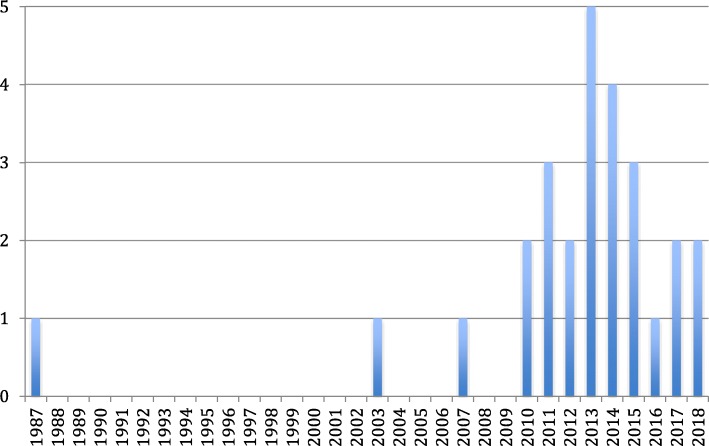
Emerging interest in SNA for KT- and implementation-related research is evident. The included articles focused on individual level evidence-based decision-making: we recommend also applying SNA to meso- or macro-level KT activities. SNA research that expands the range of professions under study, examines network dynamics over time, extends the depth of analysis of the role of network structure on KT processes and outcomes, and employs mixed methods to triangulate findings, is needed to advance the field. SNA is a valuable approach for evaluating key network characteristics, structures and positions of relevance to KT, implementation, and evidence informed practice. Examining how network structure influences connections and the implications of those holding prominent network positions can provide insights to improve network-based KT processes.
迄今为止,实施科学主要集中在确定知识转化(KT)(包括实施工作)的个体和组织障碍、过程和结果。社会网络分析(SNA)有可能通过应用网络视角来增强我们对 KT 成功的理解,该视角检查关系和社会结构对卫生专业人员研究使用和干预可接受性的影响。本综述的目的是全面绘制 SNA 方法在健康专业人员网络中研究 KT 的应用方式。
系统范围审查方法涉及在五个学术数据库中搜索关于采用定量 SNA 方法的 KT 的主要研究,并使用预定标准进行纳入筛选。数据提取包括研究目的、人群、变量、网络属性、理论应用和数据收集方法的信息。描述性统计和时间轴图表分析之前是对研究结果的理论分析。
保留了 27 篇文章,描述了 19 项横断面和 2 项纵向研究,报告了 28 个结构属性,其中中心度、关系特征(如同质性、互惠性)和整个网络密度最为常见。11 项研究检查了仅医生网络,9 项研究关注了多专业网络,1 项研究报告了护士从业者网络。创新扩散、社会传染和社会影响理论最常被应用。
显然,对 SNA 用于 KT 和实施相关研究的兴趣正在增加。纳入的文章侧重于基于个体的循证决策:我们建议也将 SNA 应用于中观或宏观层面的 KT 活动。需要开展 SNA 研究来扩展研究的专业范围,检查网络动态随时间的变化,深入分析网络结构对 KT 过程和结果的影响,并采用混合方法来验证研究结果,以推进该领域的发展。SNA 是评估与 KT、实施和循证实践相关的关键网络特征、结构和位置的有价值方法。检查网络结构如何影响连接以及具有突出网络地位的人的影响,可以提供改善基于网络的 KT 过程的见解。