Department of Psychology, University of Trier, Trier, Rheinland-Pfalz, Germany.
PLoS One. 2023 Mar 22;18(3):e0281072. doi: 10.1371/journal.pone.0281072. eCollection 2023.
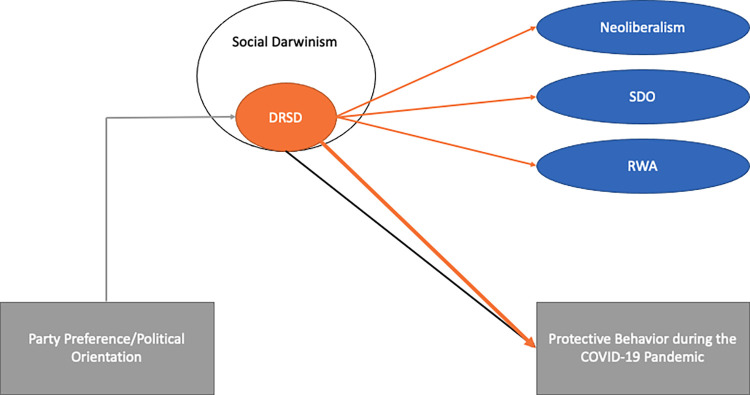
COVID-19 was a harsh reminder that diseases are an aspect of human existence and mortality. It was also a live experiment in the formation and alteration of disease-related attitudes. Not only are these attitudes relevant to an individual's self-protective behavior, but they also seem to be associated with social and political attitudes more broadly. One of these attitudes is Social Darwinism, which holds that a pandemic benefits society by enabling nature "to weed out the weak". In two countries (N = 300, N = 533), we introduce and provide evidence for the reliability, validity, and usefulness of the Disease-Related Social Darwinism (DRSD) Short Scale measuring this concept. Results indicate that DRSD is meaningful related to other central political attitudes like Social Dominance Orientation, Authoritarianism and neoliberalism. Importantly, the scale significantly predicted people's protective behavior during the Pandemic over and above general social Darwinism. Moreover, it significantly predicted conservative attitudes, even after controlling for Social Dominance Orientation.
新冠疫情严峻地提醒人们,疾病是人类生存和死亡的一部分。它也是一个关于形成和改变与疾病相关的态度的现场实验。这些态度不仅与个人的自我保护行为有关,而且似乎与更广泛的社会和政治态度有关。其中一种态度是社会达尔文主义,它认为大流行通过使自然“淘汰弱者”而使社会受益。在两个国家(N = 300,N = 533)中,我们引入并提供了疾病相关社会达尔文主义(DRSD)短量表测量这一概念的可靠性、有效性和有用性的证据。结果表明,DRSD与其他核心政治态度(如社会支配倾向、威权主义和新自由主义)有意义地相关。重要的是,该量表在大流行期间显著预测了人们的保护行为,甚至超过了一般的社会达尔文主义。此外,即使在控制了社会支配倾向之后,它也显著预测了保守态度。