Baker Katherine M, Leung Angela Q, Shah Jaimin S, Korkidakis Ann, Sakkas Denny, Penzias Alan, Toth Thomas L
Department of Obstetrics and Gynecology, Beth Israel Deaconess Medical Center, Boston, Massachusetts.
Department of Obstetrics, Gynecology and Reproductive Biology, Harvard Medical School, Boston, Massachusetts.
F S Rep. 2022 Aug 12;4(1):29-35. doi: 10.1016/j.xfre.2022.08.003. eCollection 2023 Mar.
To compare the learning curve of clinicians with different levels of embryo transfer (ET) experience using the American Society for Reproductive Medicine (ASRM) Embryo Transfer Simulator.
Prospective cohort study.
Single large university-affiliated in vitro fertilization center.
Participants with 3 levels of expertise with ET were recruited: "group 1" (Reproductive Endocrinology and Infertility attendings), "group 2" (Reproductive Endocrinology and Infertility nurses, advance practice providers, or medical assistants), and "group 3" (Obstetrics and Gynecology resident physicians).
All participants completed ET simulation training using uterine cases A, B, and C (easiest to most difficult) of the ASRM ET Simulator. Participants completed each case 5 times for a total of 15 repetitions.
The primary outcome was ET simulation scores analyzed at each attempt for each uterine case, with a maximum score of 155. Secondary outcomes included self-assessed comfort levels before and after the completion of the simulation and total duration of ET. Comfort was assessed using a 5-point Likert scale.
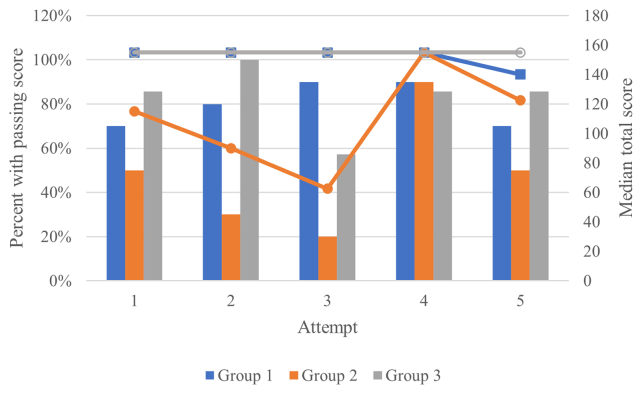
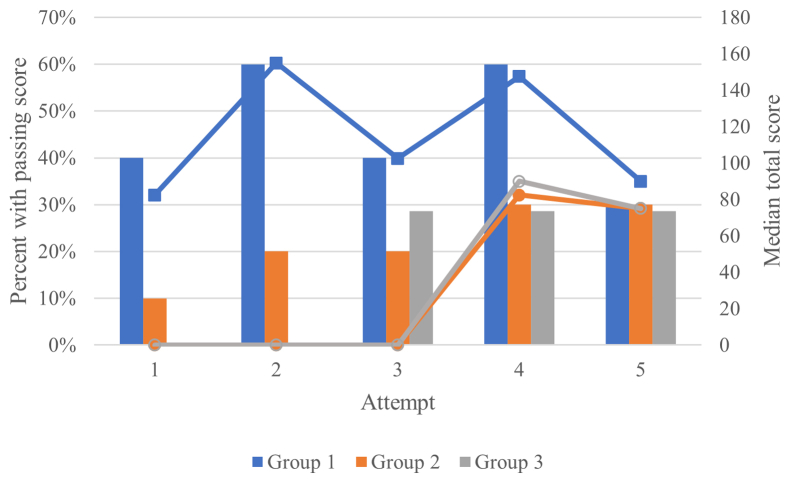
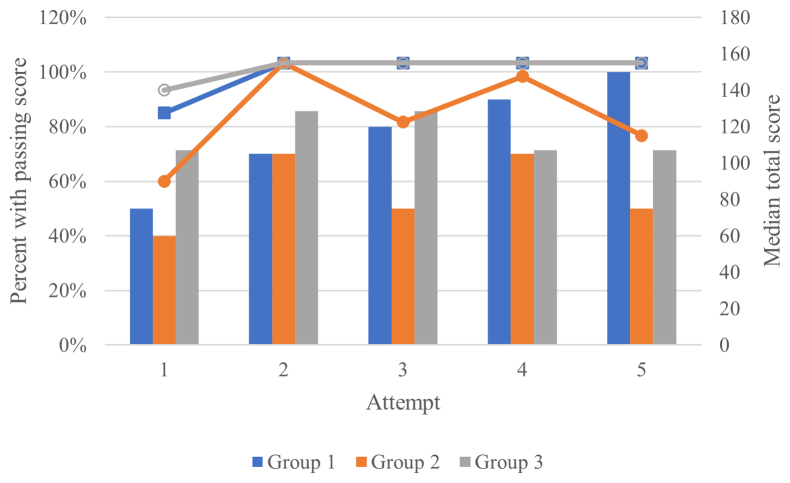
Twenty-seven participants with 3 different levels of expertise with ET were recruited from December 2020 to February 2021. For cases A and B, median total scores were not significantly different between groups 1 and 3 at first or last attempts. Group 2 did not perform as well as group 3 at the beginning of case A or group 1 at the end of case B. All groups demonstrated a decrease in total time from the first attempt to the last attempt for both cases. For case C, the "difficult" uterus, groups 2 and 3 exhibited the greatest improvement in total median score: from 0 to 75 from the first to last attempt. Group 1 scored equally well from first through last attempts. Although no one from group 2 or 3 achieved a passing score with the first attempt (80% of the max score), approximately 30% had passing scores at the last attempt. Groups 1 and 3 showed a significant decrease in total time across attempts for case C. Following simulation, 100% of groups 2 and 3 reported perceived improvement in their skills. Group 3 showed significant improvement in comfort scores with Likert scores of 1.71 ± 0.76 and 1.0 ± 0.0 for the "Easy" and "Difficult" cases, respectively, before simulation and 4.57 ± 0.53 and 2.4 ± 1.1 after simulation.
The ASRM ET Simulator was effective in improving both technical skill and comfort level, particularly for those with little to no ET experience and was most marked when training on a difficult clinical case.
使用美国生殖医学学会(ASRM)胚胎移植模拟器比较不同胚胎移植(ET)经验水平的临床医生的学习曲线。
前瞻性队列研究。
一所大型大学附属的单一体外受精中心。
招募了具有3种ET专业水平的参与者:“第1组”(生殖内分泌与不孕症主治医师)、“第2组”(生殖内分泌与不孕症护士、高级执业提供者或医学助理)和“第3组”(妇产科住院医师)。
所有参与者使用ASRM ET模拟器的子宫病例A、B和C(从最容易到最困难)完成ET模拟训练。参与者对每个病例完成5次,共进行15次重复。
主要结局是对每个子宫病例每次尝试时分析的ET模拟分数,最高分为155分。次要结局包括模拟完成前后的自我评估舒适度以及ET的总时长。使用5点李克特量表评估舒适度。
2020年12月至2021年2月招募了27名具有3种不同ET专业水平的参与者。对于病例A和B,第1组和第3组在首次或末次尝试时的总分数中位数无显著差异。在病例A开始时,第2组的表现不如第3组;在病例B结束时,第2组不如第1组。所有组在两个病例中从首次尝试到末次尝试的总时间均有所减少。对于病例C(“困难”子宫),第2组和第3组的总中位数分数改善最大:从首次尝试到末次尝试从0分提高到75分。第1组从首次到末次尝试的得分同样良好。虽然第2组或第3组中没有人在首次尝试时达到及格分数(最高分的80%),但约30%的人在末次尝试时达到了及格分数。第1组和第3组在病例C的各次尝试中总时间显著减少。模拟后,第2组和第3组中有100%的人报告感觉技能有所提高。第3组的舒适度得分有显著改善,“容易”和“困难”病例在模拟前的李克特分数分别为1.71±0.76和1.0±0.0,模拟后的分数分别为4.57±0.53和2.4±1.1。
ASRM ET模拟器在提高技术技能和舒适度方面是有效的,特别是对于那些几乎没有或没有ET经验的人,并且在对困难临床病例进行训练时最为明显。