Partin Alexander, Brettin Thomas, Zhu Yitan, Dolezal James M, Kochanny Sara, Pearson Alexander T, Shukla Maulik, Evrard Yvonne A, Doroshow James H, Stevens Rick L
Division of Data Science and Learning, Argonne National Laboratory, Lemont, IL, United States.
Section of Hematology/Oncology, Department of Medicine, University of Chicago Medical Center, Chicago, IL, United States.
Front Med (Lausanne). 2023 Mar 7;10:1058919. doi: 10.3389/fmed.2023.1058919. eCollection 2023.
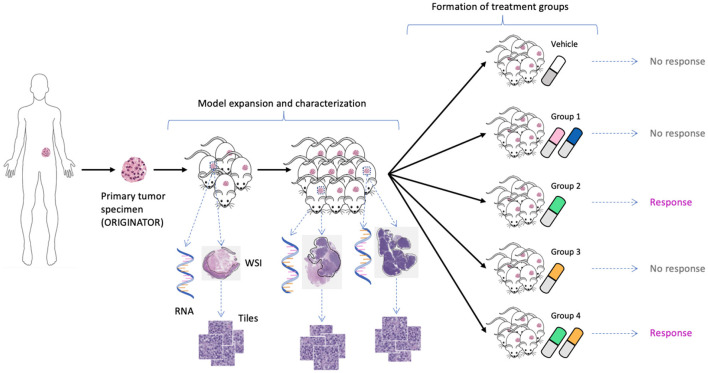
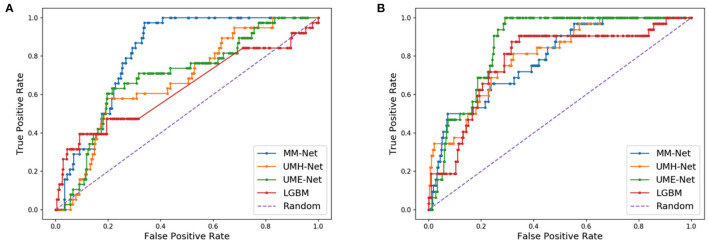
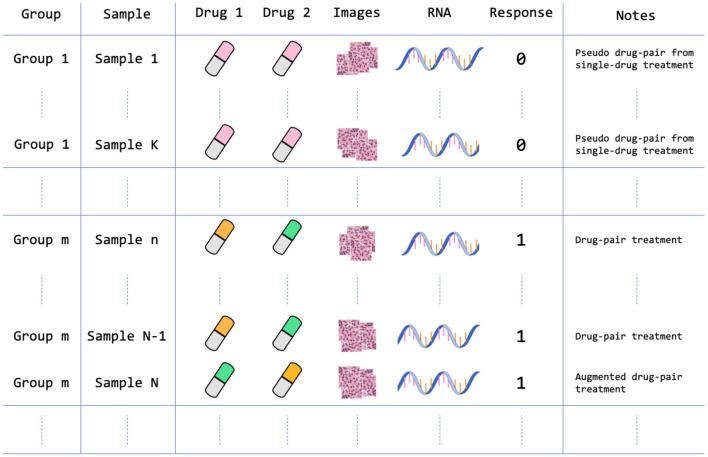
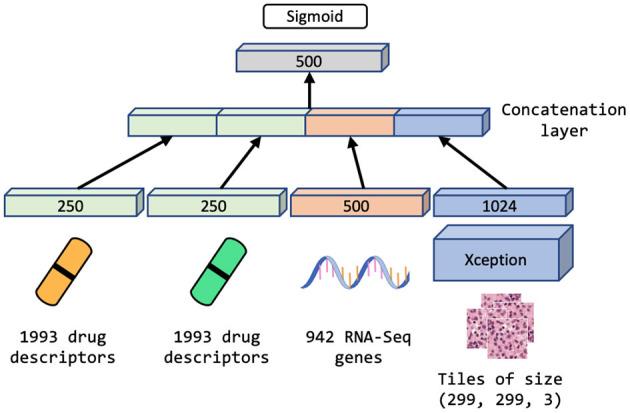
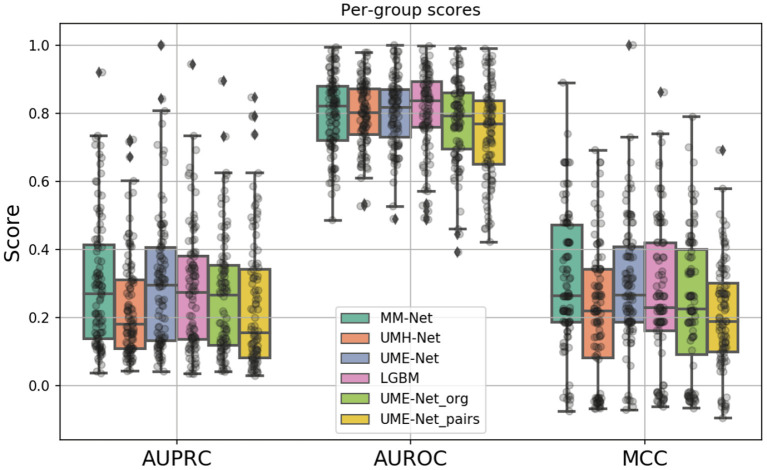
Patient-derived xenografts (PDXs) are an appealing platform for preclinical drug studies. A primary challenge in modeling drug response prediction (DRP) with PDXs and neural networks (NNs) is the limited number of drug response samples. We investigate multimodal neural network (MM-Net) and data augmentation for DRP in PDXs. The MM-Net learns to predict response using drug descriptors, gene expressions (GE), and histology whole-slide images (WSIs). We explore whether combining WSIs with GE improves predictions as compared with models that use GE alone. We propose two data augmentation methods which allow us training multimodal and unimodal NNs without changing architectures with a single larger dataset: 1) combine single-drug and drug-pair treatments by homogenizing drug representations, and 2) augment drug-pairs which doubles the sample size of all drug-pair samples. Unimodal NNs which use GE are compared to assess the contribution of data augmentation. The NN that uses the original and the augmented drug-pair treatments as well as single-drug treatments outperforms NNs that ignore either the augmented drug-pairs or the single-drug treatments. In assessing the multimodal learning based on the MCC metric, MM-Net outperforms all the baselines. Our results show that data augmentation and integration of histology images with GE can improve prediction performance of drug response in PDXs.
患者来源的异种移植瘤(PDXs)是临床前药物研究的一个有吸引力的平台。使用PDXs和神经网络(NNs)进行药物反应预测(DRP)建模的一个主要挑战是药物反应样本数量有限。我们研究了用于PDXs中DRP的多模态神经网络(MM-Net)和数据增强方法。MM-Net学习使用药物描述符、基因表达(GE)和组织学全切片图像(WSIs)来预测反应。我们探讨了与仅使用GE的模型相比,将WSIs与GE相结合是否能改善预测。我们提出了两种数据增强方法,使我们能够在不改变架构的情况下,使用单个更大的数据集训练多模态和单模态NNs:1)通过使药物表示同质化来组合单药和药物对治疗,以及2)增强药物对,这使所有药物对样本的样本量增加一倍。比较了使用GE的单模态NNs以评估数据增强的贡献。使用原始和增强后的药物对治疗以及单药治疗的NNs优于忽略增强后的药物对或单药治疗的NNs。在基于MCC指标评估多模态学习时,MM-Net优于所有基线。我们的结果表明,数据增强以及组织学图像与GE的整合可以提高PDXs中药物反应的预测性能。