Dieteren C M, O'Donnell O, Bonfrer I
Erasmus School of Health Policy & Management, Erasmus University Rotterdam, Rotterdam, the Netherlands.
Erasmus School of Economics, Erasmus University Rotterdam, Rotterdam, the Netherlands.
PLOS Glob Public Health. 2021 Dec 16;1(12):e0000114. doi: 10.1371/journal.pgph.0000114. eCollection 2021.
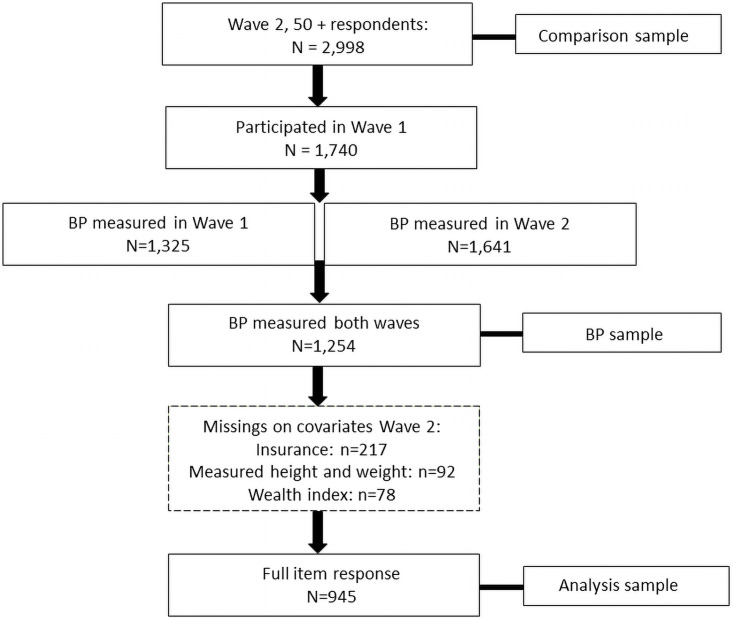
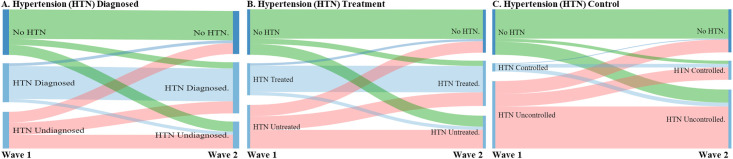
Hypertension is the leading risk factor for cardiovascular diseases (CVDs) and substantial gaps in diagnosis, treatment and control signal failure to avert premature deaths. Our aim was to estimate the prevalence and assess the socioeconomic distribution of hypertension that remained undiagnosed, untreated, and uncontrolled for at least five years among older Mexicans and to estimate rates of transition from those states to diagnosis, treatment and control. We used data from a cohort of Mexicans aged 50+ in two waves of the WHO Study on Global AGEing and adult health (SAGE) collected in 2009 and 2014. Blood pressure was measured, hypertension diagnosis and treatment self-reported. We estimated prevalence and transition rates over five years and calculated concentration indices to identify socioeconomic inequalities using a wealth index. Using probit models, we identify characteristics of those facing the greatest barriers in receiving hypertension care. More than 60 percent of individuals with full item response (N = 945) were classified as hypertensive. Over one third of those undiagnosed continued to be in that state five years later. More than two fifths of those initially untreated remained so, and over three fifths of those initially uncontrolled failed to achieve continued blood pressure control. While being classified as hypertensive was more concentrated among the rich, missing diagnosis, treatment and control were more prevalent among the poor. Men, singles, rural dwellers, uninsured, and those with overweight were more likely to have persistent undiagnosed, untreated, and uncontrolled hypertension. There is room for improvement in both hypertension diagnosis and treatment in Mexico. Clinical and public health attention is required, even for those who initially had their hypertension controlled. To ensure more equitable hypertension care and effectively prevent premature deaths, increased diagnosis and long-term treatment efforts should especially be directed towards men, singles, uninsured, and those with overweight.
高血压是心血管疾病(CVDs)的主要危险因素,在诊断、治疗和控制方面存在的巨大差距表明未能避免过早死亡。我们的目的是估计墨西哥老年人中至少五年未被诊断、未接受治疗和未得到控制的高血压患病率,并评估其社会经济分布情况,同时估计从这些状态转变为诊断、治疗和控制的比率。我们使用了来自世界卫生组织全球老龄化与成人健康研究(SAGE)2009年和2014年两轮调查中50岁及以上墨西哥人群队列的数据。测量了血压,自我报告了高血压的诊断和治疗情况。我们估计了五年内的患病率和转变率,并使用财富指数计算集中指数以识别社会经济不平等情况。使用概率模型,我们确定了在接受高血压护理方面面临最大障碍的人群特征。在具有完整项目回答的个体(N = 945)中,超过60%被归类为高血压患者。超过三分之一未被诊断出高血压的人在五年后仍处于该状态。超过五分之二最初未接受治疗的人仍然如此,超过五分之三最初血压未得到控制的人未能实现持续的血压控制。虽然被归类为高血压在富人中更为集中,但漏诊、未治疗和未控制在穷人中更为普遍。男性、单身者、农村居民、未参保者以及超重者更有可能持续存在未被诊断、未接受治疗和未得到控制的高血压。墨西哥在高血压的诊断和治疗方面都有改进的空间。即使对于那些最初血压得到控制的人,也需要临床和公共卫生方面的关注。为确保更公平的高血压护理并有效预防过早死亡,应特别加大诊断和长期治疗力度,针对男性、单身者、未参保者以及超重者。