Department of Physiological Sciences, Faculty of Science, Stellenbosch University, Stellenbosch, Private Bag X1, Matieland 7602, South Africa.
Department of Physiological Sciences, Faculty of Science, Stellenbosch University, Stellenbosch, Private Bag X1, Matieland 7602, South Africa; Department of Biochemistry and Systems Biology, Institute of Systems, Molecular and Integrative Biology, Faculty of Health and Life Sciences, University of Liverpool, Crown St, Liverpool L69 7ZB, UK; The Novo Nordisk Foundation Centre for Biosustainability, Building 220, Chemitorvet 200, Technical University of Denmark, 2800 Kongens Lyngby, Denmark.
Blood Rev. 2023 Jul;60:101075. doi: 10.1016/j.blre.2023.101075. Epub 2023 Mar 20.
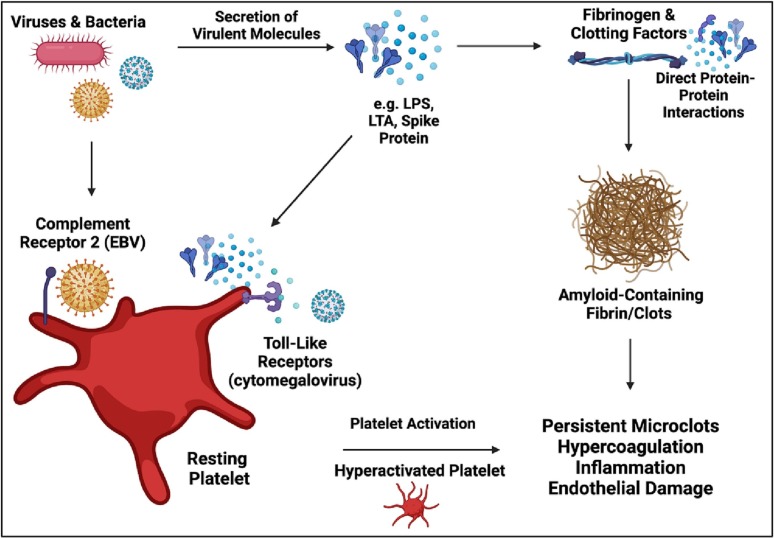
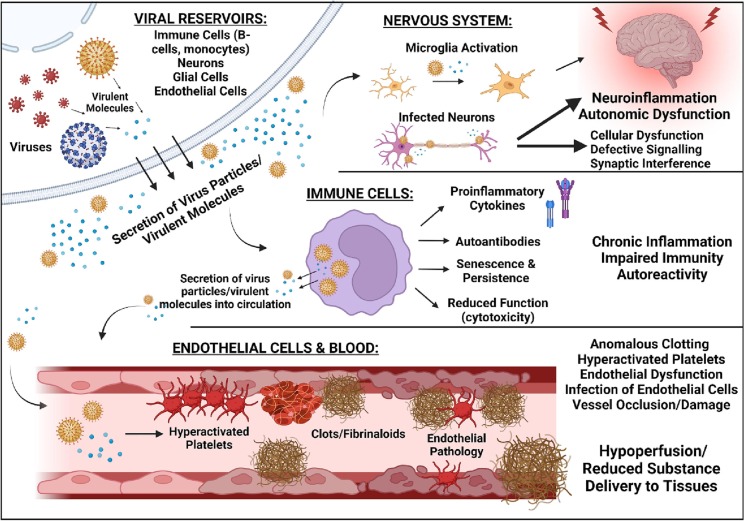
ME/CFS is a debilitating chronic condition that often develops after viral or bacterial infection. Insight from the study of Long COVID/Post Acute Sequelae of COVID-19 (PASC), the post-viral syndrome associated with SARS-CoV-2 infection, might prove to be useful for understanding pathophysiological mechanisms of ME/CFS. Disease presentation is similar between the two conditions, and a subset of Long COVID patients meet the diagnostic criteria for ME/CFS. Since Long COVID is characterized by significant vascular pathology - including endothelial dysfunction, coagulopathy, and vascular dysregulation - the question of whether or not the same biological abnormalities are of significance in ME/CFS arises. Cardiac abnormalities have for a while now been documented in ME/CFS cohorts, with recent studies demonstrating major deficits in cerebral blood flow, and hence vascular dysregulation. A growing body of research is demonstrating that ME/CFS is accompanied by platelet hyperactivation, anomalous clotting, a procoagulant phenotype, and endothelial dysfunction. Endothelial damage and dysregulated clotting can impair substance exchange between blood and tissues, and result in hypoperfusion, which may contribute to the manifestation of certain ME/CFS symptoms. Here we review the ME/CFS literature to summarize cardiovascular and haematological findings documented in patients with the condition, and, in this context, briefly discuss the potential role of previously-implicated pathogens. Overall, cardiac and haematological abnormalities are present within ME/CFS cohorts. While atherosclerotic heart disease is not significantly associated with ME/CFS, suboptimal cardiovascular function defined by reduced cardiac output, impaired cerebral blood flow, and vascular dysregulation are, and these abnormalities do not appear to be influenced by deconditioning. Rather, these cardiac abnormalities may result from dysfunction in the (autonomic) nervous system. Plenty of recently published studies are demonstrating significant platelet hyperactivity and endothelial dysfunction in ME/CFS, as well as anomalous clotting processes. It is of particular importance to determine to what extent these cardiovascular and haematological abnormalities contribute to symptom severity, and if these two systems can be targeted for therapeutic purposes. Viral reservoirs of herpesviruses exist in ME/CFS, and most likely contribute to cardiovascular and haematological dysfunction directly or indirectly. This review highlights the potential of studying cardiac functioning, the vasculature, and coagulation system in ME/CFS.
肌痛性脑脊髓炎/慢性疲劳综合征(ME/CFS)是一种使人虚弱的慢性疾病,通常在病毒或细菌感染后发展而来。从长期新冠/新冠后急性后遗症(PASC)研究中获得的见解,即与 SARS-CoV-2 感染相关的病毒性后综合征,可能有助于了解 ME/CFS 的病理生理机制。两种病症的临床表现相似,一部分长期新冠患者符合 ME/CFS 的诊断标准。由于长期新冠的特征是明显的血管病理学,包括内皮功能障碍、凝血功能障碍和血管调节异常,因此出现了一个问题,即这些相同的生物学异常是否对 ME/CFS 有意义。ME/CFS 队列中已经有一段时间记录到心脏异常,最近的研究表明大脑血液流动存在重大缺陷,因此存在血管调节异常。越来越多的研究表明,ME/CFS 伴随着血小板过度激活、异常凝血、促凝表型和内皮功能障碍。内皮损伤和失调的凝血会损害血液和组织之间的物质交换,导致灌注不足,这可能导致某些 ME/CFS 症状的出现。在这里,我们回顾了 ME/CFS 的文献,总结了在该疾病患者中记录的心血管和血液学发现,并在这方面简要讨论了先前涉及的病原体的潜在作用。总的来说,心脏和血液学异常存在于 ME/CFS 队列中。虽然动脉粥样硬化性心脏病与 ME/CFS 没有显著关联,但通过降低心输出量、大脑血液流动受损和血管调节异常来定义的心脏功能不佳则存在,并且这些异常似乎不受去适应的影响。相反,这些心脏异常可能是由于(自主)神经系统功能障碍引起的。大量最近发表的研究表明,ME/CFS 中存在明显的血小板过度活跃和内皮功能障碍,以及异常的凝血过程。特别重要的是要确定这些心血管和血液学异常在多大程度上导致症状严重程度,以及这两个系统是否可以作为治疗目的的靶点。疱疹病毒的病毒库存在于 ME/CFS 中,并且很可能直接或间接地导致心血管和血液功能障碍。本综述强调了研究 ME/CFS 中心脏功能、血管和凝血系统的潜力。