School of Physiology, Pharmacology and Neuroscience, Biomedical Sciences Building, University Walk, University of Bristol, Bristol, UK, BS8 1TD.
Neurobiology Laboratory, National Institute of Environmental Health Sciences (NIH), 111 T.W. Alexander Drive, Research Triangle Park, Durham, North Carolina, 27709, USA.
Hippocampus. 2023 Jun;33(6):730-744. doi: 10.1002/hipo.23529. Epub 2023 Mar 27.
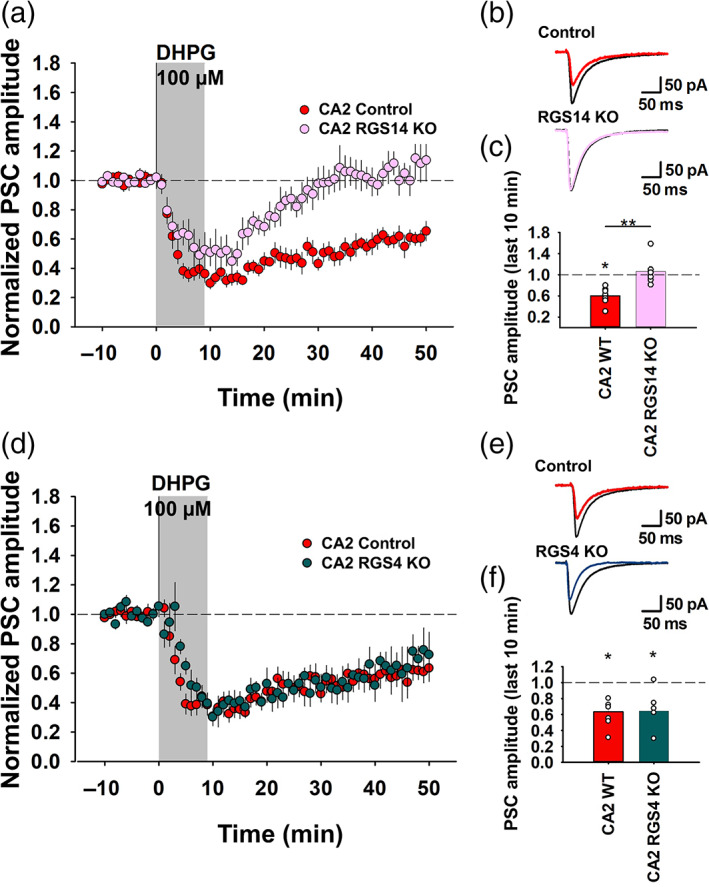
Pyramidal cells in hippocampal area CA2 have synaptic properties that are distinct from the other CA subregions. Notably, this includes a lack of typical long-term potentiation of stratum radiatum synapses. CA2 neurons express high levels of several known and potential regulators of metabotropic glutamate receptor (mGluR)-dependent signaling including Striatal-Enriched Tyrosine Phosphatase (STEP) and several Regulator of G-protein Signaling (RGS) proteins, yet the functions of these proteins in regulating mGluR-dependent synaptic plasticity in CA2 are completely unknown. Thus, the aim of this study was to examine mGluR-dependent synaptic depression and to determine whether STEP and the RGS proteins RGS4 and RGS14 are involved. Using whole cell voltage-clamp recordings from mouse pyramidal cells, we found that mGluR agonist-induced long-term depression (mGluR-LTD) is more pronounced in CA2 compared with that observed in CA1. This mGluR-LTD in CA2 was found to be protein synthesis and STEP dependent, suggesting that CA2 mGluR-LTD shares mechanistic processes with those seen in CA1, but in addition, RGS14, but not RGS4, was essential for mGluR-LTD in CA2. In addition, we found that exogenous application of STEP could rescue mGluR-LTD in RGS14 KO slices. Supporting a role for CA2 synaptic plasticity in social cognition, we found that RGS14 KO mice had impaired social recognition memory as assessed in a social discrimination task. These results highlight possible roles for mGluRs, RGS14, and STEP in CA2-dependent behaviors, perhaps by biasing the dominant form of synaptic plasticity away from LTP and toward LTD in CA2.
海马 CA2 区的锥体神经元具有与其他 CA 亚区不同的突触特性。值得注意的是,这包括放射状层突触的典型长时程增强缺失。CA2 神经元表达高水平的几种已知和潜在的代谢型谷氨酸受体 (mGluR) 依赖信号转导调节剂,包括纹状体丰富的酪氨酸磷酸酶 (STEP) 和几种 G 蛋白信号调节蛋白 (RGS) 蛋白,但这些蛋白在调节 CA2 中的 mGluR 依赖突触可塑性中的功能完全未知。因此,本研究的目的是研究 mGluR 依赖的突触抑制作用,并确定 STEP 和 RGS 蛋白 RGS4 和 RGS14 是否参与其中。通过对小鼠锥体神经元进行全细胞膜片钳记录,我们发现 CA2 中的 mGluR 激动剂诱导的长时程抑制 (mGluR-LTD) 比 CA1 中观察到的更为明显。发现 CA2 中的这种 mGluR-LTD 依赖于蛋白合成和 STEP,表明 CA2 的 mGluR-LTD 与 CA1 中观察到的机制过程相似,但此外,RGS14 而非 RGS4 对于 CA2 中的 mGluR-LTD 是必需的。此外,我们发现 STEP 的外源性应用可以挽救 RGS14 KO 切片中的 mGluR-LTD。支持 CA2 突触可塑性在社会认知中的作用,我们发现 RGS14 KO 小鼠在社会辨别任务中表现出社交识别记忆受损。这些结果突出了 mGluR、RGS14 和 STEP 在 CA2 依赖性行为中的可能作用,可能通过使 CA2 中的主导形式的突触可塑性从 LTP 偏向 LTD。