• 文献检索
  • 文档翻译
  • 深度研究
  • 学术资讯
  • Suppr Zotero 插件Zotero 插件
  • 邀请有礼
  • 套餐&价格
  • 历史记录
应用&插件
Suppr Zotero 插件Zotero 插件浏览器插件Mac 客户端Windows 客户端微信小程序
定价
高级版会员购买积分包购买API积分包
服务
文献检索文档翻译深度研究API 文档MCP 服务
关于我们
关于 Suppr公司介绍联系我们用户协议隐私条款
关注我们

Suppr 超能文献

核心技术专利:CN118964589B侵权必究
粤ICP备2023148730 号-1Suppr @ 2026

文献检索

告别复杂PubMed语法,用中文像聊天一样搜索,搜遍4000万医学文献。AI智能推荐,让科研检索更轻松。

立即免费搜索

文件翻译

保留排版,准确专业,支持PDF/Word/PPT等文件格式,支持 12+语言互译。

免费翻译文档

深度研究

AI帮你快速写综述,25分钟生成高质量综述,智能提取关键信息,辅助科研写作。

立即免费体验

高校橄榄球场边售卖酒类对医疗保健利用率的影响

The Impact of Alcohol Sales in A College Football Stadium on Healthcare Utilization.

机构信息

University of Iowa, Department of Emergency Medicine, Iowa City, Iowa.

University of Iowa, Carver College of Medicine, Iowa City, Iowa.

出版信息

West J Emerg Med. 2023 Feb 25;24(2):210-217. doi: 10.5811/westjem.2022.11.58766.

DOI:10.5811/westjem.2022.11.58766
PMID:36976589
原文链接:https://pmc.ncbi.nlm.nih.gov/articles/PMC10047730/
Abstract

INTRODUCTION

In 2021, a large Midwestern university began selling alcohol to spectators within the football stadium for the first time. The stadium routinely hosts >65,000 spectators, and drinking alcohol is highly prevalent at pre-game tailgating events. Our goal in this study was to determine the impact of in-stadium alcohol sales on the incidence of alcohol-related emergency department (ED) visits and local emergency medical services (EMS) calls. We hypothesized that the availability of alcohol throughout the stadium would lead to an increase in alcohol-related patient presentations.

METHODS

This was a retrospective study including patients who used local EMS and presented to the ED on football Saturdays in the 2019 and 2021 seasons. There were 11 Saturday games with seven home games each year. The 2020 season was excluded due to the impact of COVID-19- related restrictions on attendance. Trained extractors using predefined criteria reviewed records for each patient to determine whether the visit was alcohol related. Using logistic regression analysis we examined the odds of an EMS call and ED visit being alcohol-related before and after the start of stadium alcohol sales. We compared characteristics of visits before and after the onset of stadium alcohol sales using Student's t-test for continuous variables and chi-square test for categorical variables.

RESULTS

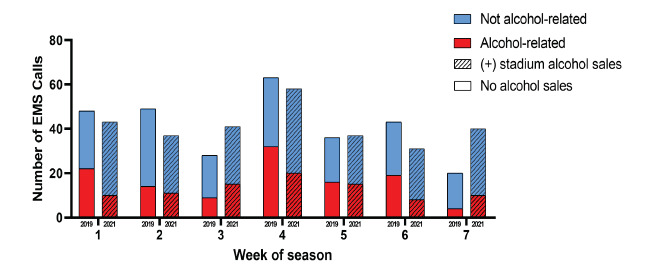
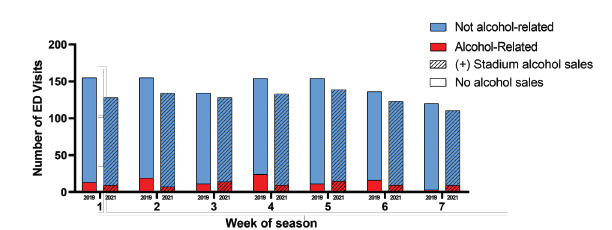
In 2021, after the onset of in-stadium alcohol sales, there were a total of 505 emergency calls to local EMS on football Saturdays (home and away), and 29% of them were for alcohol-related incidents down from 36% of 456 calls in 2019. After adjustment for covariates, the odds of a call being alcohol-related were lower in 2021 than 2019, but this difference was not significant (adjusted odds ratio [aOR] 0.83, 95% CI 0.48-1.42). Looking specifically at the seven home games each season, the difference was more pronounced (31% of calls in 2021 compared to 40% in 2019) but not statistically significant after adjustment for covariates (aOR 0.54, 95% CI 0.15-2.03). In the ED, 1,414 patients were evaluated on game days in 2021 and 8% of them for alcohol-related reasons. This is similar to 2019, when 9% of the 1,538 patients presented due to alcohol-related complaints. After adjustment for covariates, the odds of an ED visit being alcohol-related were similar in 2021 and 2019 (aOR 0.98, 95% CI 0.70-1.38).

CONCLUSION

There was a decrease in alcohol-related EMS calls on home game days in 2021, although the result was not statistically significant. In-stadium alcohol sales had no significant impact on the frequency or proportion of alcohol-related ED visits. The reason for this outcome is unclear, but it is possible that fans drank less at tailgate parties knowing they could consume more once the game started. Long lines and a two-beverage limit at stadium concessions may have kept patrons from consuming excessively. The results of this study may inform similar institutions regarding the safe implementation of alcohol sales during mass-gathering events.
https://cdn.ncbi.nlm.nih.gov/pmc/blobs/8fc0/10047730/e2b7e3225fb1/wjem-24-210-g002.jpg
https://cdn.ncbi.nlm.nih.gov/pmc/blobs/8fc0/10047730/26f4da0868b5/wjem-24-210-g001.jpg
https://cdn.ncbi.nlm.nih.gov/pmc/blobs/8fc0/10047730/e2b7e3225fb1/wjem-24-210-g002.jpg
https://cdn.ncbi.nlm.nih.gov/pmc/blobs/8fc0/10047730/26f4da0868b5/wjem-24-210-g001.jpg
https://cdn.ncbi.nlm.nih.gov/pmc/blobs/8fc0/10047730/e2b7e3225fb1/wjem-24-210-g002.jpg
摘要

简介

2021 年,一所中西部的大型大学首次在橄榄球场馆内向观众出售酒精饮料。该体育场通常可容纳超过 65000 名观众,赛前的场外停车场活动中饮酒现象非常普遍。我们的研究目标是确定体育场内销售酒精饮料对酒精相关急诊(ED)就诊和当地紧急医疗服务(EMS)呼叫发生率的影响。我们假设,整个体育场都提供酒精饮料会导致与酒精相关的患者就诊人数增加。

方法

这是一项回顾性研究,包括在 2019 年和 2021 年橄榄球周六使用当地 EMS 并在 ED 就诊的患者。每年有 11 个周六比赛,其中 7 个主场比赛。由于 COVID-19 相关限制对出勤率的影响,2020 年赛季被排除在外。受过培训的提取器使用预定义标准审查每位患者的记录,以确定就诊是否与酒精有关。使用逻辑回归分析,我们在体育场内开始销售酒精之前和之后检查了 EMS 呼叫和 ED 就诊与酒精有关的可能性。我们使用学生 t 检验比较了就诊前和就诊后特征,用于连续变量,使用卡方检验用于分类变量。

结果

2021 年,在体育场内开始销售酒精饮料后,橄榄球周六(主场和客场)共接到当地 EMS 505 次电话,其中 29%与酒精有关,而 2019 年的这一比例为 36%。在调整了协变量后,2021 年与酒精有关的电话的可能性低于 2019 年,但差异无统计学意义(调整后的比值比[OR]0.83,95%CI0.48-1.42)。具体来看,每个赛季的 7 个主场比赛,差异更为明显(2021 年的电话中有 31%与酒精有关,而 2019 年的电话中有 40%与酒精有关),但在调整了协变量后,差异无统计学意义(调整后的比值比[OR]0.54,95%CI0.15-2.03)。在 ED,2021 年有 1414 名患者在比赛日就诊,其中 8%因酒精相关原因就诊。这与 2019 年相似,当时因酒精相关投诉而就诊的 1538 名患者中有 9%。在调整了协变量后,ED 就诊与酒精有关的可能性在 2021 年和 2019 年相似(调整后的比值比[OR]0.98,95%CI0.70-1.38)。

结论

2021 年主场比赛日与酒精有关的 EMS 电话数量有所减少,尽管结果无统计学意义。体育场内的酒精销售对酒精相关 ED 就诊的频率或比例没有显著影响。这种结果的原因尚不清楚,但有可能是球迷们知道一旦比赛开始就可以多喝酒,因此在停车场的派对上喝得更少了。体育场摊位的长队和两种饮料的限制可能使顾客无法过度消费。这项研究的结果可能为类似的机构提供有关在大规模集会活动中安全实施酒精销售的信息。

相似文献

1
The Impact of Alcohol Sales in A College Football Stadium on Healthcare Utilization.高校橄榄球场边售卖酒类对医疗保健利用率的影响
West J Emerg Med. 2023 Feb 25;24(2):210-217. doi: 10.5811/westjem.2022.11.58766.
2
Alcohol-related emergency department visits associated with collegiate football games.与大学生橄榄球比赛相关的酒精相关急诊就诊。
J Am Coll Health. 2011;59(5):388-92. doi: 10.1080/07448481.2010.511364.
3
Emergency medical care for spectators attending National Football League games.为观看美国国家橄榄球联盟比赛的观众提供的紧急医疗护理。
Prehosp Emerg Care. 1997 Jul-Sep;1(3):149-55. doi: 10.1080/10903129708958809.
4
(Unintended) Consequences of initiating an alcohol sales policy at college football stadiums: A case study.(非本意的)在大学橄榄球场实行酒类销售政策的意外后果:一项案例研究。
J Am Coll Health. 2019 Jul;67(5):397-401. doi: 10.1080/07448481.2018.1484366. Epub 2018 Sep 21.
5
General Drinking Motives and Alcohol Consumption across Three Contexts: Drinking Games, Tailgating, and in Stadium.一般饮酒动机与三种情境下的饮酒行为:饮酒游戏、露天看球赛和体育场内。
Subst Use Misuse. 2022;57(8):1171-1176. doi: 10.1080/10826084.2022.2064504. Epub 2022 May 4.
6
Can Emergency Medical Services Utilization Rates Be Used to Measure the Success of An Alcohol Amnesty Policy?紧急医疗服务利用率能否用于衡量酒精免责政策的成功?
Prehosp Emerg Care. 2021 May-Jun;25(3):427-431. doi: 10.1080/10903127.2020.1771488. Epub 2020 Jun 23.
7
The association between alcohol-related arrests and college football game days.与酒精相关的逮捕与大学橄榄球比赛日之间的关联。
Drug Alcohol Depend. 2010 Jan 1;106(1):69-71. doi: 10.1016/j.drugalcdep.2009.07.012. Epub 2009 Aug 29.
8
Factors Associated With Voluntary Refusal of Emergency Medical System Transport for Emergency Care in Detroit During the Early Phase of the COVID-19 Pandemic.与 COVID-19 大流行早期底特律紧急医疗系统自愿拒绝紧急护理转运相关的因素。
JAMA Netw Open. 2021 Aug 2;4(8):e2120728. doi: 10.1001/jamanetworkopen.2021.20728.
9
Identifying the Influence of Opponent Ranking and Game Characteristics on Alcohol-Related Stadium Ejections.确定对手排名和比赛特征对与酒精相关的体育场驱逐事件的影响。
J Prim Prev. 2018 Apr;39(2):117-128. doi: 10.1007/s10935-018-0504-0.
10
The Effect of Sporting Events on Medical Transport Time at a Level 1 Trauma Center: a Retrospective Cohort Study.体育赛事对一级创伤中心医疗转运时间的影响:一项回顾性队列研究。
W V Med J. 2017 May-Jun;113(3):44-51.

引用本文的文献

1
Ambulance Transports from NCAA Division 1 Football Games.美国大学体育总会一级分区橄榄球比赛的救护车转运情况。
Prehosp Disaster Med. 2024 Jun;39(3):266-269. doi: 10.1017/S1049023X24000402. Epub 2024 Oct 10.

本文引用的文献

1
(Unintended) Consequences of initiating an alcohol sales policy at college football stadiums: A case study.(非本意的)在大学橄榄球场实行酒类销售政策的意外后果:一项案例研究。
J Am Coll Health. 2019 Jul;67(5):397-401. doi: 10.1080/07448481.2018.1484366. Epub 2018 Sep 21.
2
Trends in incidence and risk markers of student emergency department visits with alcohol intoxication in a U.S. public university-A longitudinal data linkage study.美国一所公立大学学生因醉酒前往急诊部就诊的发病率和风险标志物趋势——一项纵向数据链接研究。
Drug Alcohol Depend. 2018 Jul 1;188:341-347. doi: 10.1016/j.drugalcdep.2018.03.050. Epub 2018 May 8.
3
Identifying the Influence of Opponent Ranking and Game Characteristics on Alcohol-Related Stadium Ejections.
确定对手排名和比赛特征对与酒精相关的体育场驱逐事件的影响。
J Prim Prev. 2018 Apr;39(2):117-128. doi: 10.1007/s10935-018-0504-0.
4
Impact of the EURO-2016 football cup on emergency department visits related to alcohol and injury.2016 年欧洲杯足球赛对与酒精和损伤相关的急诊科就诊的影响。
Eur J Public Health. 2018 Jun 1;28(3):434-436. doi: 10.1093/eurpub/ckx233.
5
Ethanol Values During College Football Season: University Policy Change and Emergency Department Blood Ethanol Values From 2006 Through 2014.
Lab Med. 2016 Nov;47(4):300-305. doi: 10.1093/labmed/lmw028. Epub 2016 Aug 29.
6
Alcohol-related emergency department visits associated with collegiate football games.与大学生橄榄球比赛相关的酒精相关急诊就诊。
J Am Coll Health. 2011;59(5):388-92. doi: 10.1080/07448481.2010.511364.
7
Student drinking at U.S. college sports events.美国高校体育赛事中的学生饮酒现象。
Subst Use Misuse. 2010 Oct;45(12):1861-73. doi: 10.3109/10826081003682214.
8
Extreme ritualistic alcohol consumption among college students on game day.大学生在比赛日的极端仪式性饮酒行为。
J Am Coll Health. 2010 Mar-Apr;58(5):413-23. doi: 10.1080/07448480903540473.
9
High-risk versus low-risk football game weekends: differences in problem drinking and alcohol-related consequences on college campuses in the United States.高风险与低风险橄榄球比赛周末:美国大学校园中问题饮酒及与酒精相关后果的差异。
Int J Adolesc Med Health. 2009 Apr-Jun;21(2):249-62. doi: 10.1515/ijamh.2009.21.2.249.
10
Alcohol-related fan behavior on college football game day.大学橄榄球比赛日与酒精相关的球迷行为。
J Am Coll Health. 2007 Nov-Dec;56(3):255-60. doi: 10.3200/JACH.56.3.255-260.