Icahn School of Medicine at Mount Sinai, New York City, New York, USA.
Department of Emergency Management, University of Minnesota, Minneapolis, Minnesota, USA.
Prehosp Disaster Med. 2024 Jun;39(3):266-269. doi: 10.1017/S1049023X24000402. Epub 2024 Oct 10.
There is significant public health interest towards providing medical care at mass-gathering events. Furthermore, mass gatherings have the potential to have a detrimental impact on the availability of already-limited municipal Emergency Medical Services (EMS) resources. This study presents a cross-sectional descriptive analysis to report broad trends regarding patients who were transported from National Collegiate Athletic Association (NCAA) Division 1 collegiate football games at a major public university in order to better inform emergency preparedness and resource planning for mass gatherings.
Patient care reports (PCRs) from ambulance transports originating from varsity collegiate football games at the University of Minnesota across six years were examined. Pertinent information was abstracted from each PCR.
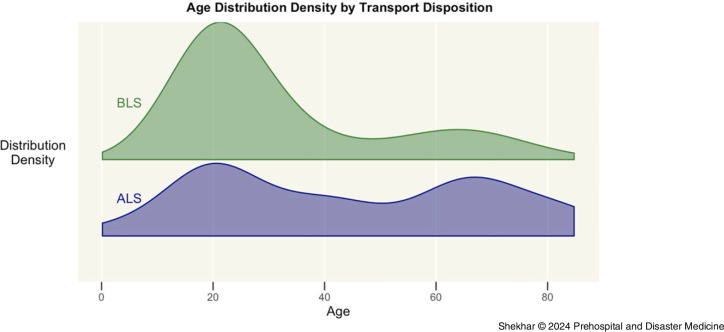
Across the six years of data, there were a total of 73 patient transports originating from NCAA collegiate football games: 45.2% (n = 33) were male, and the median age was 22 years. Alcohol-related chief complaints were involved in 50.7% (n = 37) of transports. In total, 31.5% of patients had an initial Glasgow Coma Scale (GCS) of less than 15. The majority (65.8%; n = 48; 0.11 per 10,000 attendees) were transported by Basic Life Support (BLS) ambulances. The remaining patients (34.2%; n = 25; 0.06 per 10,000 attendees) were transported by Advanced Life Support (ALS) ambulances and were more likely to be older, have abnormal vital signs, and have a lower GCS.
This analysis of ambulance transports from NCAA Division 1 collegiate football games emphasizes the prevalence of alcohol-related chief complaints, but also underscores the likelihood of more life-threatening conditions at mass gatherings. These results and additional research will help inform emergency preparedness at mass-gathering events.
为大型集会活动提供医疗服务引起了公众的广泛关注。此外,大型集会活动可能会对已经有限的城市紧急医疗服务(EMS)资源的可用性产生不利影响。本研究通过横截面描述性分析报告了在一所主要公立大学的全国大学体育协会(NCAA)一级大学橄榄球赛中从患者身上转运的广泛趋势,以便更好地为大型集会活动的应急准备和资源规划提供信息。
检查了六年来明尼苏达大学大学橄榄球赛的救护车转运患者护理报告(PCR)。从每份 PCR 中提取了相关信息。
在六年的数据中,共有 73 名患者从 NCAA 大学橄榄球赛中转运:45.2%(n=33)为男性,中位数年龄为 22 岁。与酒精相关的主要投诉涉及 50.7%(n=37)的转运患者。总共有 31.5%的患者初始格拉斯哥昏迷量表(GCS)评分低于 15。大多数患者(65.8%;n=48;每 10000 名参与者中有 0.11 人)由基础生命支持(BLS)救护车转运。其余患者(34.2%;n=25;每 10000 名参与者中有 0.06 人)由高级生命支持(ALS)救护车转运,这些患者更有可能年龄较大,生命体征异常,GCS 较低。
这项对 NCAA Division 1 大学橄榄球比赛的救护车转运分析强调了与酒精相关的主要投诉的普遍性,但也强调了在大型集会活动中更有可能出现危及生命的情况。这些结果和其他研究将有助于为大型集会活动的应急准备提供信息。