Mohammadi Somayeh, Monazzami Amirabbas, Alavimilani Solmaz
Department of Sport Physiology, Faculty of Sport Sciences, Razi University, Kermanshah, Iran.
Department of Obstetrics and Gynecology, Imam Reza Hospital, Kermanshah University of Medical Sciences, Kermanshah, Iran.
BMC Sports Sci Med Rehabil. 2023 Mar 29;15(1):47. doi: 10.1186/s13102-023-00653-z.
Studies have revealed that high-intensity interval training (HIIT) has beneficial effect on hormonal, cardiovascular indices in women with polycystic ovary syndrome (PCOS). There, however, is still no comprehensive data on the type, intensity and duration of training for these women.
The current study aimed to investigate the effects of high-intensity interval training (HIIT) on metabolic, hormonal and cardiovascular indices in women with PCOS compared to a control group.
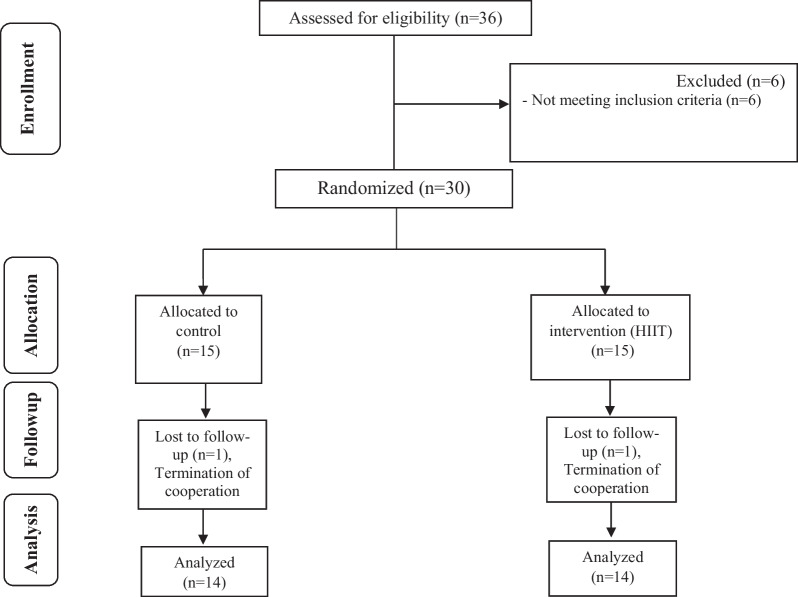
In a randomized controlled study, 28 patients (age: 23.8 ± 5.3 years, weight: 82.4 ± 9.7 kg, BMI: 30.33 ± 3.99 kg/m) were divided into two groups including HIIT (n = 14) and the control (n = 14). The training protocol was performed with 100-110 maximum aerobic velocity (MAV), 4-6 sets, 4 laps, 3 sessions per week for eight weeks. Anthropometric indices, aerobic performance, insulin resistance and sensitivity, lipid profiles, testosterone, cortisol and hs-CRP were evaluated.
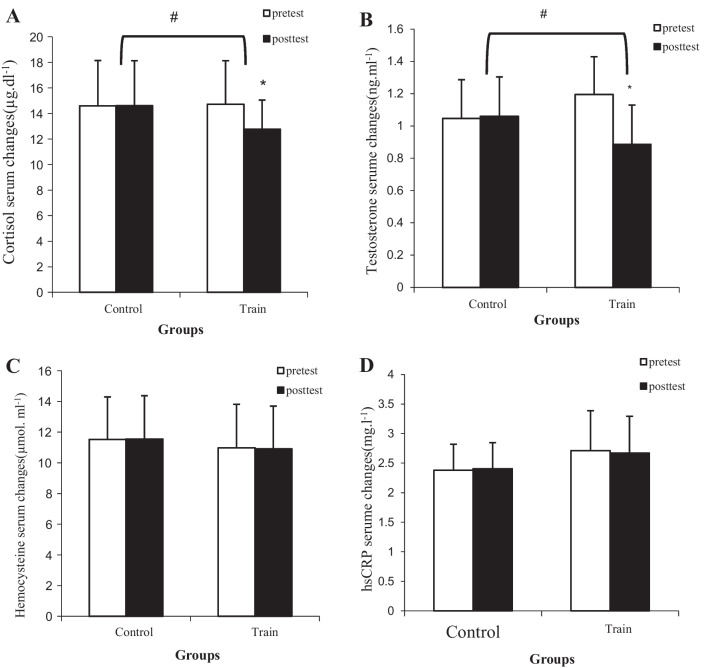
The HIIT intervention decreased BMI, waist to hip ratio (WHR), visceral fat, insulin, insulin resistance, low density lipoprotein (LDL), atherogenic index, cholesterol and cortisol (P < 0.05). All variables remained unchanged in the control group (P > 0.05). Except for VAI, FBG, HDL, TG and AIP, the rest of the variables in the training and control groups show a significant difference (P < 0.05).
The results of the present study indicate that eight weeks of HIIT has beneficial effects on anthropometric, insulin sensitivity, fat profile, and inflammatory and cardiovascular indices in PCOS patients. It seems that the intensity of HIIT (100-110 MAV) is a determining factor in creating optimal adaptations in PCOS patients.
IRCT20130812014333N143. Registration date: 22/03/2020. URL: https://en.irct.ir/trial/46295 .
研究表明,高强度间歇训练(HIIT)对多囊卵巢综合征(PCOS)女性的激素和心血管指标有有益影响。然而,关于这些女性的训练类型、强度和持续时间仍缺乏全面的数据。
本研究旨在探讨与对照组相比,高强度间歇训练(HIIT)对PCOS女性代谢、激素和心血管指标的影响。
在一项随机对照研究中,28例患者(年龄:23.8±5.3岁,体重:82.4±9.7kg,BMI:30.33±3.99kg/m)被分为两组,即HIIT组(n = 14)和对照组(n = 14)。训练方案以最大有氧速度(MAV)100 - 110、4 - 6组、4圈、每周3次的频率进行,持续8周。评估人体测量指标、有氧能力、胰岛素抵抗和敏感性、血脂谱、睾酮、皮质醇和高敏C反应蛋白。
HIIT干预降低了BMI、腰臀比(WHR)、内脏脂肪、胰岛素、胰岛素抵抗、低密度脂蛋白(LDL)、动脉粥样硬化指数、胆固醇和皮质醇(P < 0.05)。对照组所有变量均无变化(P > 0.05)。除VAI、空腹血糖(FBG)、高密度脂蛋白(HDL)、甘油三酯(TG)和动脉粥样硬化指数乘积(AIP)外,训练组和对照组的其余变量均有显著差异(P < 0.05)。
本研究结果表明,8周的HIIT对PCOS患者的人体测量、胰岛素敏感性、脂肪分布以及炎症和心血管指标有有益影响。似乎HIIT的强度(100 - 110 MAV)是PCOS患者产生最佳适应性的决定因素。
IRCT20130812014333N143。注册日期:2020年3月22日。网址:https://en.irct.ir/trial/46295 。