Agradi Stella, Cremonesi Paola, Menchetti Laura, Balzaretti Claudia, Severgnini Marco, Riva Federica, Castiglioni Bianca, Draghi Susanna, Di Giancamillo Alessia, Castrica Marta, Vigo Daniele, Modina Silvia Clotilde, Serra Valentina, Quattrone Alda, Angelucci Elisa, Pastorelli Grazia, Curone Giulio, Brecchia Gabriele
Department of Veterinary Medicine, University of Milano, Via dell'Università 6, 26900 Lodi, Italy.
Institute of Agricultural Biology and Biotechnology (IBBA), National Research Council (CNR), U.O.S. di Lodi, Via Einstein, 26900 Lodi, Italy.
Animals (Basel). 2023 Mar 8;13(6):976. doi: 10.3390/ani13060976.
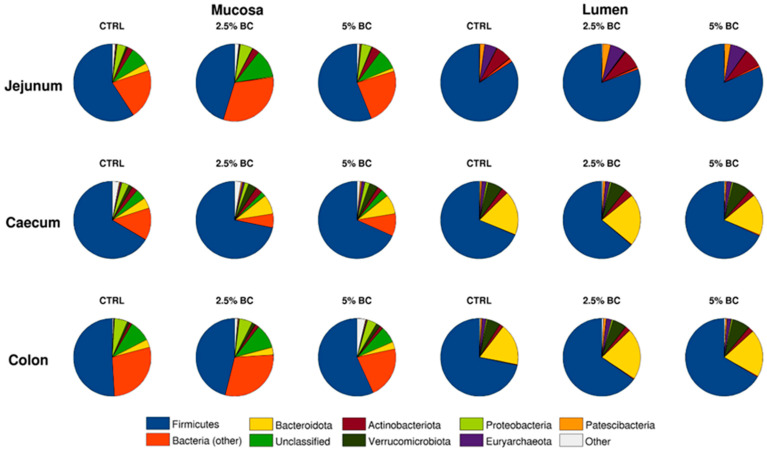
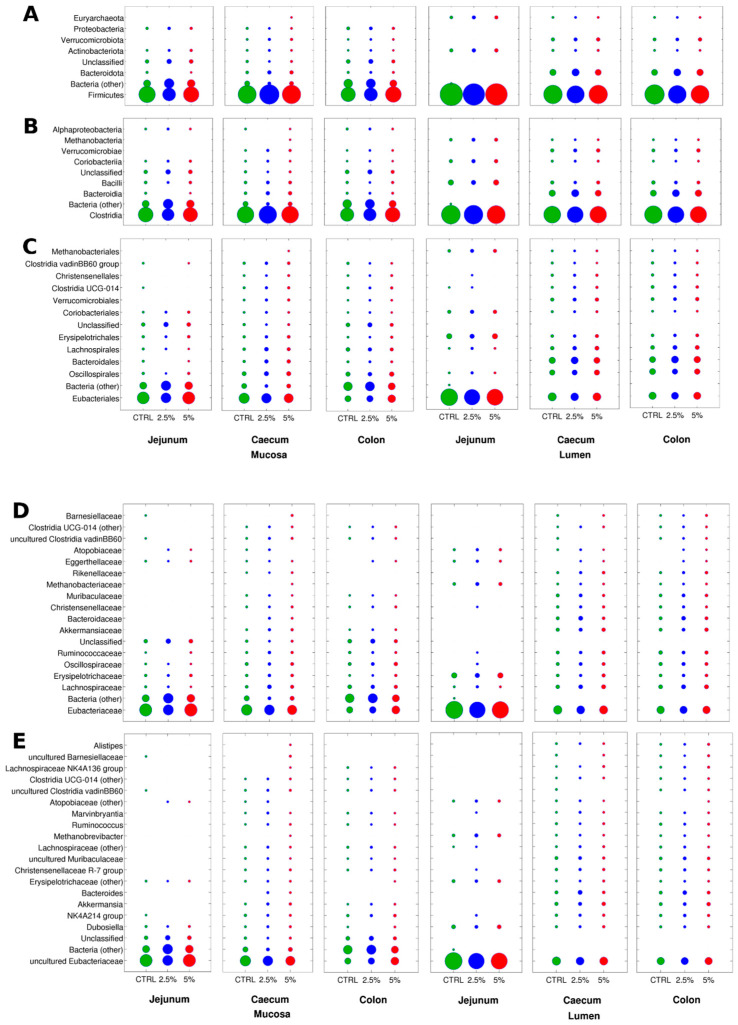
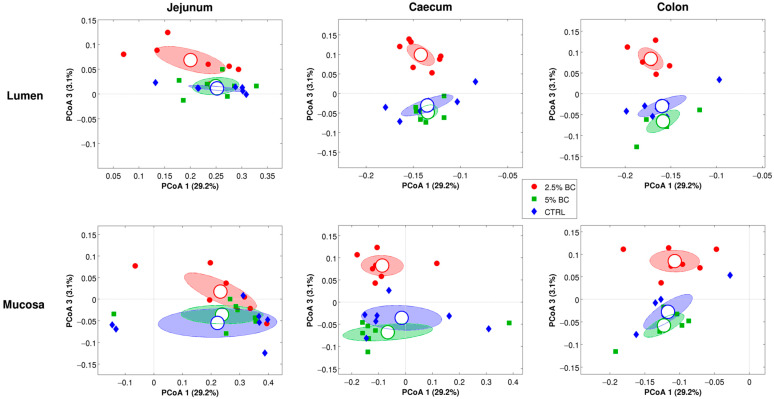
BC is a nutraceutical that can modulate intestinal microbiota. This study investigates the effects of BC diet supplementation on luminal and mucosa-associated microbiota in the jejunum, caecum, and colon of rabbits. Twenty-one New Zealand White female rabbits were divided into three experimental groups ( = 7) receiving a commercial feed (CTRL group) and the same diet supplemented with 2.5% and 5% BC (2.5% BC and 5% BC groups, respectively), from 35 (weaning) to 90 days of age (slaughtering). At slaughter, the digestive tract was removed from each animal, then both content and mucosa-associated microbiota of jejunum, caecum, and colon were collected and analysed by Next Generation 16SrRNA Gene Sequencing. Significant differences were found in the microbial composition of the three groups (i.e., beta-diversity: < 0.01), especially in the caecum and colon of the 2.5% BC group. The relative abundance analysis showed that the families most affected by the BC administration were Clostridia UCG-014, Barnesiellaceae, and Eggerthellaceae. A trend was also found for Lachnospiraceae, Akkermansiaceae, and Bacteroidaceae. A functional prediction has revealed several altered pathways in BC groups, with particular reference to amino acids and lactose metabolism. Firmicutes:Bacteroidetes ratio decreased in caecum luminal samples of the 2.5% BC group. These findings suggest that BC supplementation could positively affect the intestinal microbiota. However, further research is needed to establish the optimal administration dose.
BC是一种可调节肠道微生物群的营养保健品。本研究调查了补充BC饮食对兔空肠、盲肠和结肠腔内及黏膜相关微生物群的影响。将21只新西兰白兔雌性兔分为三个实验组(每组n = 7),从35日龄(断奶)至90日龄(屠宰),分别给予商业饲料(CTRL组)以及添加2.5%和5% BC的相同饮食(分别为2.5% BC组和5% BC组)。屠宰时,从每只动物身上取出消化道,然后收集空肠、盲肠和结肠的内容物及黏膜相关微生物群,并通过下一代16SrRNA基因测序进行分析。发现三组的微生物组成存在显著差异(即β多样性:P < 0.01),尤其是在2.5% BC组的盲肠和结肠中。相对丰度分析表明,受BC给药影响最大的菌科为梭菌属UCG - 014、巴恩斯氏菌科和埃格特氏菌科。还发现毛螺菌科、阿克曼氏菌科和拟杆菌科有变化趋势。功能预测显示BC组有几条途径发生改变,特别是氨基酸和乳糖代谢途径。2.5% BC组盲肠腔样本中的厚壁菌门:拟杆菌门比例下降。这些发现表明补充BC可能对肠道微生物群有积极影响。然而,需要进一步研究以确定最佳给药剂量。