Sacca Valeria, Maleki Nasim, Wen Ya, Hodges Sierra, Kong Jian
Department of Psychiatry, Massachusetts General Hospital and Harvard Medical School, 120 2nd Avenue, Charlestown, MA 02129, USA.
Brain Sci. 2023 Feb 25;13(3):395. doi: 10.3390/brainsci13030395.
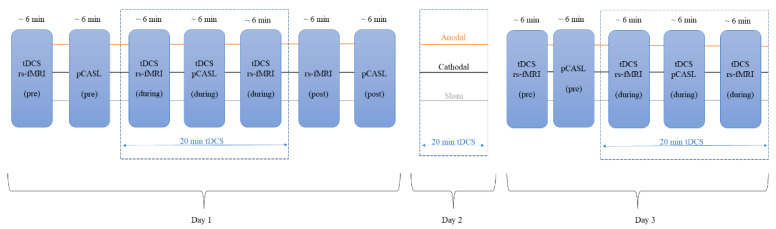
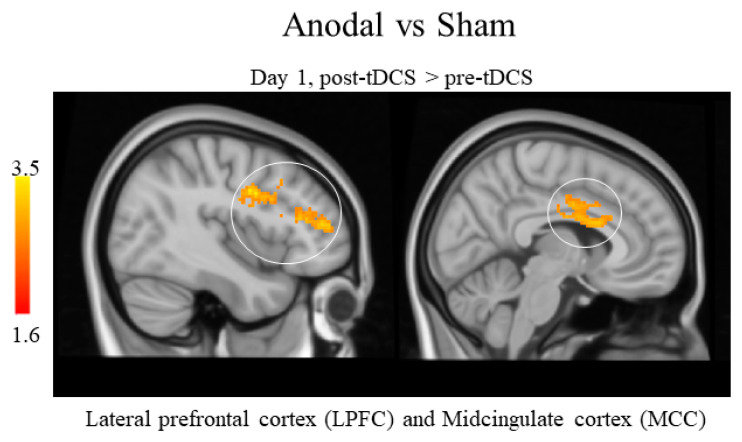
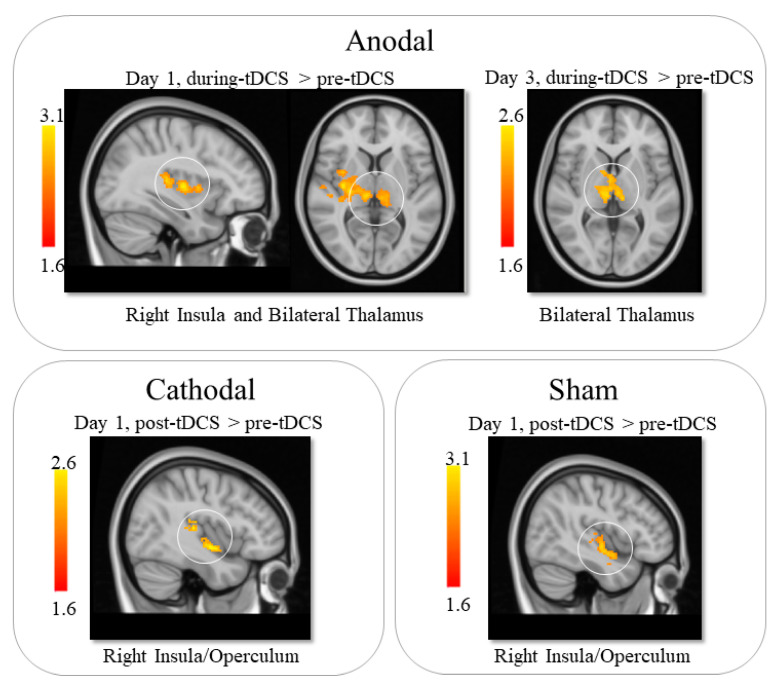
Transcranial direct current stimulation (tDCS) is a promising non-invasive method to modulate brain excitability. The aim of this study was to better understand the cerebral blood flow (CBF) changes during and after repeated tDCS at the right dorsolateral prefrontal cortex (DLPFC) in healthy participants using pulsed continuous arterial spin labeling (pCASL). Elucidating CBF changes associated with repeated tDCS may shed light on the understanding of the mechanisms underlying the therapeutic effects of tDCS. tDCS was applied for three consecutive days for 20 min at 2 mA, and MRI scans were performed on day 1 and 3. During anodal tDCS, increased CBF was detected in the bilateral thalamus on day 1 and 3 (12% on day 1 and of 14% on day 3) and in the insula on day 1 (12%). After anodal tDCS on day 1, increased CBF was detected in the cerebellum and occipital lobe (11.8%), while both cathodal and sham tDCS were associated with increased CBF in the insula (11% and 10%, respectively). Moreover, anodal tDCS led to increased CBF in the lateral prefrontal cortex and midcingulate cortex in comparison to the sham. These findings suggest that tDCS can modulate the CBF and different tDCS modes may lead to different effects.
经颅直流电刺激(tDCS)是一种很有前景的用于调节大脑兴奋性的非侵入性方法。本研究的目的是使用脉冲式连续动脉自旋标记(pCASL),更好地了解健康受试者在右侧背外侧前额叶皮质(DLPFC)进行重复tDCS期间及之后的脑血流量(CBF)变化。阐明与重复tDCS相关的CBF变化可能有助于理解tDCS治疗效果的潜在机制。tDCS连续三天每天以2毫安的电流施加20分钟,并在第1天和第3天进行MRI扫描。在阳极tDCS期间,第1天和第3天双侧丘脑检测到CBF增加(第1天为12%,第3天为14%),第1天岛叶检测到CBF增加(12%)。在第1天进行阳极tDCS后,小脑和枕叶检测到CBF增加(11.8%),而阴极tDCS和假刺激tDCS均与岛叶CBF增加相关(分别为11%和10%)。此外,与假刺激相比,阳极tDCS导致外侧前额叶皮质和中央前扣带回皮质的CBF增加。这些发现表明,tDCS可以调节CBF,不同的tDCS模式可能导致不同的效果。