Adekanmbi Toyin, Wang Xiuquan, Basheer Sana, Nawaz Rana Ali, Pang Tianze, Hu Yulin, Liu Suqi
Canadian Centre for Climate Change and Adaptation, University of Prince Edward Island, St. Peters Bay, Charlottetown, PE C0A 2A0, Canada.
School of Climate Change and Adaptation, University of Prince Edward Island, Charlottetown, PE C1A 4P3, Canada.
Foods. 2023 Mar 10;12(6):1176. doi: 10.3390/foods12061176.
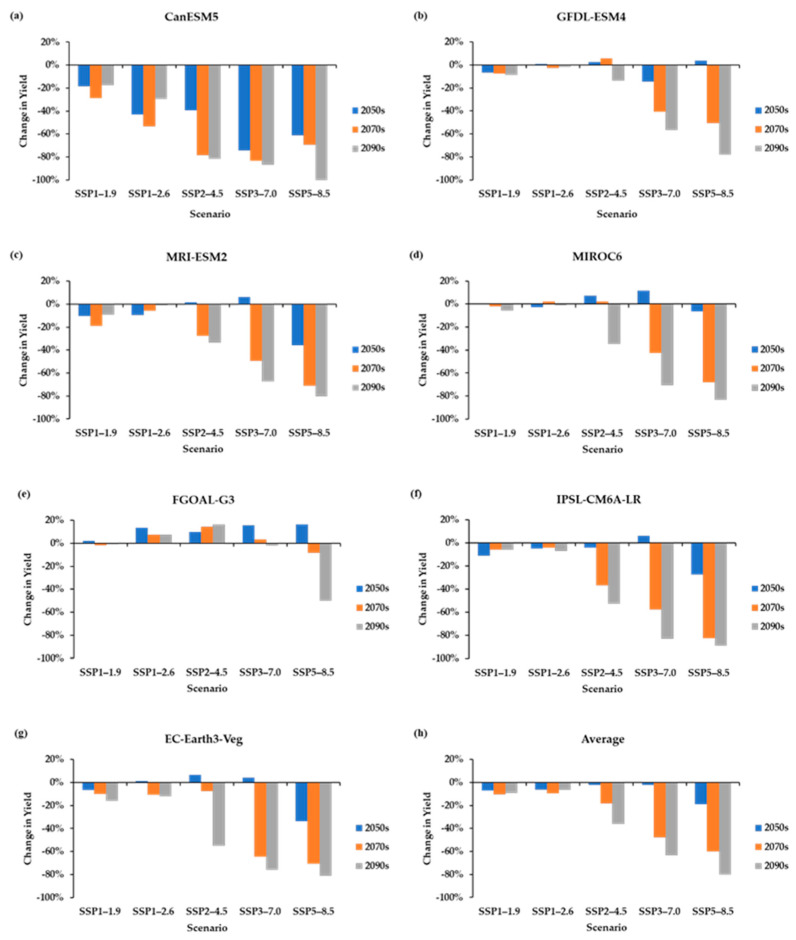
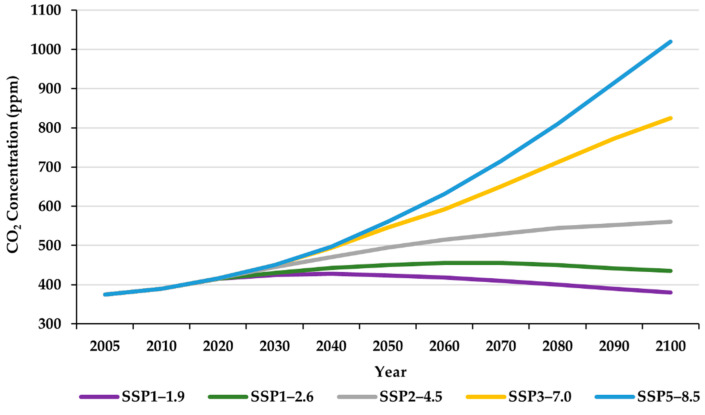
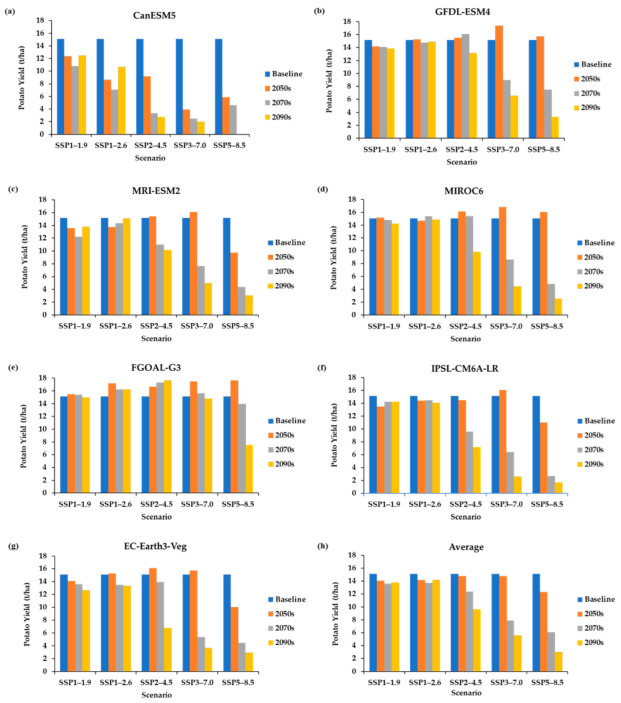
Crop yields are adversely affected by climate change; therefore, it is crucial to develop climate adaptation strategies to mitigate the impacts of increasing climate variability on the agriculture system to ensure food security. As one of the largest potato-producing provinces in Canada, Prince Edward Island (PEI) has recently experienced significant instability in potato production. PEI's local farmers and stakeholders are extremely concerned about the prospects for the future of potato farming industries in the context of climate change. This study aims to use the Decision Support System for Agrotechnology Transfer (DSSAT) potato model to simulate future potato yields under the Coupled Model Intercomparison Project Phase 6 (CMIP6) climate scenarios (including SSP1-1.9, SSP1-2.6, SSP2-4.5, SSP3-7.0, and SSP5-8.5). The study evaluates the combined effects of changing climatic conditions at local scales (i.e., warming temperature and changing precipitation patterns) and increasing carbon dioxide (CO) concentration in the atmosphere. The results indicate future significant declines in potato yield in PEI under the current farming practices. In particular, under the high-emission scenarios (e.g., SSP3-7.0 and SSP5-8.5), the potato yield in PEI would decline by 48% and 60% in the 2070s and by 63% and 80% by 2090s; even under the low-emission scenarios (i.e., SSP1-1.9 and SSP1-2.6), the potato yield in PEI would still decline by 6-10%. This implies that it is important to develop effective climate adaptation measures (e.g., adjusting farming practices and introducing supplemental irrigation plans) to ensure the long-term sustainability of potato production in PEI.
作物产量受到气候变化的不利影响;因此,制定气候适应策略以减轻气候变率增加对农业系统的影响,从而确保粮食安全至关重要。作为加拿大最大的马铃薯生产省份之一,爱德华王子岛(PEI)近期马铃薯生产出现了显著不稳定。PEI当地农民和利益相关者对气候变化背景下马铃薯种植产业的未来前景极为担忧。本研究旨在使用农业技术转移决策支持系统(DSSAT)马铃薯模型,在耦合模式比较计划第6阶段(CMIP6)气候情景(包括SSP1-1.9、SSP1-2.6、SSP2-4.5、SSP3-7.0和SSP5-8.5)下模拟未来马铃薯产量。该研究评估了当地尺度气候变化(即温度升高和降水模式变化)以及大气中二氧化碳(CO)浓度增加的综合影响。结果表明,在当前种植方式下,PEI未来马铃薯产量将大幅下降。特别是在高排放情景下(如SSP3-7.0和SSP5-8.5),PEI的马铃薯产量在2070年代将下降48%和60%,到2090年代将下降63%和80%;即使在低排放情景下(即SSP1-1.9和SSP1-2.6),PEI的马铃薯产量仍将下降6-10%。这意味着制定有效的气候适应措施(如调整种植方式和引入补充灌溉计划)对于确保PEI马铃薯生产的长期可持续性很重要。