Institute of Subtropical Agriculture, Chinese Academy of Sciences, Changsha, 410125, China.
Research Faculty of Agriculture, Hokkaido University, Sapporo, 0608589, Japan.
Sci Rep. 2023 Jan 5;13(1):230. doi: 10.1038/s41598-022-27357-7.
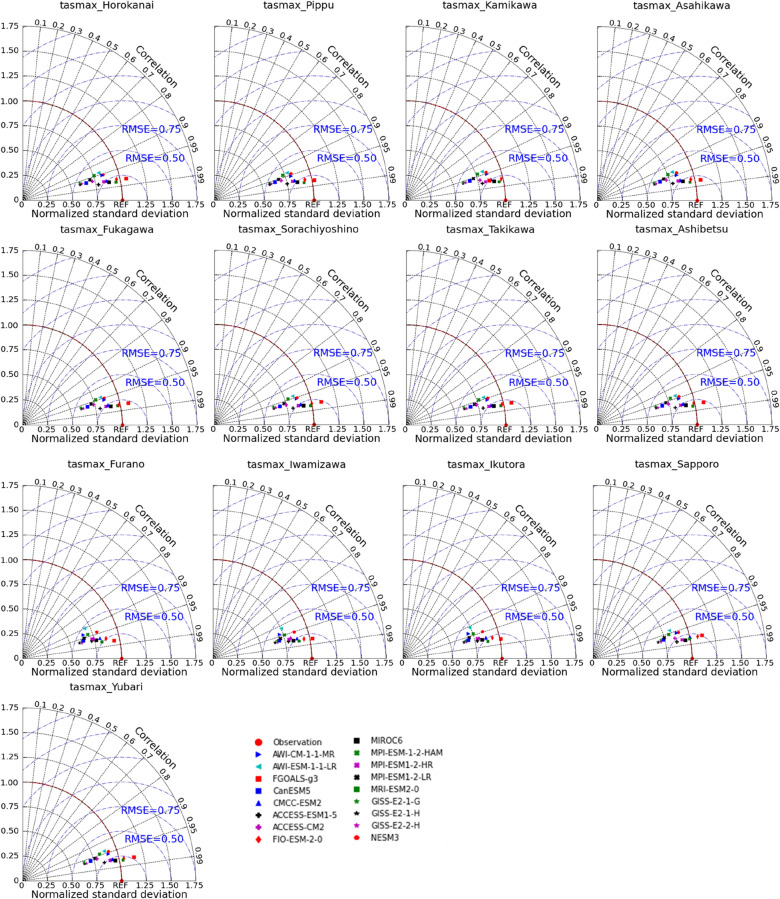
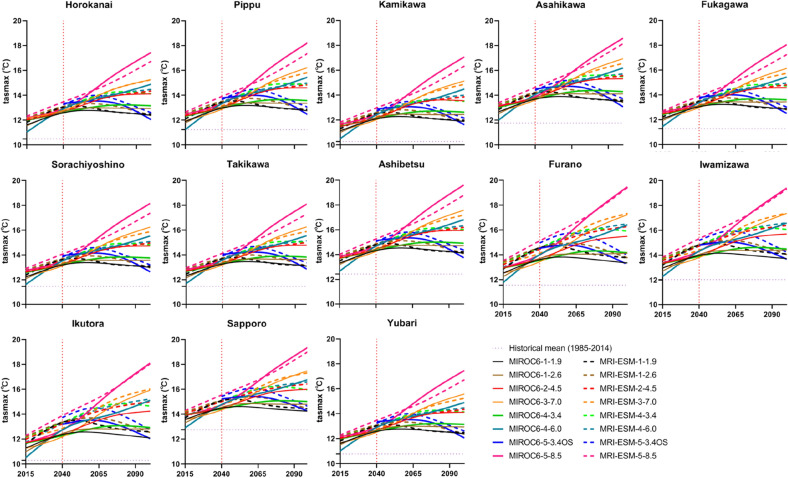
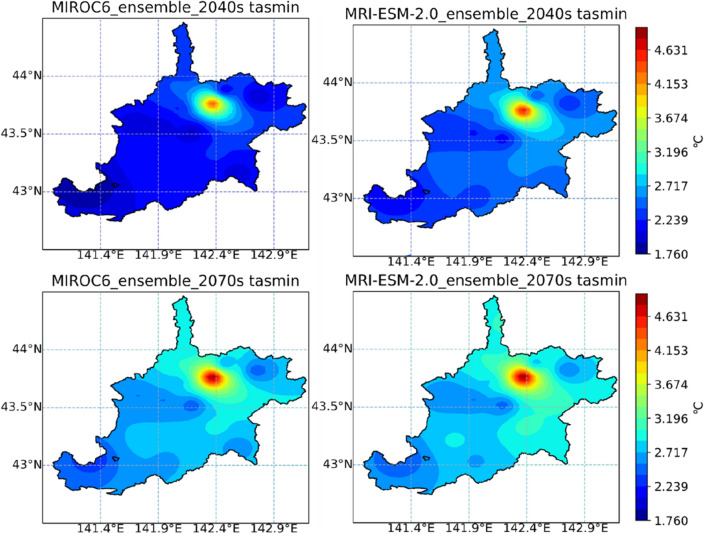
Simulation of future climate changes, especially temperature and rainfall, is critical for water resource management, disaster mitigation, and agricultural development. Based on the category-wise indicator method, two preferred Global Climate Models (GCMs) for the Ishikari River basin (IRB), the socio-economic center of Hokkaido, Japan, were examined from the newly released Coupled Model Intercomparison Project Phase 6 (CMIP6). Climatic variables (maximum/minimum temperature and precipitation) were projected by the Statistical DownScaling Model (SDSM) under all shared socioeconomic pathway-representative concentration pathway (SSP-RCP) scenarios (SSP1-1.9, SSP1-2.6, SSP2-4.5, SSP3-7.0, SSP4-3.4, SSP4-6.0, SSP5-3.4OS, and SSP5-8.5) in two phases: 2040-2069 (2040s) and 2070-2099 (2070s), with the period of 1985-2014 as the baseline. Predictors of SDSM were derived from CMIP6 GCMs and the reanalysis dataset NOAA-CIRES-DOE 20th Century Reanalysis V3 (20CRv3). Results showed that CMIP6 GCMs had a significant correlation with temperature measurements, but could not represent precipitation features in the IRB. The constructed SDSM could capture the characteristics of temperature and precipitation during the calibration (1985-1999) and validation (2000-2014) phases, respectively. The selected GCMs (MIROC6 and MRI-ESM-2.0) generated higher temperature and less rainfall in the forthcoming phases. The SSP-RCP scenarios had an apparent influence on temperature and precipitation. High-emission scenarios (i.e., SSP5-8.5) would project a higher temperature and lower rainfall than the low-emission scenarios (e.g., SSP1-1.9). Spatial-temporal analysis indicated that the northern part of the IRB is more likely to become warmer with heavier precipitation than the southern part in the future. Higher temperature and lower rainfall were projected throughout the late twenty-first century (2070s) than the mid-century (2040s) in the IRB. The findings of this study could be further used to predict the hydrological cycle and assess the ecosystem's sustainability.
未来气候变化,特别是温度和降雨量的模拟,对水资源管理、灾害缓解和农业发展至关重要。本研究基于类别指标方法,从新发布的耦合模式比较计划第六阶段(CMIP6)中选择了两个对日本北海道石狩流域(IRB)最适用的全球气候模型(GCM)。在所有共享社会经济途径代表性浓度途径(SSP-RCP)情景(SSP1-1.9、SSP1-2.6、SSP2-4.5、SSP3-7.0、SSP4-3.4、SSP4-6.0、SSP5-3.4OS 和 SSP5-8.5)下,使用统计降尺度模型(SDSM)对气候变量(最高/最低温度和降水)进行预测,共分为两个阶段:2040-2069 年(2040 年代)和 2070-2099 年(2070 年代),1985-2014 年为基准期。SDSM 的预测因子来自 CMIP6 GCM 和再分析数据集 NOAA-CIRES-DOE 20 世纪再分析 V3(20CRv3)。结果表明,CMIP6 GCM 与温度测量值具有显著相关性,但无法代表 IRB 中的降水特征。所构建的 SDSM 分别能够捕捉到校准(1985-1999 年)和验证(2000-2014 年)阶段的温度和降水特征。所选 GCM(MIROC6 和 MRI-ESM-2.0)在未来阶段产生了更高的温度和更少的降水。SSP-RCP 情景对温度和降水有明显影响。高排放情景(即 SSP5-8.5)预计比低排放情景(如 SSP1-1.9)产生更高的温度和更低的降水。时空分析表明,在未来,IRB 的北部比南部更有可能变暖,降水更多。在整个 21 世纪后期(2070 年代),IRB 的温度比中期(2040 年代)更高,降水更少。本研究的结果可进一步用于预测水文循环并评估生态系统的可持续性。