Department of Food Market and Consumer Research, Institute of Human Nutrition Sciences, Warsaw University of Life Sciences, 07-787 Warsaw, Poland.
Int J Environ Res Public Health. 2021 Mar 20;18(6):3217. doi: 10.3390/ijerph18063217.
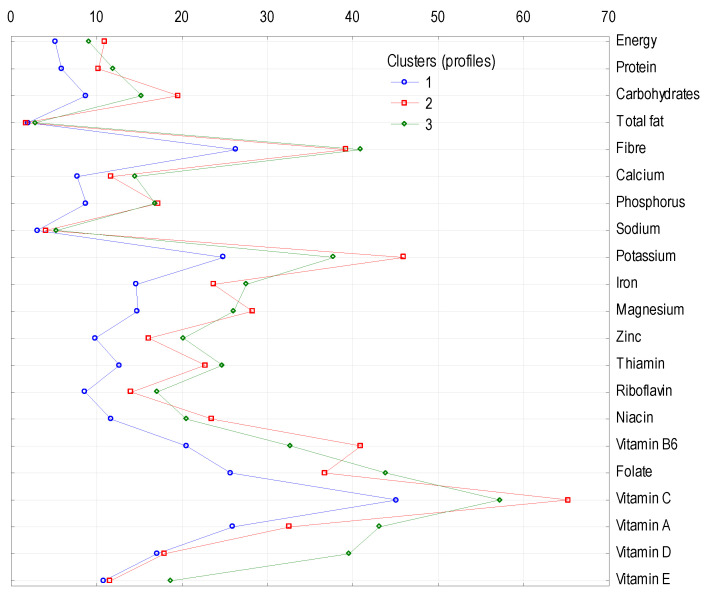
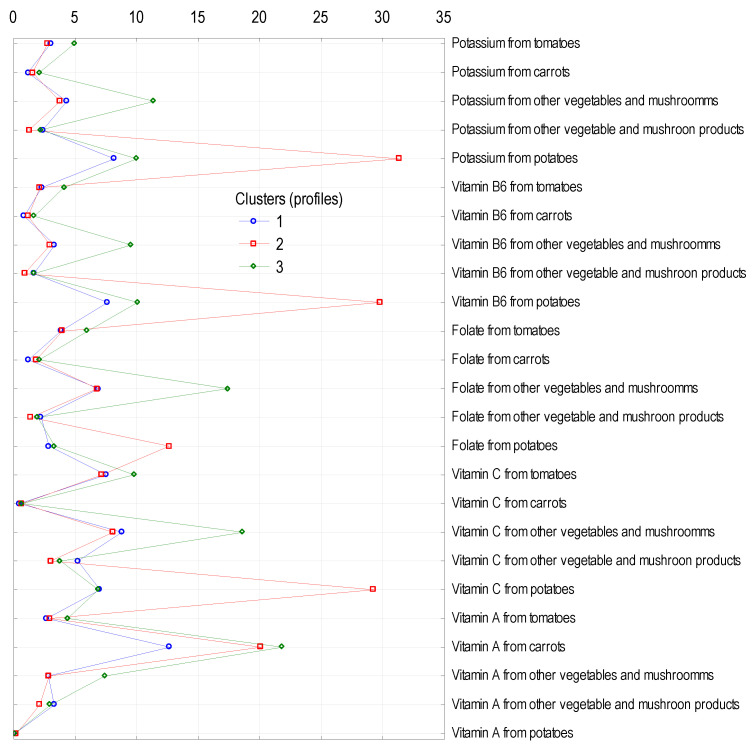
The aim of our study was to analyse vegetables, potatoes and their products as sources of energy and nutrients in the average diet in Poland. Representative data of the 2016 Household Budget Survey from 36,886 households were used. This is the largest study sample in Poland, so we generalized the conclusions to the whole population using the statement 'average diet'. We analysed three main product groups: vegetables, vegetable products, and potatoes and potatoes products, dividing them into 14 subgroups (e.g., tomatoes, cabbage, carrots, other vegetables, and mushrooms). The percentages of energy, protein, carbohydrates, total fat, nine vitamins (thiamine, riboflavin, niacin, vitamin B6, folate, vitamin C, vitamin A, vitamin D, and vitamin E), seven minerals (calcium, phosphorus, sodium, potassium, iron, magnesium and zinc), and fibre from the analysed food subgroups are presented. Additionally, the influence of household characteristics on the supply of energy and nutrients from each subgroup of vegetables, potatoes, and their products was evaluated using cluster analysis. In the analysis, R programme and Kohonen neural networks were applied. Our study showed that vegetables, potatoes, and their products provide 7.3% of daily dietary energy supply. Vegetables contribute more than 20% of the supply of six nutrients: vitamin C (51.8%), potassium (32.5%), folate (31.0%), vitamin A (30.6%), vitamin B6 (27.8%), and magnesium (20.2%), as well as fibre (31.8%). Cluster analysis distinguished three clusters that differed in nutritional supply from vegetables, potatoes, and their products. Educational level, income measured by quintile groups, village size, socio-economic characteristics, urbanization degree, and land use were the most important factors determining differences between clusters.
本研究旨在分析波兰普通饮食中蔬菜、土豆及其制品作为能量和营养物质的来源。使用了 2016 年来自 36886 户家庭的家庭预算调查的代表性数据。这是波兰最大的研究样本,因此我们使用“普通饮食”这一说法将结论推广到整个人群。我们分析了三个主要的产品组:蔬菜、蔬菜制品和土豆及其制品,将它们分为 14 个亚组(例如,西红柿、白菜、胡萝卜、其他蔬菜和蘑菇)。分析了来自这些食品亚组的能量、蛋白质、碳水化合物、总脂肪、九种维生素(硫胺素、核黄素、烟酸、维生素 B6、叶酸、维生素 C、维生素 A、维生素 D 和维生素 E)、七种矿物质(钙、磷、钠、钾、铁、镁和锌)和膳食纤维的百分比。此外,还使用聚类分析评估了家庭特征对每个蔬菜、土豆及其制品亚组提供的能量和营养物质的影响。在分析中,应用了 R 程序和科恩神经网络。我们的研究表明,蔬菜、土豆及其制品提供了日常饮食能量供应的 7.3%。蔬菜对六种营养素的供应贡献超过 20%:维生素 C(51.8%)、钾(32.5%)、叶酸(31.0%)、维生素 A(30.6%)、维生素 B6(27.8%)和镁(20.2%),以及膳食纤维(31.8%)。聚类分析区分了三个在蔬菜、土豆及其制品营养供应方面存在差异的聚类。教育水平、五分位数组衡量的收入、村庄规模、社会经济特征、城市化程度和土地利用是决定聚类之间差异的最重要因素。