Institute of Theoretical and Experimental Biophysics of Russian Academy of Sciences, 142290 Pushchino, Russia.
Hospital Clinico Research Foundation, INCLIVA Health Research Institute, 46010 Valencia, Spain.
Int J Mol Sci. 2023 Mar 17;24(6):5739. doi: 10.3390/ijms24065739.
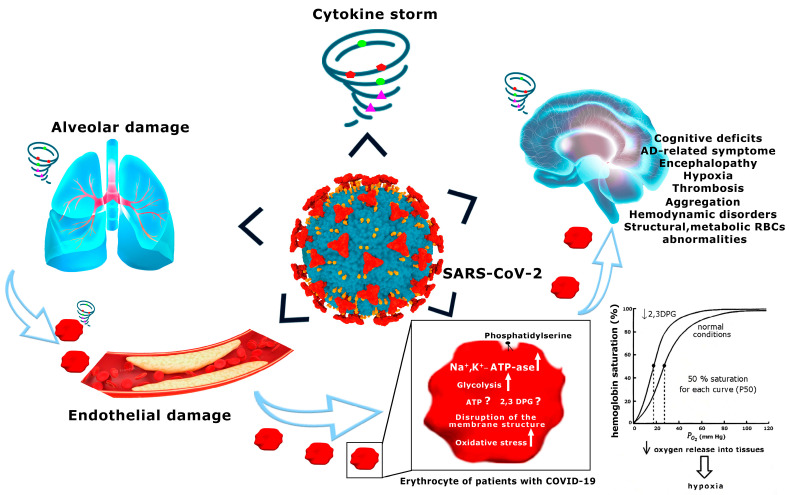
Coronavirus disease 2019 (COVID-19) is a rapidly spreading acute respiratory infection caused by SARS-CoV-2. The pathogenesis of the disease remains unclear. Recently, several hypotheses have emerged to explain the mechanism of interaction between SARS-CoV-2 and erythrocytes, and its negative effect on the oxygen-transport function that depends on erythrocyte metabolism, which is responsible for hemoglobin-oxygen affinity (Hb-O affinity). In clinical settings, the modulators of the Hb-O affinity are not currently measured to assess tissue oxygenation, thereby providing inadequate evaluation of erythrocyte dysfunction in the integrated oxygen-transport system. To discover more about hypoxemia/hypoxia in COVID-19 patients, this review highlights the need for further investigation of the relationship between biochemical aberrations in erythrocytes and oxygen-transport efficiency. Furthermore, patients with severe COVID-19 experience symptoms similar to Alzheimer's, suggesting that their brains have been altered in ways that increase the likelihood of Alzheimer's. Mindful of the partly assessed role of structural, metabolic abnormalities that underlie erythrocyte dysfunction in the pathophysiology of Alzheimer's disease (AD), we further summarize the available data showing that COVID-19 neurocognitive impairments most probably share similar patterns with known mechanisms of brain dysfunctions in AD. Identification of parameters responsible for erythrocyte function that vary under SARS-CoV-2 may contribute to the search for additional components of progressive and irreversible failure in the integrated oxygen-transport system leading to tissue hypoperfusion. This is particularly relevant for the older generation who experience age-related disorders of erythrocyte metabolism and are prone to AD, and provide an opportunity for new personalized therapies to control this deadly infection.
新型冠状病毒肺炎(COVID-19)是一种由严重急性呼吸综合征冠状病毒 2(SARS-CoV-2)引起的快速传播的急性呼吸道传染病。该疾病的发病机制尚不清楚。最近,有几种假说解释了 SARS-CoV-2 与红细胞相互作用的机制及其对依赖红细胞代谢的氧输送功能的负面影响,而氧输送功能又决定了血红蛋白-氧亲和力(Hb-O 亲和力)。在临床环境中,目前没有测量调节 Hb-O 亲和力的物质来评估组织氧合,从而对红细胞在综合氧输送系统中的功能障碍评估不足。为了更深入地了解 COVID-19 患者的低氧血症/缺氧,本综述强调需要进一步研究红细胞生化异常与氧输送效率之间的关系。此外,严重 COVID-19 患者出现类似于阿尔茨海默病(AD)的症状,这表明他们的大脑已经发生了改变,增加了患 AD 的可能性。鉴于红细胞功能障碍在 AD 病理生理学中所起的作用尚未完全评估,红细胞结构和代谢异常,我们进一步总结了现有数据,表明 COVID-19 神经认知障碍很可能与 AD 中已知的大脑功能障碍机制具有相似的模式。鉴定出 SARS-CoV-2 作用下红细胞功能变化的参数,可能有助于寻找导致组织灌注不足的综合氧输送系统进行性和不可逆衰竭的其他因素。这对于经历与年龄相关的红细胞代谢紊乱且易患 AD 的老年人群尤为重要,并为控制这种致命感染的新的个性化治疗方法提供了机会。