de Souza Fonseca Ricardo Roberto, Silva Camila Pantoja, de Senna Sastre Beatriz Leal, Tanaka Erich Brito, Carvalho Tábata Resque Beckmann, de Oliveira Paula Gabriela Faciola Pessôa, de Menezes Silvio Augusto Fernandes, Laurentino Rogério Valois, de Oliveira Renata Pimentel, de Oliveira Roberta Pimentel, Lago Andréa Dias Neves, Almeida Machado Luiz Fernando
Biology of Infectious and Parasitic Agents Post-Graduate Program, Federal University of Pará, Belém 66075-110, PA, Brazil.
Virology Laboratory, Institute of Biological Sciences, Federal University of Pará, Belém 66075-110, PA, Brazil.
J Clin Med. 2023 Mar 17;12(6):2349. doi: 10.3390/jcm12062349.
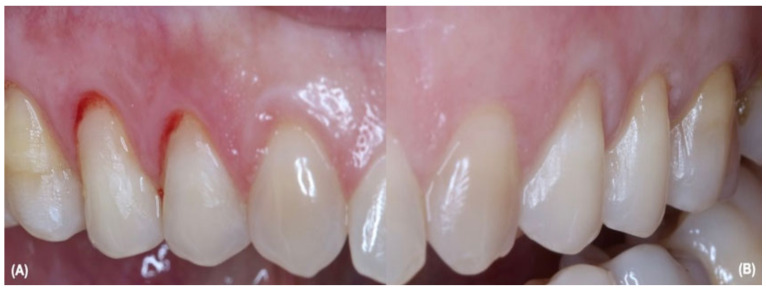
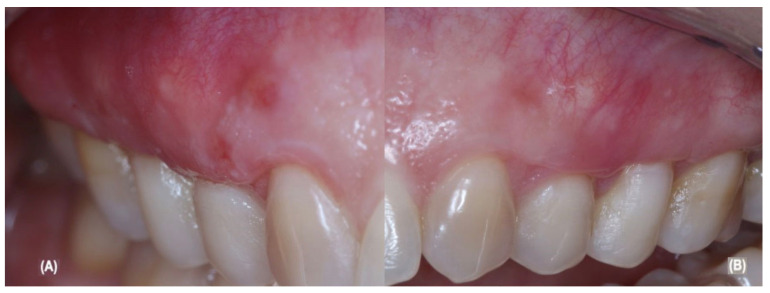
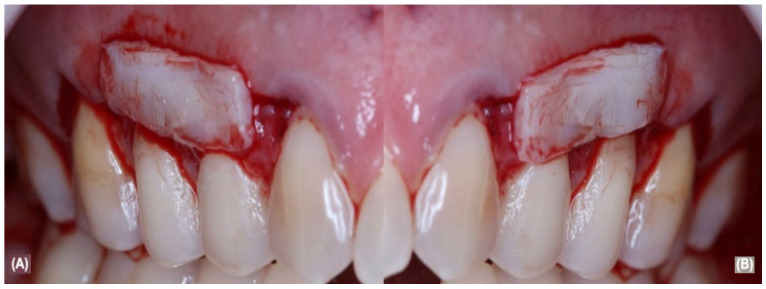
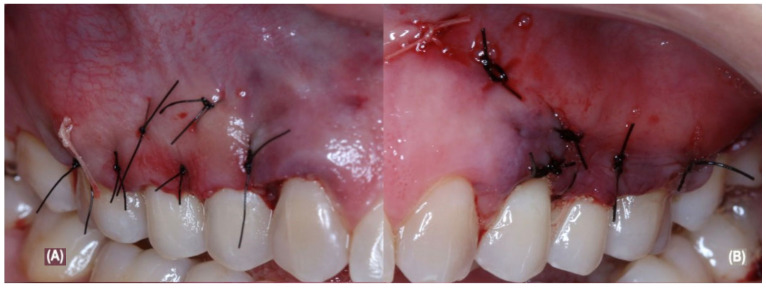
Gingival recession (GR) is described as an apical displacement of the gingival margin in relation to the cementoenamel junction, exposing the root surface to the oral cavity environment. This study aimed to evaluate the clinical results of a bilateral root coverage (RC) of GR associated with an autogenous connective tissue graft (aCTG) alone or combined with low-level laser therapy (aCTG + LLLT).
This cross-sectional, split-mouth, double-blind, clinical pilot study featured three individuals who attended a periodontics post-graduate program with the main complaint of GR and dental hypersensitivity (DHS). Of these, only one patient met the inclusion criteria and the parameters evaluated were: DHS, the keratinized tissue's thickness and width clinical attachment level (CAL), probing on depth (PD), and bilateral GR based on Cairo RT I. The patient was evaluated by a first clinical evaluator and the treatment was randomly divided into two groups, G1: aCTG only (control group, = 3 teeth per side) and G2: aCTG + LLLT (test group, = 3 teeth per side). LLLT used a diode laser (660 nm) with a dose of 3 J/cm per point and 4 s per point was applied in four different periods, preoperatively; transoperatively and immediately postoperatively, the application was performed in three points (eight applications) on alternate days for 7 days and a 90-day follow-up was performed for clinical evaluations of the periodontal parameters and the collected data were analyzed by Kruskal-Wallis and Dunn tests.
the RC mean percentage was <95% in both groups after 90 days. Comparing treatment sides, G1 ( = 3/3, 100%) had a higher prevalence of RC than G2 had ( = 3/3, 95%). DHS significantly decreased after 90 days in both groups. Both groups showed an improvement in the other periodontal parameters evaluated during the short-term follow-up; mainly, PD had a statistically significant ( ˂ 0.05) increase after 90 days and a CAL decrease during this period; KTW and KTT also had a significant increase in both groups ( ˂ 0.05).
the results indicated that aCTG + LLLT might have an additional benefit to GR root coverage within the evaluated time and this section also includes the within-study limitations.
牙龈退缩(GR)被描述为牙龈边缘相对于牙骨质釉质界的根尖向移位,使牙根表面暴露于口腔环境中。本研究旨在评估单独使用自体结缔组织移植(aCTG)或联合低水平激光治疗(aCTG + LLLT)对GR进行双侧牙根覆盖(RC)的临床效果。
这项横断面、分口、双盲的临床试点研究纳入了三名参加牙周病研究生课程的个体,他们的主要诉求是GR和牙齿过敏症(DHS)。其中,只有一名患者符合纳入标准,评估的参数包括:DHS、角化组织的厚度和宽度、临床附着水平(CAL)、探诊深度(PD)以及基于开罗RT I的双侧GR。由第一位临床评估者对患者进行评估,并将治疗随机分为两组,G1:仅aCTG(对照组,每侧 = 3颗牙)和G2:aCTG + LLLT(试验组,每侧 = 3颗牙)。LLLT使用二极管激光(660 nm),每点剂量为3 J/cm,每点照射4 s,在四个不同时期应用,术前;手术中及术后立即进行,在三个点(共八次照射)隔日进行,持续7天,并进行90天的随访以评估牙周参数,收集的数据通过Kruskal-Wallis和Dunn检验进行分析。
90天后两组的RC平均百分比均<95%。比较治疗侧,G1( = 3/3,100%)的RC患病率高于G2( = 3/3,95%)。两组在90天后DHS均显著降低。两组在短期随访期间评估的其他牙周参数均有改善;主要是,90天后PD有统计学意义的增加( ˂ 0.05),而在此期间CAL降低;两组的KTW和KTT也有显著增加( ˂ 0.05)。
结果表明,在评估的时间内,aCTG + LLLT可能对GR牙根覆盖有额外益处,本节还包括研究中的局限性。